Monthly Archives: September 2012

Should the Government Track Your Political Activity?

Former FEC Commissioner Brad Smith asks an important question in this short video. Click here if the embed doesn’t work.

Quantifying Regulation

The Daily Caller‘s Michael Bastasch with a nice writeup of some of the research Wayne Crews and I have been working on.

CEI’s Battered Business Bureau: The Week in Regulation


Just another week in the world of regulation:

  •  51 new final rules were published during the Labor Day-shortened week, down from 74 the previous week.
  • That’s the equivalent of a new regulation every 3 hours and 17 minutes — 24 hours a day, 7 days a week.
  • All in all, 2,632 final rules have been published in the Federal Register this year.
  • If this keeps up, the total tally for 2012 will be 3,839 new rules.
  • 1,641 new pages were added to the 2012 Federal Register last week, for a total of 55,324 pages.
  • At its current pace, the 2012 Federal Register will run 79,489 pages.
  • Rules are called “economically significant” if they have costs of $100 million or more in a given year. The 35 such rules published so far in 2012 have compliance costs of at least $17.3 billion. Two of the rules do not have cost estimates, and a third cost estimate does not give a total annual cost. We assume that rules lacking this basic transparency measure cost the bare minimum of $100 million per year. The true cost is almost certainly higher.
  • 4 economically significant rules were published last week.
  • So far, 266 final rules that meet the broader definition of “significant” have been published in 2012.
  • So far this year, 964 final rules affect small business. 71 of them are significant rules.

Highlights from final rules published last week:

For more data, go to TenThousandCommandments.com.

Regulation of the Day 228: Peyton Manning’s Jersey

Suspected gang member Konnor Vanatta.

When the Indianapolis Colts released star quarterback Peyton Manning this spring after 14 years of faithful service (and a Super Bowl victory), the Denver Broncos eagerly picked him up. Coloradoans rejoiced, and have made Manning’s number 18 jersey the best-selling in the NFL since April.

Konnor Vanatta, 8, of Greeley, Colorado, owns one of the new jerseys. He can’t wait for Manning to make his Denver debut this Sunday against the Pittsburgh Steelers. Like many football fans his age, Konnor was eager to show his allegiance by wearing his Manning jersey to school. The trouble is that he is not allowed to. His jersey has what local school officials call a “gang number” on it, with possible ties to a gang in Los Angeles.

Greeley and Los Angeles are 1,069 miles apart.

I’d never heard of gang numbers before, so I went to the FBI’s website at fbi.gov and ran a few searches for terms like “Peyton Manning gang affiliation,” “Denver Broncos,” “gang numbers,” and the like. About all I found out was that the FBI does not consider the Broncos a gang, nor is Peyton a suspected gang member. Neither is Konnor, who is a third grader.

Still, zero tolerance means zero tolerance. Any clothing with the number 18 on it is verboten in Weld County’s public school system. Other suspected gang numbers are 13 and 14, along with all three numbers in reverse – 31, 41, and 81.

Which means Peyton isn’t the only Bronco who isn’t welcome in Greeley, Colorado schools. Young fans of wide receivers Tyler Grisham (13) and Brandon Stokley (14), cornerback Omar Bolden (31), and tight end Joel Dreessen (81) will also have to leave their jerseys at home. And baseball fans shouldn’t even think about wearing their Drew Pomeranz (13) Rockies jerseys come springtime.

Unlike school officials, Konnor’s mother appears to have common sense. She told a local CBS affiliate:

“I knew that Greeley had a gang problem but I didn’t think in any event it should affect someone that’s in third grade,” Vanatta said.

Vanatta said she appreciates that school leaders want to be cautious, but she worries maybe they are just “giving the gangs what they want.”

“When they are counting and when they’re learning their numbers, are they going to make them skip 14, 13, 41, 81, 18 when they are counting? It’s getting ridiculous,” she said.

Good points all. Even the NFL weighed in, with NFL.com editor Gregg Rosenthal correctly describing the policy as “idiocy.”

CEI Podcast for September 6, 2012: Modernizing Air Traffic Control


Have a listen here.

America’s air traffic control system can be charitably described as an antique. Land-use and Transportation Policy Analyst Marc Scribner describes some of the problems the FAA has encountered in its attempt to move from the vacuum tube to GPS, and suggests a better path to modernization.

The Conventions Continue


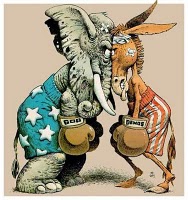
Last week I pointed out that the GOP and Democratic nominating conventions will cost taxpayers as much as $136 million, and to little effect. This week the political duopoly begins the second half of its festivities. With both sides still bleating their talking points past each other, I was reminded of a startlingly relevant quotation all the way back from 1815. It appears on page 411 of Benjamin Constant’s Principles of Politics Applicable to All Governments:

When a nation is shallow and imitative, it finds nothing more powerful than editorial slogans. They are short, they seem clear, they are inscribed easily in the memory. Cunning men throw them to fools who seize them, because they are thus spared the trouble of thinking. They repeat them, because this gives them the appearance of understanding. Hence it arises that propositions whose absurdity astonishes us when they are analyzed, slip into a thousand heads and are repeated by a thousand tongues, such that one is endlessly reduced to proving what is obvious.

I’m not just picking on Democrats here. The GOP has the same problem, and to the same degree. There are a lot of reasons why such a base strategy is politically successful. One is rational ignorance; people have better things to do than dissect the fineries of policy.

Another is tribalism. If Homo sapiens has been a species for one million years, then we have lived in small tribes of 150 people or so for nearly 99.9 percent of our history, up until the agricultural revolution a little more than 10,000 years ago. After all, for most of our species’ history, other tribes were just as likely to steal from or kill members of your tribe as they were to share a meal or become friends. That’s why a wary, us-versus-them mindset is in our blood. People have a natural tendency to identify with one political tribe and vilify the other one.

Substance gets lost in the resulting vitriol. Any rock, down to the tiniest pebble, must be hurled at the hated Other. Even if you miss, you feel better about yourself simply for having thrown it.

It may be only two months until the election, but it feels like so much longer than that. What to do, then? Leading up to the election and beyond, independent voices need to keep pointing out the parties’ fiscal and regulatory excesses, as well as ways to reform them. It takes some repetition, but if we keep at it someone will listen.

CEI’s Battered Business Bureau: The Week in Regulation


Just another week in the world of regulation:

  •  74 new final rules were published last week, down from 76 the previous week.
  • That’s the equivalent of a new regulation every 2 hours and 16 minutes — 24 hours a day, 7 days a week.
  • All in all, 2,581 final rules have been published in the Federal Register this year.
  • If this keeps up, the total tally for 2012 will be 3,872 new rules.
  • 2,086 new pages were added to the 2012 Federal Register last week, for a total of 53,683 pages.
  • At its current pace, the 2012 Federal Register will run 78,946 pages.
  • Rules are called “economically significant” if they have costs of $100 million or more in a given year. The 31 such rules published so far in 2012 have compliance costs of at least $16.5 billion. Two of the rules do not have cost estimates, and a third cost estimate does not give a total annual cost. We assume that rules lacking this basic transparency measure cost the bare minimum of $100 million per year. The true cost is almost certainly higher.
  • Two economically significant rules were published last week.
  • So far, 258 final rules that meet the broader definition of “significant” have been published in 2012.
  • So far this year, 484 final rules affect small business. 68 of them are significant rules.

Highlights from final rules published last week:

  • Both of last week’s economically significant rules come from the Fish and Wildlife Service, which sets the rules for hunting migratory birds. The cost analysis in both cases is lacking; they claim that hunters will spend $1.2 billion at businesses in hunting areas, which is well and good. Of course, they would have spent the money elsewhere if they didn’t go hunting, meaning the net effect on GDP is near-zero. And there is nary a word about compliance costs or paperwork hours. As such, I have no choice but to score these rules as zero-cost on the running tally of this year’s economically significant rule compliance costs.
  • New federal reporting requirements for cranberry growers in Massachusetts, Rhode Island, Connecticut, New Jersey, Wisconsin, Michigan, Minnesota, Oregon, Washington, and Long Island.
  • The Consumer Safety Product Safety Commission, in accordance with the Danny Keysar Child Product Safety Notification Act, passed a new regulation for children’s play yards.
  • The Agricultural Marketing Service is raising its assessment on imported cotton to the same level charged for domestic cotton. The federal government shouldn’t be marketing farm products. That’s what trade associations are for. But if they’re going to do it, at least they’re trying not to give preferential treatment to some producers over others.

For more data, go to TenThousandCommandments.com.