
I’ll be live-blogging tonight’s State of the Union address for OpenMarket.org, CEI’s blog. Coverage will start around 8:30 PM EST. Click here to follow along.
I’ll paste the post over to this blog sometime after the event.

I’ll be live-blogging tonight’s State of the Union address for OpenMarket.org, CEI’s blog. Coverage will start around 8:30 PM EST. Click here to follow along.
I’ll paste the post over to this blog sometime after the event.
Comments Off on Live-Blogging the State of the Union Address
Posted in Housekeeping
Bryan Caplan argues that antitrust enforcement literally kills people. It’s a startling claim to make, but hear him out. One thing that people do when they have a lot of money is give to charity. Bill Gates, one of the richest men in the world, has given away billions of dollars and saved countless lives. If not for the Microsoft antitrust case back in the 1990s, he would be able to save even more people:
If Gates’ philanthropy is as efficacious as most people think, there’s a shocking implication: The antitrust case against Microsoft had a massive body count. Gates saves about one life for every $5000 he spends. If the case cost him $5B, and he would have given away 48%, antitrust killed 480,000 people. If the case cost him $5B, and he would have given away every penny, antitrust killed a million people. Imagine how many people would be dead today if the government managed to bring Microsoft to its knees, and Gates to bankrutpcy. It staggers the imagination.
Comments Off on A Hidden Cost of Antitrust
Posted in Uncategorized
Tagged Antitrust, antitrust enforcement, bryan caplan, microsoft
The two political parties have only so much money to spend on campaigns. Dollars spent on one race cannot be spent on another. They have to prioritize important campaigns, even if that means conceding others.
That’s why, if I were a partisan Democrat, I would be upset with my party over the recall elections in Wisconsin. Millions of dollars are being taken away from close races around the country to go towards unseating a governor who will be up for re-election in two years anyway.
The recall may well succeed; one measure of enthusiasm is the roughly one million signatures on the recall petition, twice what was needed. But the most this expensive campaign would buy is two years in the governor’s mansion.
And this campaign will be spectacularly expensive. Labor interests view their livelihood as being at stake. That’s hyperbole in my opinion, but people do feel that way. And they will be pouring millions into the race. Tempers are running high, and strategists for the blue team have to be disappointed that so many on their side have lost theirs.
Activists are so passionate about unseating Walker that they fired before they aimed. There is no Democratic candidate to unify behind, giving Republicans a built-in advantage. Not only will there be a bruising (and expensive) primary, but many Democratic voters will be on the wrong side of the enthusiasm gap if their preferred candidate loses the primary or the nominee has low name recognition.
No one knows how it will play out yet. But even if it succeeds, this particular temper tantrum could well cost Democrats a few Congressional seats. Maybe even the White House, if it takes enough resources away from the ground game in swing states.
Posted in Elections, Political Animals
Tagged recall walker, scott walker, walker recall, wisconsin recall, wisconsin recall elections
 First drain cleaner, now cold medicine. These are lousy times for Illinoisians with sluggish drains and runny noses. Just as they are now required to present valid ID when buying drain cleaner, the people of Illinois have had to do the same thing since 2009 when buying cold medicine. But according to a new bill signed into law Friday, “Now stores will transmit those records electronically to state police. The information sent to authorities will include the customer’s name and address.”
No person may buy “more than 7.5 grams of pseudoephedrine in 30 days – or more than a month’s supply of 24-hour Claritin-D for a single person.” Stores must refuse such sales.
Everyone catches a cold now and then. Which means almost everyone buys cold medicine now and then. Which means this database will basically have Illinois’ entire 13-million strong population within a year or two. This is a rather wide net.
The goal is to put a damper on methamphetamine production. The regulation is easy to evade, though. Instead of one person buying large amounts of medicine, several people can buy smaller amounts. Or our drug-addled friends can take a short drive to Indiana, Wisconsin, or another border state. Or they could make meth from different ingredients. Or they could switch to a different drug entirely. The total net impact on drug production and consumption is likely to be almost precisely zero. The legislature clearly didn’t think this one through; prohibition doesn’t work.
This regulation is something else besides ineffective. It also reveals an ugly attitude that no state should have towards its people, that everyone is a suspect. Talk about adding insult to illness.
Comments Off on Regulation of the Day 207: Cold Medicine
Posted in prohibition, Regulation of the Day
Tagged drug prohibtion, ephedrine, illinois, illinois cold medicine database, illinois cold medicine law, meth, methamphetamines, pseudoephedrine
 How far removed are we from our proto-human ancestors? Not as much as one would think. Richard Wrangham has a creative way to illustrate that in the beginning of his book Catching Fire: How Cooking Made Us Human:
Although the australopithecines were far different from us, in the big scheme of things they lived not so long ago. Imagine going to a sporting event with sixty thousand seats around the stadium. You arrive early with your grandmother, and the two of you take the first seats. Next to your grandmother sits her grandmother, your great-great-grandmother. Next to her is your great-great-great-great-grandmother. The stadium fills with the ghosts of preceding grandmothers. An hour later the seat next to you is occupied by the last to sit down, the ancestor of you all. She nudges your elbow, and you turn to find a strange nonhuman face. Beneath a low forehead and big brow-ridge, bright dark eyes surmount a massive jaw. Her long, muscular arms and short legs intimate her gymnastic climbing ability. She is your ancestor and an australopithecine, hardly a companion your grandmother can be expected to enjoy. She grabs an overhead beam and swings away over the crowd to steal some peanuts from a vendor.
Evolution may happen at glacial pace from our perspective. But if you zoom out a bit, it happens incredibly fast. Interesting stuff.
Human history is a complicated tale. There are many ways to tell it. One is as a story of progress — from caves to huts to highrises. Another is regress — from harmony with nature to clanging, polluting machinery that destroys it.
Conflict is another common theme. Illiberals have spent the better part of the industrial era spinning tales of class struggle and racial or national conflict.
Competition is a less severe theme that many liberals like to stress. When church and state compete for power, the people are either left alone, or they can flee whichever is more oppressive. States that are numerous, small, and close have to have friendly, liberal policies, or else risk becoming little more than empty spaces.
Equality is still another. Many people think that rich and poor are less equal than before; look at income data. Others think that people are more equal than before. Slavery, monarchy, and titled nobility are largely things of the past. Status has (mostly) been replaced by contract.
History is much too complex for such simple conceits to explain everything. But all of them have at least some value for understanding where we came from, where we are now, and where we might be headed in the future.
There is one more aspect of history that has fascinated scholars from Thucydides to Lord Acton. That aspect is freedom. Like the others, it neither pretends to nor does explain everything.
But it does have one advantage. It ties together all the above narrative possibilities and more. Progress, regress, collective, individual, conflict, cooperation, more equality, less equality — they’re all there. And they all matter.
In my opinion, no living scholar synthesizes those disparate parts into a coherent whole better than Tom Palmer. The video below is a shortened version of a lecture that I have had the privilege of seeing a number of times over the years, with the added bonus of top-notch production values. This amateur history buff continues to learn from it to this day.
It’s 26 minutes long, which is about as long as an average sitcom. It is also far more rewarding, and at least as entertaining. If you have some spare time, it is well worth foregoing an episode of I Love Lucy to watch it. Click here if the embedded video doesn’t work. And do keep an eye out for part two.
Comments Off on The History of Liberty
Posted in History
Tagged harmony with nature, history buff, lord acton, narrative possibilities
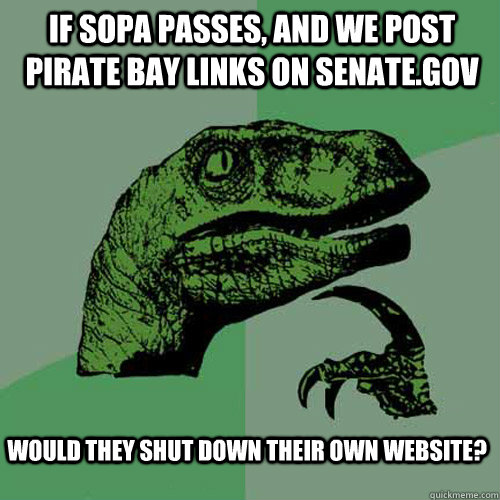
Wikipedia, Reddit, and other popular websites all went black today to protest SOPA and PIPA, two bills currently before Congress. Critics charge that the bills could potentially shut down the Internet as we know it. Associate Director of Technology Studies Ryan Radia explains how the bills would work, and how they would indeed stifle free speech.
Comments Off on CEI Podcast for January 18, 2012: Dropping the SOPA
Posted in CEI Podcast, Free Speech
Tagged free expression, Free Speech, internet freedom, pipa, ryan radia, sopa, stop sopa, wikipedia, wikipedia blackout
 Rick Moranis is an actor, comedian, and writer. Among other roles, he played Dark Helmet in Spaceballs, one of my favorite movies. Turns out he also knows a bit about the economic way of thinking. Here he is in today’s Wall Street Journal:
This morning, while I was grinding my blend of French, Colombian and Italian coffee beans, it occurred to me that I could be doing harm to the coffee shop and diner businesses in my neighborhood by making my own coffee at home. Might I have a responsibility and obligation to consume their product, either within their premises or brought right to my door by one of their speedy, undocumented-alien delivery men?
…
How much of this country’s economy am I personally destroying by my consumption preferences? I honestly never intended to do so much harm.

This picture is not a joke. The regulation is genuine. But it isn’t unique; I once wrote a Regulation of the Day about a similar federal rule.
(via Radley Balko and John Stossel)
Comments Off on Why? Just Because.
Posted in regulation
Tagged florida, florida vending machine regulation, vending machines


 Inertia Wins!