

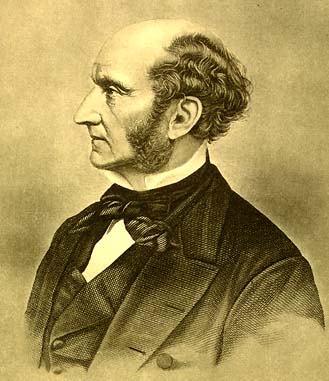
John Stuart Mill was born on this day in 1806. I wrote an appreciation of him last year, and told a bit of his unusual life story. This year, I’ll write a little bit on his philosophy of utilitarianism.
There are two kinds of utilitarianism: act utilitarianism, and rule utilitarianism. Act utilitarianism leads to absurd conclusions; rule utilitarianism, while more lenient, is one of the strongest philosophical underpinnings of liberalism (in the traditional European sense of the word). Many later liberals, including F.A. Hayek, were rule utilitarians.
Act utilitarians think that each individual act should be judged according to how much good it does. This leads to some problems, since most actions involve at least some small harm to others.
If I drive to work, I can save myself a lot of time. But by contributing to traffic congestion, I hurt each of my thousands of fellow drivers just a little bit. Maybe I cost them more total time than I save, so my driving causes a net loss in utility. So that’s not a good option. The subway, then? Same thing. Not only do I lose some time compared to driving, but I make the train more crowded, which causes disutility to every passenger on the train.
Better to just sit at home, then. But then I don’t get anything done. That’s bad for my career, not to mention my bank account. Act utilitarianism is a bit like Pareto optimality in economics: it leads to paralysis. It is an impossible standard.
That’s why I prefer rule utilitarianism. Instead of judging each act by its utility, put rules in place that give people incentives to act well. No law or institution is perfect. Even the best ones hurt somebody; a law against theft is bad for thieves. But good institutions beget good results, especially in the long run.
A property-rights-based system of government is an excellent example of rule utilitarianism. It will not be perfect. Laws against stealing obviously have not put end to stealing. Even within the law, people inevitably have honest disagreements about what belongs to who. Externalities such as pollution will hurt some peoples’ property. But the results are certainly better than a system without property rights. The whole of world history is proof. It’s also better than act utilitarianism, which lacks that overarching institutional-level standard.
Rule utilitarianism is one of the greatest gifts ever given to liberalism’s intellectual toolkit, and we have Mill to thank for it. Happy birthday to you, John Stuart Mill.

 Inertia Wins!