Retro Review: Vlad Tarko on Elinor Ostrom

My review of Vlad Tarko’s excellent intellectual biography of Elinor Ostrom is up at cei.org. Ostrom was the first woman to win the economics Nobel. In addition to popularizing the concept of polycentric governance, she, along with her husband Vincent Ostrom, co-founded the Workshop at Indiana University, which continues to produce high-quality multidisciplinary scholarship.

Trump Defers Tariff Payments for Struggling Businesses: A Good Start, More Needed

President Trump has deferred selected tariff payments for companies experiencing coronavirus-related hardship. U.S. Customs issued a press release here and the temporary final rule appeared in the April 22 Federal Register. It came after more than two weeks of starts, stops, denials, reversals, and at least one accusation of “fake news” from the president. This indicates that trade policy is still an area of uncertainty and not something rebuilding businesses can plan around—potentially endangering post-virus economic recovery.

The deferrals are better than nothing. But it is important not to oversell them. Here is a bit of context on the impact they are likely to have:

  • They are deferrals, not exemptions. U.S. producers will still pay all affected tariff duties, just 90 days later. Because of this, companies have no reason to reduce prices for consumers.
  • The deferrals are only for imports made in March and April—precisely when imports significantly slowed. That limits their usefulness in buying time for cash-strapped businesses.
  • None of the Trump tariffs from 2017 onwards are eligible for deferrals. Since Trump has roughly doubled tariffs, this means about half of all tariffs are not eligible for deferred payment. That includes the steel and aluminum tariffs, the China tariffs, and other recent measures against the European Union, Turkey, and India.
  • Antidumping and countervailing duties are also ineligible for deferred payments. These are the most common type of trade barrier, further limiting the deferrals’ impact.
  • Companies must be experiencing “significant financial hardship” to be eligible This means a company must have lost at least 60 percent of its sales since this time in 2019.

The Cato Institute’s Dan Ikenson estimates the deferrals will total about $6 billion. That is certainly enough to buy some time for some struggling businesses. For context, total customs duties in 2019 were $85 billion. Total U.S. imports were $3.43 trillion (in chained 2012 dollars; $3.77 trillion in 2019 dollars). The most newsworthy part of these deferrals might be how newsworthy they aren’t.

The administration and Congress could do much better. A more wide-ranging trade relief measure ewould include Trump’s newly enacted tariffs. It could even do away with them entirely.

Considering the hemming, hawing, and uncertainty that surrounded even this small deferral, Congress should give businesses some stability to plan around by taking back the tariff-making authority it delegated away to the president in the 1960s and 1970s. This would prevent further increases while insuring against ad hoc multibillion-dollar policy changes with little or no notice.

While better than nothing, this deferral is far less than what needs to be done to allow businesses to rebuild, save consumers money, and for supply networks to get medical equipment where it is most needed.

That said, the deferral has a subtle hidden benefit. It marks at least the second time the Trump administration has tacitly admitted that Americans, not foreign exporters, pay tariffs. The first admission happened last August when adviser Peter Navarro called a delay in upcoming new China tariffs “President Trump’s Christmas present to the nation.” More such presents would help protect public health right now while helping with economic rebuilding when the pandemic passes.

On the Radio: #NeverNeeded Regulations

At 7:15 ET today, I’ll appear on the Lars Larson Show to talk about #NeverNeeded regulations.

Congress Has Already Introduced Bills to Reform #NeverNeeded Regulations

Policy makers have already waived more than 350 regulations and counting that were slowing the pandemic response and harming economic recovery. But with a 185,000-page Code of Federal Regulations and plenty more rules at the state and local levels, there is more to do. Fortunately, a number of bills have already been introduced in Congress that could help get rid of more #NeverNeeded regulations.

CEI’s Agenda for Congress has more reform ideas, though not all of them are applicable to the #NeverNeeded effort. For a guide on identifying #NeverNeeded regulations, see our handy infographic. We also a have a short paper full of reform ideas and the neverneeded.cei.org website. And of course, the #NeverNeeded social media hashtag is a continuing source of new ideas.

Fixing the Regulatory Process

Regulations from the Executive in Need of Scrutiny (REINS) Act (S. 92) 

This bill would require Congress to vote on new regulations costing more than $100 million per year. The Senate version is sponsored by Rand Paul (R-KY), Chuck Grassley (R-IA), Joni Ernst (R-IA), Todd Young (R-IN), and Ted Cruz (R-TX). Rep. Jim Sensenbrenner (R-WI) sponsors the House version. The REINS Act is a separation of powers bill intended to make sure agencies don’t go rogue and pass major rules Congress never authorized through legislation.

While the REINS Act would affect fewer than 50 rules in an average year out of more than 3,000, it would add stability to an uncertain regulatory climate. Agencies would have to stay within the bounds Congress has legislated for them, and would not be able to pass hasty “flash policy” that could hurt the virus response and economic recovery. For more, see my paper on the REINS Act.

Guidance Out Of Darkness (GOOD) Act (S.380)

Agencies are required to put new regulations through a notice-and-comment rulemaking process. This allows the public to see and contribute to draft versions of regulations before they become final. But agencies routinely avoid this transparency and accountability by enacting regulation through other means such as guidance documents, memoranda, or even press releases and blog posts. CEI’s Wayne Crews calls these extralegal rules “regulatory dark matter.” Courts routinely defer to dark matter in cases, meaning it has de facto force of law.

President Trump issued an Executive Order last year requiring agencies to make all of their guidance documents public. This is an excellent start, but the problem with Executive Orders is that the next president can undo them on a whim. Dark matter reform needs the permanence that comes with congressional legislation. The GOOD Act, sponsored by Sen. Ron Johnson (R-WI) and Rep. Mark Walker (R-NC), would increase agency transparency and accountability. It would also add stability to the regulatory environment that recovering businesses can plan around during a chaotic time. Wayne Crews has more on regulatory dark matter here.

Jones Act Repeal

Open America’s Waters Act of 2019 (S. 694) 

The Jones Act costs the economy somewhere between $656 million to $9.8 billion per year. The Open America’s Waters Act, sponsored by Sen. Mike Lee (R-UT), would repeal it entirely. The Jones Act is a shipping law from 1920 that is essentially a Buy American law for moving goods between U.S. ports. Incumbent shipping companies love the Jones Act for obvious reasons—it keeps competition out. But because of the Jones Act, shipping between U.S. ports is slow and expensive.

There is little incentive to innovate or save costs, and the ships are aged and small, since there is little need to invest in fleet improvements in a government-protected cartel. This contrasts sharply with international shipping, where the Jones Act does not apply. When competition is allowed, shipping is cheaper, faster, more reliable, and more competitive.

An effective coronavirus response needs medical supply networks to be fast, flexible, and affordable. Improved shipping will also aid in the coming economic recovery. The Jones Act has long been obsolete. Now is the ideal time to finally get rid of it, and the Open America’s Waters Act would do just that. CEI’s Mario Loyola’s forthcoming Jones Act paper has more.

Protecting Access to American Products Act (S. `1873)

If outright repeal of the Jones Act proves not possible politically, then this bill, also sponsored by Sen. Lee, is a second-best backup plan. It would streamline the Jones Act waiver process

National Environmental Policy Aact Reform

Federal Permitting Reform and Jobs Act (S. 1976)

This bill would ease environmental permitting and other obstructions that delay infrastructure projects. It builds on previous reforms in the Fix America’s Surface Transportation Act of 2015. The Senate version is sponsored by Sen. Rob Portman (R-OH) and the House version’s bipartisan sponsors include Reps. Kelly Armstrong (R-ND), Rob Bishop (R-UT), and Collin Peterson (D-MN). Congress is clearly committed to trillions of dollars of “flash policy” such as stimulus and bailouts. Much of it will be wasteful, but reforms such as this bill will help at least a little more of that money spent on projects instead of on red tape.

This list is only a beginning. Adding to it would help public health during the COVID-19 response and with economic recovery when it is safe again. Policy makers can find plenty of ideas in CEI’s new #NeverNeeded paper, as well as our Agenda for Congress.

CEI #NeverNeeded Panel Event Now on YouTube

The link is here. The speakers include my colleagues Kent Lassman, Iain Murray, and me.

For the next several weeks, there will be new online events each Tuesday featuring CEI experts on a variety of reform areas. More information is at cei.org.

This Week in Ridiculous Regulations

Congress is back in session this week, but that’s almost certainly not the only bad news the coming days will bring. Please do all you can to keep yourself and your loved ones safe. Hopefully Congress will also act on some of the #NeverNeeded regulations that are hindering the pandemic response. Meanwhile, regulatory agencies issued new final regulations ranging from telehealth corrections to red crab specifications.

On to the data:

  • Last week, 49 new final regulations were published in the Federal Register, after 66 the previous week.
  • That’s the equivalent of a new regulation every three hours and 26 minutes.
  • Federal agencies have issued 933 final regulations in 2020. At that pace, there will be 3,110 new final regulations. Last year’s total was 3,150 regulations.
  • There were also 61 proposed regulations in the Federal Register last week, for a total of 645 on the year. At that pace, there will be 2,150 new proposed regulations in 2020. Last year’s total was 2,184 proposed regulations.
  • Last week, agencies published 419 notices, for a total of 6,527 in 2020. At that pace, there will be 21,757 new notices this year. Last year’s total was 21,804.
  • Last week, 1,352 new pages were added to the Federal Register, after 1,306 pages the previous week.
  • The 2020 Federal Register totals 21,738 pages. It is on pace for 72,460 pages. The 2019 total was 76,288 pages. The all-time record adjusted page count (which subtracts skips, jumps, and blank pages) is 96,994, set in 2016.
  • Rules are called “economically significant” if they have costs of $100 million or more in a given year. Two such rules have been published this year. Four such rules were published in 2019.
  • The running cost tally for 2020’s economically significant regulations ranges from net savings of between $180 million and $4.69 billion. 2019’s total ranges from net savings of $350 million to $650 million, mostly from estimated savings on federal spending. The exact number depends on discount rates and other assumptions.
  • Agencies have published 19 final rules meeting the broader definition of “significant” so far this year. 2019’s total was 66 significant final rules.
  • So far in 2020, 184 new rules affect small businesses; seven of them are classified as significant. 2019’s totals were 501 rules affecting small businesses, with 22 of them significant.

Highlights from last week’s new final regulations:

For more data, see Ten Thousand Commandments and follow @10KC and @RegoftheDay on Twitter.

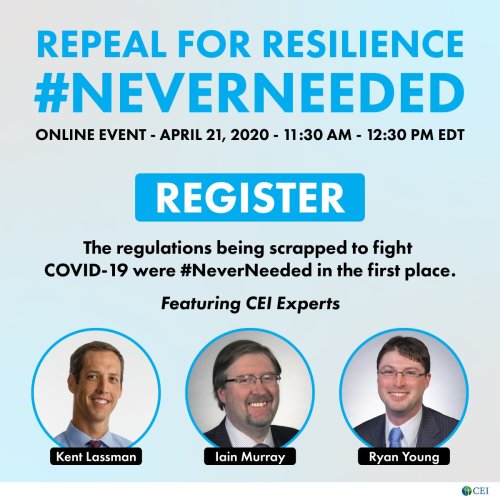
Repeal for Resilience: CEI #NeverNeeded Online Event on April 21

This coming Wednesday, April 21 at 11:30 ET, I’ll be speaking in an online event with my colleagues Iain Murray and Kent Lassman. We’ll be discussing how regulatory reform can help keep people safe during the pandemic while helping minimize the economic damage.

The event will be held using the Zoom video conferencing program. If you would like to attend, the link to signup is here.

CEI NeverNeeded Event 200421

California’s #NeverNeeded AB5 Is Harming the Coronavirus Response

California’s AB5 law was already backfiring before the COVID-19 pandemic hit. The legislation intends to reclassify many California-based independent contractors as formal employees in an attempt to raise their wages and benefits. It has instead cost thousands of jobs—many of which are home-based and quarantine-friendly.

California legislators have reportedly been mulling an “oops” bill that would offer exemptions from AB5 requirements. Over in the Orange County Register, I argue that exemptions are not enough. AB5 should be repealed outright:

While offering exemptions has the virtue of requiring politicians to admit their policies are hurting people, it has three significant problems.

One, exemptions take time to process. We don’t have that right now. …

Two, the officials who grant exemptions would gain great power. There is a risk some would use this power to enrich themselves. California legislators would also be tempted to bully companies for campaign contributions by dangling AB5 exemptions.

Three, exemptions would give favored businesses a government-granted advantage over competitors.

Read the whole piece here. I weighed in earlier on AB5 here. Ryan Radia’s CEI study on AB5 is here.

How to Spot a #NeverNeeded Regulation

Not every regulation on the books is directly harming the COVID-19 response. There are a lot of other regulations that need reform, but the #NeverNeeded set deserves urgent action. To help policy makers identify which regulations are the most pressing, the Competitive Enterprise Institute has prepared the following guide:

A regulation is #NeverNeeded if:

It slows distribution of proven medical diagnostic tests and devices. Regulations such as trade barriers and Buy American provisions raise prices at a time of distress and keep needed equipment out of the country. At the same time, lengthy permits and approvals for factories switching over to making medical equipment such as masks, ventilators, and tests mean that first responders sometimes have to make do without lifesaving equipment or personal protection.

It blocks patients’ remote access to medical providers. Telemedicine was highly restricted until regulators realized how serious the coronavirus pandemic would become. Medical professionals have also traditionally been banned from practicing across state borders—even though human anatomy does not vary from state to state. Such rules keep doctors out of virus hotspots where they are most needed. Many such regulations have already been eased. They must now be permanently repealed.

It increases the cost of energy at a time when Americans can least afford it. People have bills to pay, and with unemployment potentially reaching record levels, not everyone can afford green mandates and other regulations that raise people’s energy bills. A recent easing of fuel economy standards is a good start.

It makes it more difficult to hire employees. A new National Bureau of Economic Research study finds that the higher a minimum wage is, the more often people dodge it. Virginia Governor Ralph Northam is also seeking to delay a minimum wage increase in that state. California should repeal its AB5 bill that makes it harder for people to work as independent contractors. Not only are many such jobs readily available during a time of social distancing, but many contractors can work from home and away from contagion. Many occupational licenses at the state and local level keep willing workers out of work so incumbents can limit the number of their competitors.

It adds another layer of bureaucracy of complexity to legal compliance. A good rule of thumb for public policy is that simplicity is beautiful. If regulators are after a certain result, they should give people as much flexibility as they can in how they achieve that result. During the current crisis, complexity and bureaucracy also cost time. Time is a luxury we do not have. If someone has a way to help, they should be allowed to do so. Factories around the country are retooling as fast as possible to make emergency supplies. Distilleries are making sanitizer. Clothing companies are making masks. The Evans drumhead company is making face shields. The Gates Foundation is spending billions of dollars to speed up coronavirus vaccine development and mass distribution. In many cases, regulations are stopping these helpers from doing all that they could. These range from denaturing requirements for sanitizer alcohol to state and local permit regimes to the Food and Drug Administration’s lengthy approval process.

It blocks access to capital for consumers or businesses. Crowdfunding is a useful tool for keeping small businesses afloat. Due to regulations, many such campaigns have to be done informally, in person, or via a social media campaign. Crowdfunding through more formal channels, such as banks or financial institutions, could be cheaper in many cases for the business and less risky for the investors. Regulations should not prevent this. Other regulatory caps and conditions on loans are just as harmful, as are other regulations similar to the Obama-era Operation Chokepoint, which prevent many small businesses from even having bank accounts, let alone access to loans and other capital. John Berlau has more on this.

If a regulation fits any of these categories, it was probably #NeverNeeded in the first place. Quickly removing these rules would help keep people safe, and make virus-related economic distress less painful. Going forward, it is also important to reform the regulatory process itself. If that system remains in place, new #NeverNeeded rules will continue to be enacted indefinitely, harming future crisis responses. CEI has some ideas for that, too. For more, see neverneeded.cei.org, our recent #NeverNeeded paper, and the #NeverNeeded hashtag on Twitter.

This Week in Ridiculous Regulations

More than 7 million people in the U.S. are unemployed now due to the COVID-19 quarantine. When Congress convenes next week, it will likely begin work on a Phase 4 stimulus bill. CEI analysts have made the case that addressing #NeverNeeded regulations must be part of any such legislation. Meanwhile, the 2020 Federal Register surpassed 20,000 pages, and agencies issued new final regulations ranging from pecan reporting requirements to exempted bumpers.

On to the data:

  • Last week, 66 new final regulations were published in the Federal Register, after 58 the previous week.
  • That’s the equivalent of a new regulation every two hours and 33 minutes.
  • Federal agencies have issued 882 final regulations in 2020. At that pace, there will be 3,139 new final regulations. Last year’s total was 3,150 regulations.
  • There were also 41 proposed regulations in the Federal Register last week, for a total of 589 on the year. At that pace, there will be 2,104 new proposed regulations in 2020. Last year’s total was 2,184 proposed regulations.
  • Last week, agencies published 422 notices, for a total of 6,108 in 2020. At that pace, there will be 21,815 new notices this year. Last year’s total was 21,804.
  • Last week, 1,306 new pages were added to the Federal Register, after 1,602 pages the previous week.
  • The 2020 Federal Register totals 20,384 pages. It is on pace for 72,800 pages. The 2019 total was 76,288 pages. The all-time record adjusted page count (which subtracts skips, jumps, and blank pages) is 96,994, set in 2016.
  • Rules are called “economically significant” if they have costs of $100 million or more in a given year. Two such rules have been published this year. Four such rules were published in 2019.
  • The running cost tally for 2020’s economically significant regulations ranges from net savings of between $180 million and $4.69 billion. 2019’s total ranges from net savings of $350 million to $650 million, mostly from estimated savings on federal spending. The exact number depends on discount rates and other assumptions.
  • Agencies have published 19 final rules meeting the broader definition of “significant” so far this year. 2019’s total was 66 significant final rules.
  • So far in 2020, 170 new rules affect small businesses; seven of them are classified as significant. 2019’s totals were 501 rules affecting small businesses, with 22 of them significant.

Highlights from last week’s new final regulations:

For more data, see Ten Thousand Commandments and follow @10KC and @RegoftheDay on Twitter.