
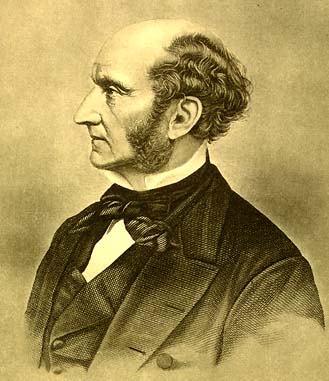
Happy 203rd Birthday, John Stuart Mill

John Stuart Mill was born on this day in 1806. He is best known for classical liberal writings like On Liberty and The Subjection of Women. College students today also learn about his philosophy of utilitarianism, inherited from father James Mill and family friend Jeremy Bentham.

Mill had an unusual life story, told in one of the most compelling autobiographies in literature. John’s father gave him an intensive education that, for example, had him reading ancient Greek at age three. John never had any formal schooling, and the only children with whom he was allowed contact were his siblings.

His father’s pedagogical experiment worked in that it gave John one of the most formidable intellects of his age. But it failed in other ways. His strict upbringing resulted in a nervous breakdown at age 20 that set him back years. He was always socially awkward, and didn’t marry until age 45 — itself an interesting story.

Mill made important contributions to economics, political science, and philosophy. A deep love of liberty runs through them all. I don’t personally agree with everything he wrote (utilitarianism leads to absurd conclusions when taken too far), but he remains one of brightest lights in the classical liberal pantheon. Happy birthday, John Stuart Mill.

(Cross-posted at Open Market)

Another Postage Hike on Monday

On Monday, postage rates will go up from 42 to 44 cents. Thanks to the forever stamp, most of us won’t have to bother with those infernal 2-cent stamps this time around.

As so often happens, this convenience has a trade-off. Lowering the transaction costs associated with rate increases means there will be more of them, at least in theory. Sure enough, for the first time in history, rates have gone up four years in a row.

Forever stamps make price hikes so painless that many people probably won’t even notice for months to come. Monday’s increase has barely made a dent in the news.

The forever stamp is a great idea. But frequent rate increases are a serious drawback. This is especially dangerous given the monopoly status USPS enjoys; competition is the only reliable form of price control. Unfortunately, an anti-trust investigation remains less than likely.

(Cross-posted at Open Market)

Hubris and Humility

I’m not proud of it, but I watched most of Independence Day on the tv tonight. Worse, I actually found one of the commercials intellectually stimulating. It — probably unintentionally — touched on a profound insight into human nature.

The 30-second spot promotes a show where paranormal investigators visit haunted houses looking for evidence of supernatural activity. Unexplained noises and happenings abound.

One of the hosts said something along the lines of, whether believer or skeptic, you have to admit that we don’t have answers for everything. This is true.

The unsaid, though unsubtly-hinted-at implication was that some creepy phenomena therefore have other-worldly causes.

That’s the insight. People hate to admit not knowing something; often they would rather just make up an answer.

It takes a big man (or woman) to say, “I don’t know,” mean it, and be ok with it. There is a certain hubris built into the human psyche.

On one hand, it gives us courage. We can go up against overwhelming odds, and our disproportionate self-regard tells us, “I can overcome.” And sometimes, we do. Overconfidence does have its uses.

On the other hand, it makes us say really weird things. If I can’t explain this weird noise coming out of my basement, well, I can’t admit that! I have to say something, anything, so I don’t feel dumb. Er, uh, it must be a ghost, then!

Of course, the logic does not follow from “I don’t know” to “therefore it is a ghost.” But it sure feels good to say, “I know the answer!” And just as important, I look and feel good because of it.

We humans are strange, wonderful, and arrogant creatures. One of these days I hope to find out what makes us tick. Until then, I will grudgingly admit that I do not know.

Congress to Tackle College Football

Having solved all of America’s other problems, Congress is turning its attention to how college football’s national championship is decided.

In a bit of unintentional comedy, Rep. Joe Barton literally compared the current system to communism.

I love it. Yes, Congress has no business here. But any time wasted on issues like this is time that Congress can’t spend further ruining the economy.

There are worse trade-offs than that.

(Cross-posted at Open Market.)

Advice for Conservatives

Cato Institute President Ed Crane says to conservatives, you’re doing it wrong. I couldn’t agree more.

Conservatives are supposed to be the opposition to progressives. Their problem is that opposing something requires philosophical disagreement. At heart, left and right are variations of the same theme.

There are three main currents of conservative thought. All three have their progressive analogues:

Supply-side conservatives have a laser-like focus on tax cuts and economic growth. Both are good things, true. But they forgot about spending, and about philosophy. Means became ends. Hence the Reagan deficits and the Bush spending explosion.

Look at the deficits, philosophical as well as fiscal, of the new administration’s First One Hundred Days. Congress and President Obama have quickly established serious supply-side credibility.

Then there are neo-conservatives. Crane says, “All they give us is a war against a country that never attacked us and schemes for ‘national greatness’ like going to Mars.”

Not too different from progressive clarion calls for our country to unite under a common purpose, however vaguely defined. Or the push for mandatory volunteering programs, formerly known as the draft.

Finally, there are social conservatives. Often deeply religious, they can sometimes be less than tolerant of other people. They are the right-wing equivalent of the green movement.

Environmentalism is really a conservative philosophy at heart, anyway. At a fundamental level, greens want to conserve, both in the Rousseauian sense and in the Burkean sense.

Conservatives are in no shape to be a viable opposition movement. They resemble their enemy too much.

Where else to turn, then? Crane sums up his own philosophy in two sentences. “Politics is about man’s relationship to the state. That relationship, to be healthy, should be minimal.”

I think we’ve found a winner.

That’s exactly why CEI, Cato, Reason, and other classical liberal groups are so important. We see through the left-right false dichotomy, and we get the word out. Nowhere does this matter more than in a democracy. In the long run, the people get what they want, good or bad.

The last several elections have proven that in some years, people want bad conservative policies. In other years, people want bad progressive policies.

We can do better. These groups exist to see that we do.

(Full disclosure: I work at CEI, and used to work at Cato.)

Fed’s Policies Contradict Each Other

My colleague Seth Bailey and I have this letter in today’s Financial Times:

Sir, Henry Kaufman frets that “libertarian dogma led the Fed astray” (April 28). Congress, not free-market ideology, is the real culprit.One reason is mission creep. The Fed’s original job was to keep inflation low by keeping the money supply in check. That’s it. The Humphrey-Hawkins Act of 1978 expanded that mission to include keeping unemployment low.

Low-inflation monetary policy and low-unemployment monetary policy contradict each other. If the Fed keeps inflation low, then it cannot lower unemployment rates through an artificial inflation-induced boom. If the Fed wants to lower unemployment, it must forgo low inflation. Worse, since a bust always follows an inflationary boom, business cycles become more volatile.

The results speak for themselves. The Fed can control inflation – if left free from political interference. But it cannot also accomplish its other missions, especially through the un-libertarian means of manipulating price levels. Where is the libertarianism?

Ryan Young and Seth Bailey,
Research Associates,
Competitive Enterprise Institute,
Washington, DC, US

The Economics of Pirate Deterrence

How can we stop pirate attacks? By applying the law of demand. If something becomes more costly, people consume less of it. In this case, making piracy more costly means fewer people will become pirates.

How do this? One cruise ship company has an answer: fire back. Making piracy a riskier, more dangerous proposition — i.e., more expensive — forces pirates to think twice before attacking.

How disheartening, then, that both of the experts quoted in this news report oppose arming ships that pass through pirate-infested waters. They ignore the law of demand at the peril of innocent people.

This is exactly why I mourn economic illiteracy.

(cross-posted at Open Market.)

Coal Powered Cars

Why the push for electric cars? Plugging a car in would reduce oil consumption, true. But oil is a cleaner fuel than coal. And 2/3 of U.S. electricity comes from… coal.

Think about it. The Chevy Volt is a coal-powered car. Doesn’t sound very green to me.

Cheering for Bush

I’ve often been accused of being a Bush-hater. True enough, on everything from foreign policy to spending to health care to farm subsidies to energy policy, my disagreements with the former president do run deep.

In that light, may I offer my congratulations to Brewers pitcher Dave Bush (no relation), who today took a no-hitter into the 8th inning against the defending World Series champion Philadelphia Phillies.

That’s a Bush I can cheer for!

Ending Poverty

One of the central lessons of economics is that poverty is the natural order of things. Creating wealth requires active effort. It needs to be produced; “making money” is a literal statement.

Tyler Cowen, in the guise of a movie review, teaches that oft-ignored lesson as vividly as I’ve ever seen. Well worth a read.