TSA Thwarts Breast Pump Bomber

New mothers are the fastest-growing demographic among potential terrorists. That’s why TSA officials at a Hawaii airport were suspicious of one young mom’s mechanical breast pump. That’s suspicious in and of itself. But they decided that “because the bottles in her carry-on were empty,” they needed to take a closer look.

The woman’s bottles were empty because the TSA does not allow liquids through security. Bottled water, soda, coffee, whatever. Dump it out before you get in line. There is an exception for breast milk, but the woman didn’t know that.

Long story short, the TSA made the woman use the pump to prove that it was genuine, and not a bomb:

“I asked him if there was a private place I could pump and he said no, you can go in the women’s bathroom. I had to stand in front of the mirrors and the sinks and pump my breast in front of every tourist that walked into that bathroom. I was embarrassed and humiliated and then angry that I was treated this way.”

This is a classic example of what Lenore Skenazy calls worst-first thinking. The TSA released a statement apologizing to the woman, which it rarely does in these types of cases. But they keep happening. When screeners see ordinary people, they assume the worst, first. This is not how one deals with a threat rarer than getting hit by lightning.

Corporate Welfare for Farmers

In a recent blog post, I describe the Agricultural Marketing Service’s (AMS) Beef Promotion and Research “checkoff” program as corporate welfare. The agency’s Public Affairs Director disagrees. In an email, he asked me to issue a correction. I would, but the facts won’t allow it. Still, some clarification would be helpful.

He claims that “Zero appropriations are used” in AMS’s research and promotion activities. Note the use of the word “appropriations” instead of “taxes.” This is a sneaky use of language. It doesn’t matter if Congress appropriates AMS money or not. The relevant question is whether AMS uses tax dollars to advertise for private businesses. It does.

Under federal law, farmers producing certain foods (beef, pork, milk, honey, various crops, etc.) are assessed fees. The AMS uses the revenue to promote those products. Those “Got Milk?” and “The other white meat” ads are prime examples.

The “Certified Angus Beef,” program, on the other hand, is a wholly private, voluntary marketing program supported by qualified producers of that particular cattle breed. But AMS’s beef checkoff assessment is mandatory (that is, a tax).

AMS argues that the entire industry benefits from collaborative promotion, though the Congressional Research Service explains that it’s not clear whether or to what extent this is true. What IS clear is that not all producers benefit to the same extent — those Certified Angus producers and others who sell branded products have to pay the tax to support advertising for their un-branded competitors.

And, though many beef producers love the program, many others would prefer not to participate at all. What’s more, farmers pass at least part of those fees on to consumers in the form of higher prices. We all get to share in the burden.

AMS’s rationale is that it’s difficult for farmers to advertise individually. Of course, trade associations already exist for beef, dairy, and other agricultural products. If farmers wish to advertise collectively, they can easily do so through their trade associations.

Checkoff program supporters will inevitably argue that purely voluntary collective action allows free riders to benefit from the efforts of others. But it’s pretty clear that the Certified Angus folks have found a way to prevent defection. There is no need for Washington to get involved. (Perhaps the AMS should rebrand itself as the Department of Redundancy Department?)

In the end, Washington is spending tax money on ads for private businesses in a way that benefits some at the expense of others. This is corporate welfare.

(Hat tip to my colleague Greg Conko for his helpful comments.)

CEI’s Battered Business Bureau: The Week in Regulation


Just another week in the world of regulation:

  •  89 new final rules were published last week, compared to 68 the previous week. That’s the equivalent of a new regulation every one hour and 53 minutes, 24 hours a day, 7 days a week. All in all, 589 final rules have been published in the Federal Register this year. If this keeps up, the total tally for 2012 will be 3,477 new rules.
  •  1,594 new pages were added to the 2012 Federal Register last week, for a total of 12,961 pages. At this pace, the 2012 Federal Register will run 77,149 pages.
  •  There were 17 significant actions this week, as defined by Executive Order 12866. Of those, none are “economically significant” final rules, meaning a cost $100 million or more per year. So far, 85 significant rules have been published in 2012.
  •  So far this year, 100 final rules affect small businesses. 19 of them are significant rules.
  •  The 9 economically significant rules published so far in 2012 cost at least $15.01 billion. Two of the rules do not have cost estimates. We assume that rules lacking basic transparency measure cost the bare minimum of $100 million per year. The true cost is almost certainly higher.

Here are highlights from final rules that passed this week:

  •  The Agricultural Marketing Service published a proposed rule under which it would like to pay for advertising and promoting beef. Corporate welfare: it’s what’s for dinner.
  •  The Defense Department, General Services Administration, and NASA jointly issued five separate rules on Friday about acquisition and dealing with contractors. Read them here, here, here, here, and here.
  •  The FAA issued new security regulations for airplane bathrooms.

For more data, updated daily, go to TenThousandCommandments.com.

CEI Podcast for March 1, 2012: A Highway Bill Everyone Can Hate


Have a listen here.

Land-Use and Transportation Policy Analyst Marc Scribner explains why almost nobody is happy with how this year’s highway bill is turning out. Fiscal conservatives are leery of the price tag. Earmarkers are disappointed at efforts to make the bill pork-free. Transit activists are upset that the current version of the House bill would end the practice of using 20 percent of gas tax revenue to subsidize mass transit.

Why Does Santorum Oppose Cross-Party Voting?

I don’t often play political analyst. I’m more interested in actual policy issues, and I don’t prefer one party over the other. But it’s fun to do now and then. So here’s why I think Rick Santorum is wrong to oppose open primaries that states like Michigan have.

In an open primary, people don’t have to be Republicans to vote in a Republican primary. Independents and Democrats can vote, too. Closed primaries exclude non-party members from voting in a given party’s primary.

Rick Santorum’s goal is to win the GOP’s presidential nomination. He will not be getting this blog’s endorsement, to understate the case. But I’ll give him some free advice anyway.

Santorum’s social issue stances are, to be polite, polarizing. That makes him an easy general election kill; he doesn’t appeal to independents or Democrats. That gives independents, and especially Democrats, an incentive to vote for Santorum in the primaries, at least in open-primary states where the rules allow it. A Santorum-Obama contest will probably end in Obama’s favor.

So if Santorum wants the nomination, and at least a small shot at the White House, he should court hostile voters in open-primary states like Michigan.

Romney, for his many faults, probably has the best shot of winning a general election of anyone in the GOP field. That means Democrats want him to lose, and someone polarizing like Santorum to win. They’ll turn out for Santorum, if only he’d ask them to. That’s probably his best shot at winning something most people would rather he wouldn’t.

It’s a cynical strategy. Then again, politics is nothing if not applied cynicism.

UPDATE: Looks like the Santorum campaign didn’t need any prompting from me. Turns out they’ve been doing robocalls.

Another Good Month

Some time last night, this month became this blog’s most-trafficked month, knocking January 2012 from its lofty perch.

Thanks for reading, and tell your friends.

CEI’s Battered Business Bureau: The Week in Regulation


It may have been a short work week, but it was still a busy one in the world of regulation:

  • 68 new final rules were published this week. That’s a new rule every 2 hours and 28 minutes, 24 hours a day, 7 days a week. All in all, exactly 500 final rules have been published in the Federal Register this year. If this keeps up, 3,327 new rules will hit the books in 2012.
  • 1,545 new pages were added to the 2012 Federal Register this week, for a total of 11,367 pages. At this pace, the 2012 Federal Register will run 76,804 pages.
  • There were 15 significant actions this week, as defined by Executive Order 12866. Of those, one is an “economically significant” final rule. That means it costs $100 million or more per year.
  • So far this year, 84 final rules affect small businesses. 16 of them are significant rules.
  • Economically significant rules published so far in 2012 cost at least $15.01 billion. Two of the nine rules do not have cost estimates. We assume that rules lacking this basic transparency measure cost the bare minimum of $100 million per year. The true cost is almost certainly higher.

Here are highlights from final rules that passed this week:

  • The Small Business Administration is changing the size requirements for certain types of businesses to qualify as small. By raising some size limits, the SBA hopes to increase the amount of money that it transfers from taxpayers to private businesses.
  • The EPA issued a 123-page final rule designating and revising critical habitats for two types of minnow, each measuring less than 3 inches in length.
  • The Pipeline and Hazardous Materials Safety Administration has revised its fireworks approval policy.
  • We dare you to read all the way through this regulation that was published today to implement part of the Dodd-Frank financial regulation bill.

For more data, updated daily, go to TenThousandCommandments.com.

CEI Podcast for February 23, 2012: Global Warming and Mass Movements


Have a listen here.

In 1841, the Scottish writer Charles Mackay observed, ” the cup of life is not bitter enough to our palate, and we distill superfluous poison to put into it, or conjure up hideous things to frighten ourselves at, which would never exist if we did not make them.” CEI Warren Brookes Fellow Matt Patterson believes this glass-half-empty aspect of human nature applies directly to today’s global warming debate.

Regulation of the Day 212: Locating Your Newsstand


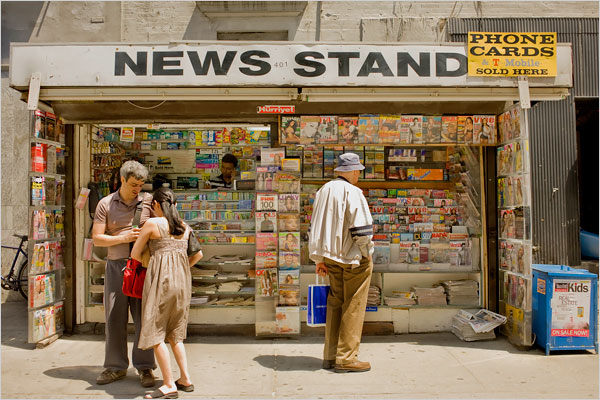
New York City’s Administrative Code requires all of the city’s 330 newsstands to be located at least 9 feet, 6 inches away from buildings. That way pedestrians will have a clear path to walk by. Marilyn Louie has run a newsstand in Chinatown since 1982. Before that, her father ran it. All in all, her newsstand has sat in the same spot for 35 years – precisely 9 feet, 3 inches away from the nearest building. It took inspectors a few decades to get around to measuring, but now they want Louie to tear down her newsstand, citing the three-inch shortfall. Louie’s newsstand is also 4 inches closer to the curb than regulations allow.

There have been no pedestrian complaints.

Politics may play a role here. A Spanish company named Cemusa must have friends in high places, because the city government is in the process of requiring all newsstand owners to tear down their existing structures and replace with them with new ones – made by Cemusa. The New York Post reports that the new newsstands are “prone to leaks and break-ins,” so Louie’s reluctance to go along with the plan is understandable.

Cemusa is also installing new bus stop shelters and public bathrooms throughout New York City.

The city government has offered to let Louie move her business to one of several other spots by the end of the month. Louie, who struggles to make $40,000 per year despite working 7-day weeks, scouted out the proposed locations. They either lack foot traffic, or there are already numerous competitors already there selling similar merchandise.

Football is often called a game of inches. When it comes to regulation and the right to make a living, so is the game of life. What a shame that Marilyn Louie is finding this out the hard way.

How to Build a Democracy


It is the height of hubris to claim that one knows how to build a democracy from scratch. The U.S. has learned this from its attempts in Iraq, Afghanistan, and countless other countries. But there are a few common themes that can help. One lesson is that it has to come from within, not imposed by foreign countries. Another is that new institutions have to evolve out of old ones, and have to suit local conditions and cultures.

Over at the Daily Caller, I trace out two other themes that emerging democracies should keep in mind: simpler is better, and rely on negative rights, not positive rights. Here’s a taste:

The Arab Spring is over a year old now. It’s too early to tell if that movement will bring liberal democracy to countries that badly need it. But if it does succeed, it will be right in line with a decades-long global trend. According to Freedom House, 41 percent of the world’s countries in 1989 were democracies. By 2011, 60 percent were democracies.

There are still a few monarchies here and there, and plenty of dictatorships. Cuba and North Korea are even keeping the last dying embers of communism alight. But more and more, democracy is seen as the way to go.

This is a wonderful development. But not all democracies succeed. Without the proper institutions, democracy can be very temporary, as Russia has found out.

Read the whole thing here.