CEI’s Battered Business Bureau: The Week in Regulation

summer flounder
This week in the world of regulation:

  • Last week, 68 new final rules were published, down from 69 the previous week.
  • That’s the equivalent of a new regulation every 2 hours and 28 minutes — 24 hours a day, 7 days a week.
  • All in all, 3,623 final rules have been published in the Federal Register this year.
  • If this keeps up, the total tally for 2012 will be 3,728 new rules.
  • Last week, 1,265 new pages were added to the 2012 Federal Register, for a total of 75,450 pages.
  • At its current pace, the 2012 Federal Register will run 76,677 pages.
  • Rules are called “economically significant” if they have costs of $100 million or more in a given year. The 46 such rules published so far in 2012 have compliance costs of at least $24 billion. Two of the rules do not have cost estimates, and two other rules have cost estimates that do not give a total annual cost. We assume that rules lacking this basic transparency measure cost the bare minimum of $100 million per year. The true cost is almost certainly higher.
  • No economically significant rules were published last week.
  • So far, 339 final rules that meet the broader definition of “significant” have been published in 2012.
  • So far this year, 682 final rules affect small business; 94 of them are significant rules.

Highlights from final rules published last week:

  • If you own a citrus grove, you can buy crop insurance from the federal government. A new rule updates some of the program’s provisions.
  • It may be December, but that isn’t stopping the National Oceanic and Atmospheric Administration from issuing a new rule for fishing for summer flounder.
  • Sometimes the federal government will switch from one contractor to another for a given service. When it does, its policy is to “require service contractors and their subcontractors under successor contracts to offer employees of the predecessor contractor and its subcontractors a right of first refusal of employment for positions for which they are qualified.” If the government’s reason for making a switch is performance-related, then this rule may well make doing so pointless.
  • Americans are now allowed to import sand pears from China.
  • If you were thinking of importing pig semen from Estonia, Hungary, Slovakia, or Slovenia, read this regulation first.

For more data, go to TenThousandCommandments.com.

I Saw Daddy Pat Down Santa Claus

If you’re a holiday traveler, you will appreciate this song. Click here if the embed doesn’t work.

In related news, due to holiday traveling, there will be limited blogging until late next week. A scheduled post or two will pop up in the meantime, but that’ll be about it. Thanks for reading, and see you then.

“There Are No Externalities, Only Chips.”

Michael Munger’s explanation of externalities and Pigouvian taxes is both hilarious and informative. Click here if the embedded video below doesn’t work.

CEI Podcast for December 19, 2012: The EPA Regulatory Report Card

EPA_logo
Have a listen here.

Fellow in Regulatory Studies Ryan Young talks about the need for more transparency in the world of regulation, as well as CEI’s new EPA Regulatory Report Card. The report card, which collects data about the amount and cost of EPA regulation from numerous sources into one publicly accessible document, is something he argues that all agencies should be doing on their own each year. David Bier guest-hosts.

Path to Transparency: The EPA Regulatory Card

magnifying glass
Transparency is in short supply in the world of regulation. How many rules does an agency have in the pipeline? How much will they cost? How much does the total stock of rules currently in effect cost, and how many are there? Some of these questions can’t be answered. The data for others are available, but scattered across different sources and dfficult to assemble.

There is a solution: each agency should have an annual regulatory report card that puts all this disparate information into one publicly accessible document. Agencies should already be doing this themselves, but aren’t.

That’s why, to set a good example, with plenty of help from my CEI colleagues, I put together just such a report card for the EPA. In it, you’ll find out that the best available estimate of the EPA’s total cost is $353 billion, which is more than Denmark’s entire 2011 GDP. You’ll also find out that the Code of Federal Regulations contains as many as 154,350 individual regulatory restrictions — just in the Title concerning environmental protection.

For all that important information and more, read the EPA Regulatory Report Card here.

The Regulatory Reduction Commission

Regulatory reform is as urgent an issue as ever. In today’s Washington Times, Wayne Crews and I write about a reform that has nearly two decades of bipartisan support, as well as a proven track record when applied to spending cuts: a Regulatory Reduction Commission. Here’s how it would work:

Both spending and regulations are almost impossible to cut using conventional political means. Yet one approach was tried in the 1990s that had some success: the Base Closure and Realignment Commission (BRAC).

When the Cold War ended, America no longer needed such a large military. Because no member of Congress would vote to close an unneeded military base in his own district or state, the independent BRAC commission’s job was to give Congress an omnibus package of bases to vote on closing, without amendment. This approach was able to overcome the usual vote-trading and back-scratching, and the package passed. The Pentagon (and taxpayers) saved piles of money.

Since then, Mr. Mandel, Mr. Gramm and analysts across the political spectrum all have had the same thought: Using BRAC as a model with a proven track record for cutting unnecessary spending, can a similar mechanism be extended to repealing unneeded regulations?

It can. All it takes is a bit of courage from Congress and President Obama. Hopefully that isn’t asking too much.

Read the whole thing here.

CEI’s Battered Business Bureau: The Week in Regulation

used-car-sign-300x300
This week in the world of regulation:

  • Last week, 69 new final rules were published, down from 94 the previous week.
  • That’s the equivalent of a new regulation every 2 hours and 26 minutes — 24 hours a day, 7 days a week.
  • All in all, 3,555 final rules have been published in the Federal Register this year.
  • If this keeps up, the total tally for 2012 will be 3,728 new rules.
  • Last week, 1,287 new pages were added to the 2012 Federal Register, for a total of 74,185 pages.
  • At its current pace, the 2012 Federal Register will run 76,956 pages.
  • Rules are called “economically significant” if they have costs of $100 million or more in a given year. The 46 such rules published so far in 2012 have compliance costs of at least $24 billion. Two of the rules do not have cost estimates, and two other rules have cost estimates that do not give a total annual cost. We assume that rules lacking this basic transparency measure cost the bare minimum of $100 million per year. The true cost is almost certainly higher.
  • No economically significant rules were published last week.
  • So far, 333 final rules that meet the broader definition of “significant” have been published in 2012.
  • So far this year, 675 final rules affect small business; 94 of them are significant rules.

Highlights from final rules published last week:

For more data, go to TenThousandCommandments.com.

Packers Beat Bears, Clinch NFC North

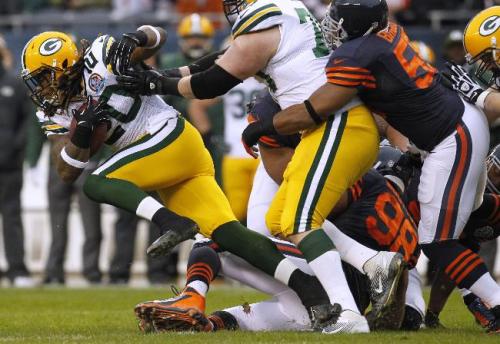
alex green bears run q1
Aaron Rodgers tossed for 291 yards, 3 touchdowns, all to James Jones, and no interceptions for a 116.8 passer rating. Chicago’s Brandon Marshall got his revenge by hauling in a Jay Cutler touchdown pass, but it wasn’t enough. Packers 21, Bears 13.

The 10-4 Packers clinched the division with the win, clinching a playoff berth. The Bears will now have to pull off a run for a wildcard slot.

All in all, a good day if you’re a Packer fan.

Packers vs. Bears

cutler-woodson-reuters
Tomorrow, the Green Bay Packers and Chicago Bears will face off for the 187th time — the most any two teams have played each other in NFL history. It is the NFL’s marquee rivalry. The Packers have won 13 NFL championships, the most of any team. The Bears are second in NFL annals with 9.

The Packers have fared better in the Super Bowl era, winning 4 Lombardi trophies to Chicago’s lone victory in 1985. Then again, the Bears hold the edge in head-to-head play, with a 92-87-6 record, including playoffs.

The players are very much aware of their rivalry’s intensity, and seem to revel in it. Chicago’s best receiver, Brandon Marshall, said this week at a press conference:

“I don’t like the Green Bay Packers. I’m not going to use the word ‘hate,’ but I really dislike the Packers and their players,” Marshall said. “But you know what? The talk has to back it up. We’ll go out there and do everything we have to do to get a win.”

Marshall leads the NFL with 103 catches through 13 games. The Packers somehow kept him in check when they met earlier in the season, allowing only 2 catches for 24 yards. He has clearly taken it personally, calling tomorrow’s game the “biggest game of my career.”

Packer defenders have given Marshall plenty of reason to take umbrage, particularly Charles Woodson. After their last game Woodson, who will not play tomorrow due to injury, said of Jay Cutler, Chicago’s talented but interception-prone quarterback:

“Heard some talk out of the Bears: Packers secondary not working coverage, bigger receivers … we heard about it,” Woodson told ESPN’s Rachel Nichols after the game. “We understand that Jay is excited about his new weapons, but it’s the same-old Jay. We don’t need luck; Jay will throw us the ball.”

Cutler threw four interceptions that day, all but ensuring a Bears loss. No doubt he has been putting in extra time this week studying film and making sure his receivers know their routes, and his linemen know their protection schemes; tomorrow’s game should be a fun one. Cutler hasn’t historically played well against Green Bay, but when he’s having a good day, he drives his team up and down the field almost at will.

But enough about tomorrow. It turns out that 80 years ago, in 1932, this rivalry once had championship-level implications due to a quirk in the rules.

Recall that the Packers and Bears are the NFL’s two most decorated franchises, with 13 and 9 championships, respectively. Every week, Green Bay’s PR staff puts out a Dope Sheet packed with information about the Packers, that week’s opponent, their history together, roster information, and endless statistics. On page 5 of this week’s Dope Sheet I found a tidbit that there is an argument that maybe Green Bay should really have 14 championships to Chicago’s 8:

On the heels of its three straight NFL championships [1929-31]… the Bears stole from Green Bay a fourth straight title (which at the time was determined by league standings). Chicago barely finished atop the league standings, which unlike today did not count ties. Had the league counted ties in standings, the Packers would have won. The next year, 1933, the  NFL began determining its champion with postseason games.

This was also the last time the Packers have led the all-time series. The Bears have held the advantage ever since — 80 years and counting.

An Important Distinction

Master of the Senate, the third volume of Robert Caro’s biography of Lyndon Johnson, opens with a lengthy history of the world’s greatest deliberative body from America’s founding up to Johnson’s time. On page 44, describing the end of a lengthy period of Senatorial stagnation in the early 20th century, Caro writes about how leadership deliberated:

The “Senate Four” or the “Big Four,” as they were known, still met in summer at Aldrich’s great castle in Narragansett, near Newport – four aging men in stiff high white collars and dark suits (Aldrich, being at home, might occasionally unbend to wear a blazer) even on the hottest days, sitting on a colonnaded porch in rockers and wicker chairs deciding Republican policy – a policy that was still based on an unshaken belief in laissez-faire and the protective tariff.

Caro is a masterful biographer and a fine writer, but he is sometimes a little confused on economics. Protective tariffs are government interventions in the market, and therefore the precise opposite of laissez-faire. Then, as now, Republican leaders were much more pro-business than pro-market. This is an important distinction to make. Failing to make it can lead to egregious — and avoidable — errors.