Slow News Day

Politico: State dinner menu, guests unveiled

CEI’s Battered Business Bureau: The Week in Regulation

kiwifruit whole and sliced
Despite Friday’s Federal Register containing an impressive 853 pages, regulations continued their relatively slow pace. If this keeps up, 2014 will see the fewest regulations issued in decades.

On to the data:

  • Last week, 55 new final regulations were published in the Federal Register. There were 52 new final rules the previous week.
  • That’s the equivalent of a new regulation every three hours and 3 minutes.
  • So far in 2014, 268 final regulations have been published in the Federal Register. At that pace, there will be a total of 2,577 new regulations this year. This would be the lowest total in decades; this will likely change as the year goes on.
  • Last week, 1,487 new pages were added to the Federal Register.
  • Currently at 7,563 pages, the 2014 Federal Register is on pace for 72,722 pages, which would be the lowest total since 2007.
  • Rules are called “economically significant” if they have costs of $100 million or more in a given year. Four such rules have been published so far this year, none of them in the past week.
  • The total estimated compliance costs of 2014’s economically significant regulations is currently $1.6 million. They also affect several billion dollars of government spending.
  • 30 final rules meeting the broader definition of “significant” have been published so far this year.
  • So far in 2014, 50 new rules affect small businesses; 8 of them are classified as significant.

Highlights from selected final rules published last week:

For more data, see Ten Thousand Commandments and follow @10KC and @RegoftheDay on Twitter.

CEI Podcast for February 6, 2014: Keystone XL Pipeline Inches towards Approval

keystone xl construction
Have a listen here.

Marlo Lewis examines a State Department report finding that Keystone serves the national interest and finds opposing arguments wanting.

The Kronies

John Papola strikes again with a brilliant bit of satire. Click here if the embedded video below doesn’t work, and the full Kronies website is here.

Regulation without Representation

This is supposed to be a year of action. Unfortunately, there will likely be very little action in the area of regulatory reform. Over at The Hill‘s Congress blog, Wayne Crews and I make the case for reining in the regulatory state as a way to improve the federal government’s fiscal health. Here’s a taste:

Take the much-discussed annual federal deficits under presidents Bush and Obama. In recent years, the government has been spending a little less than a quarter of the nation’s GDP, but its revenues rarely top 20 percent of GDP. Given Congress’s and the president’s continuing unwillingness to reduce spending to match revenues, they could turn instead to regulatory reform as a budget balancer.

A deregulatory “stimulus” would help create the conditions for rapid economic growth. If government’s 20 percent slice comes from a much larger pie, revenue gains could cover most, if not all of the shortfall, eventually erasing deficits. This, of course, would require keeping spending in check, which may be wishful thinking. But it offers a solution, if politicians really want one.

Read the whole thing here.

CEI’s Battered Business Bureau: The Week in Regulation

paperwork
Despite Friday’s Federal Register containing an impressive 853 pages, regulations continued their relatively slow pace. If this keeps up, 2014 will see the fewest regulations issued in decades.

On to the data:

  • Last week, 52 new final regulations were published in the Federal Register. There were 43 new final rules the previous week.
  • That’s the equivalent of a new regulation every three hours and 14 minutes.
  • So far in 2014, 216 final regulations have been published in the Federal Register. At that pace, there will be a total of 2,572 new regulations this year. This would be the lowest total in decades; this will likely change as the year goes on.
  • Last week, 1,808 new pages were added to the Federal Register.
  • Currently at 5,264 pages, the 2014 Federal Register is on pace for exactly 62,667 pages, which would be the lowest total since 1995.
  • Rules are called “economically significant” if they have costs of $100 million or more in a given year. Four such rules have been published so far this year, none of them in the past week.
  • The total estimated compliance costs of 2014’s economically significant regulations is currently $1.6 million. They also affect several billion dollars of government spending.
  • 26 final rules meeting the broader definition of “significant” have been published so far this year.
  • So far in 2014, 38 new rules affect small businesses. Seven of them are classified as significant.

Highlights from selected final rules published last week:

For more data, see Ten Thousand Commandments and follow @10KC and @RegoftheDay on Twitter.

OC Register on Yellen as Fed Chair

I didn’t see this until today, but earlier this month the Orange County Register was kind enough to cite me in an editorial about Janet Yellen shortly after her confirmation vote.

CEI Podcast for January 30, 2014: State of the Union

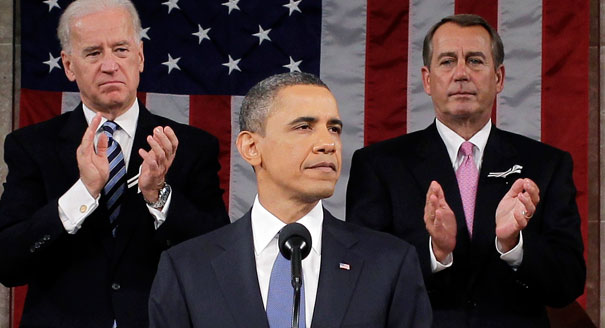
SOTU 2014 Obama Biden Boehner
Have a listen here.

Vice President for Strategy Iain Murray analyzes the President’s 2014 State of the Union speech.

State of the Union: Economic Band-Aids for Poverty and Unemployment

One of progressivism’s most admirable traits is its concern for the little guy. But many progressive policies for alleviating poverty, unemployment, and other social problems don’t work as advertised. This is because those policies often focus only on the desired outcome, and ignore the deeper processes that ultimately generate those outcomes. This misplaced focus was on full display in President Obama’s State of the Union speech.

This is a subtle point that would benefit from an analogy. Suppose, while slicing vegetables, that you accidentally cut your finger. The sensible thing to do is put on a band-aid. But in the long run, you are far better off knowing and practicing proper knife safety. The band-aid eases the immediate problem. But if you focus on the long-term process of safety, you are far less likely to get hurt in the first place.

Now apply this thinking to the President’s call for passing the $10.10 federal minimum wage bill currently winding its way through Congress. A lot of people aren’t making very much money. The obvious thing to do is legislate a raise for them. Pass it! Some people will clearly benefit; no doubt many of them will appear at press conferences if the increase is enacted. But there is a tradeoff. Those raises are offset by reduced hours and even firings for other people.

There is also an unseen cost to the minimum wage: workers who are never hired in the first place. These minimum wage casualties cannot be trotted out in front of cameras because we don’t know who they are. But we do know that they exist. They are mostly young, and they are disproportionately minorities. These workers lack experience and skills because they haven’t lived long enough to gain them yet. It may not be worth it to pay an employee at that skill and experience level $10.10 per hour.

Pricing people out of employment prevents them from getting the experience they need to get higher-paying jobs later in life. It makes the old paradox even more painful: without experience, you can’t get the job, but without the job, you can’t get experience.

The chase after an end result—higher wages for low-skilled workers—ignores the larger social processes at work in the economy. In the long run, wages are tied to productivity. The more a worker produces, the more his services are worth to his employer. Instead of mandating higher wages, a process-oriented reformer emphasizes policies that allow workers to be more productive.

A deregulatory stimulus along the lines of what Wayne Crews and I have been proposing for some time would do nicely; workers would spend less time complying with rules and more time being productive, and thus better paid. It would also remove obstacles to innovation and technological advance that are the long-run drivers of increasing productivity and wealth creation. When that process is blocked, wages stagnate.

Unfortunately, the topic of regulation did not come up even once during the entire speech. Hopefully this does not reflect the administration’s priorities.

The same outcome-over-process oversight is in the President’s proposal to extend–restore, in his words–unemployment benefits. If someone loses their job, the obvious thing to do is to give them a helping hand while they look for a new job. But again, unemployment insurance has tradeoffs that at least offset the advantages.

People respond to incentives. And unemployment benefits reduce one’s incentive to look for a job. They allow some people to wallow in discouragement longer than they otherwise would. Other people decide that receiving benefits can let them wait until a higher-paying job opens up, instead of having to take an available, if unappealing job right away. The result is unnaturally high unemployment. This is not the policy’s intention, but it is very much its result.

More effective policies would make the hiring process easier. Reducing compliance burdens would reduce the regulatory friction scraping against otherwise-promising new hires.

As companies grow, more and more rules affect them. When a company reaches 4 employees, it becomes subject to the Immigration Reform Act and its associated paperwork. At 15 employees, the Americans with Disabilities Act comes into play, and the Family and Medical Leave Act announces its presence at 50 employees. There are many others.

Many companies stop hiring when they come up against these thresholds, because they can’t afford them. Reducing these burdens would do far more to ease the sting of unemployment than extending unemployment benefits.

As in past years, the President used Tuesday’s State of the Union speech to describe the equivalent of band-aids for injury-prone cooks. But he seems unaware that the long-run process of practicing kitchen safety is what it takes to ultimately reduce the amount of culinary casualties. As in the kitchen, so in the economy.

New Study on Unemployment Benefits

The Washington Free Beacon quotes me on a new study about how unemployment benefits affect the unemployment rate. The article is here, and the study is here.