Category Archives: regulation

Live-Blogging the State of the Union

Since I wasn’t clever enough to figure out how to syndicate the content to this blog, just click on over to CEI’s staff blog, OpenMarket.org, to read my live-blog of tonight’s State of the Union address.

I’ll paste the full text over here sometime after the speech. But at OpenMarket, you can follow along as it happens. So head on over.

On the Radio – State of the Union

Today at 3:35 EST, I’ll be on WTIC 1080 AM (Hartford, CT) to talk about the State of the Union address. You can listen online here.

I will also be live-blogging the speech starting around 8:30 EST for CEI’s blog, OpenMarket.org. You can follow the action here. I will also try to syndicate the feed to this blog, but no guarantees since I’m not exactly tech-savvy.

Tim Carney Knows How Washington Works

Tim’s latest column, “Bail them out, regulate them, then work for them,” is a must-read.

Amy Friend, a former staffer for Sen. Chris Dodd, played a large role in writing the Dodd-Frank financial regulation bill. And she just got a new job at a lobbying firm. Tim explains:

There are two types of people on K Street: access people, who can get you in the door; and policy people, who know what’s on every page of every relevant bill and regulation. Friend is the latter. While business will dry up for other Dodd alumni on K Street, Friend is valuable because — to quote one Republican lobbyist — “she knows what’s on page twenty-three-[bleep]ing-hundred of that bill,” and every other page, too.

In other words, Friend didn’t just write a landmark piece of legislation — she wrote her meal ticket.

Tim doubts that Friend is corrupt. But her story is very common in Washington. Lobbying wouldn’t be such a booming business if regulation wasn’t, too. And the revolving door between the Hill and K Street can be very profitable, even when no corruption is involved. Most people forget that regulators act just as self-interestedly as the people they regulate.

6 Painless Ways to Cut Federal Red Tape

President Obama signed an Executive Order this week that will initiate a “government-wide review of the rules already on the books to remove outdated regulations that stifle job creation and make our economy less competitive.”

Over at AOL News, Wayne Crews and I explain why this will hardly change a thing. We also offer 6 suggestions for reducing regulatory burdens with a minimum of political pain. Here are three of them:

  • Appoint an annual bipartisan commission to comb through the books and suggest rules that deserve repeal. Congress would then vote up-or-down on the repeal package without amendment, to avoid behind-the-scenes deal-making.
  • Require all new regulations to have built-in five-year sunset provisions. If Congress decides a rule is worth keeping, it can vote to extend it for another five years.
  • Consider Sen. Mark Warner’s, D-Va., “one in, one out” proposal, which holds that for every new rule that hits the books, an old one must be repealed.

Read the rest here.

CEI Podcast for January 12, 2011: Public-Private Partnerships

Have a listen here.

Land-use and Transportation Policy Analyst Marc Scribner talks about his new CEI Issue Analysis, “The Limitations of Public-Private Partnerships.” Marc argues that PPPs are an improvement over the status quo in surface transportation because they introduce at least an element of competition into a sector where there is usually none. But PPPs are harmful in real estate developments because they tend to favor politicians’ preferences over those of consumers.

A New Record for the Federal Register?

This article quotes me on the 2010 Federal Register. When the adjusted page count becomes available, it could break President Bush’s all-time record of 79,435 pages. The unadjusted length is 82,589 pages, and the adjustment is expected to decrease that by a thousand pages or so.

New Jersey Trying to Seize Unused Gift Card Balances

New Jersey residents with unused gift cards might want to make that trip to Target or Home Depot soon. The state legislature voted to seize the unused balances of all gift cards and traveler’s checks issued in the state before a certain date.

A judge struck down the law, but the state is appealing the ruling. By stealing the gift card balances from their owners, the state could raise up to $80 million.

That’s one way to fix a busted budget. Here’s another: spend less.

Canadian Town Bans Pet Giraffes, Walruses

Having solved all other problems, the Morinville, Alberta town council is banning residents from owning 130 species as pets. Targeted animals include armadillos, elephants, giraffes, walruses (walri?), spiders, and kangaroos.

2010 Federal Register is Third-Largest Ever

Today is the last working day of 2010 which means the last edition of the 2010 Federal Register came out this morning. The final unadjusted page count is 82,589 pages. That’s the third highest ever.

Page counts are typically highest in years when power changes hands. This year was no exception. The two other highest unadjusted page counts occurred when Carter handed off to Reagan, and when Clinton handed off to Bush. The Bush-Obama handoff featured the largest-ever adjusted page count, 79,435.

This time, the spike happened with only the House changing parties. The next few years will tell us a lot. 2010’s high page count may have been a combination of this year’s ambitious legislation plus a midnight rush to get the White House’s regulatory wish list in place before the other team can block it.

Or, as in the past, it could be that we have reached a new, permanent plateau of frenzied federal activity.

I’m hoping for the former. But the Republicans in Congress are no friends of limited government, so one never knows. They will reliably oppose anything the other team comes up with. But as the Bush years showed, they’ll also vote for the exact same policies so long as it’s their team that’s proposing them. This is not a recipe for fiscal or regulatory health.

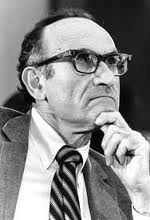
Alfred E. Kahn, 1917-2010

The man who deregulated air travel passed away yesterday at age 93. That man, Alfred Kahn, was a Cornell economics professor who did far more than teach. He revolutionized the role of economics in regulatory policy. He also did important work on electricity deregulation in addition to his famous work on deregulating air travel.

Kahn’s most famous book was The Economics of Regulation, which pointed out that regulations often hinder competition, not help it. His use of the economic way of thinking was distinctly unfashionable at the time. One of his greatest legacies is righting that wrong.

As a lifelong partisan Democrat, Kahn had credibility in political circles at a time when regulatory skeptics were shooed away from the corridors of power. After chairing the New York Public Service Commission, President Carter appointed him to lead the Civil Aeronautics Board in 1977, which he dismantled.

Before Kahn, airlines had to get permission from the CAB to establish new routes or terminate old ones. The CAB set ticket prices, not the market. This prevented profitable or high-demand routes from being given adequate service, and kept money-losing, little-traveled routes open. It prevented airlines from keeping up with their customers’ ever-changing needs.

The CAB was also a wonderful device for keeping pesky startups from competing with established industry giants such as Pan American. Southwest Airlines, for example, would only fly routes inside the state of Texas to avoid CAB regulations.

Once the CAB was abolished, Southwest and other small airlines tried out new business models and offering lower fares. Some of them prospered; others did a poor job giving people what they wanted and ceased to be. Today, air travel may not have the amenities it used to, but it cheaper, more flexible, and more adaptable than it was under the CAB.

Washington could use more people like Alfred Kahn. He had his successes in a few choice sectors of the economy, but many more still have Civil Aeronautics Boards of their own stopping them from reaching their potential. Let us learn from his example of a life well lived; a good place to start is Thomas McCraw’s Prophets of Regulation.