Category Archives: regulation

CEI Podcast for November 10, 2011: Eminent Domain Abuse

Have a listen here.

Land-use and Transportation Policy Analyst Marc Scribner explains why allowing the government to seize land from its owners and give it to developers is a bad idea. Voters in Mississippi agree; on Tuesday they overwhelmingly passed a ballot initiative that would place limits on eminent domain abuse. Marc discusses the pros and cons of Mississippi’s initiative and the prospects for reform in other states.

2011 Federal Register Tops 70,000 Pages

Yesterday, the 2011 Federal Register hit the 70,000 page milestone. This is just the 14th time in the Register‘s 76-year history the unadjusted page count has gotten that high. And remember, it’s still November. It’s on pace to top 80,000 pages.

To be more precise, assuming 250 working days this year, the projected page count is currently 80,641. That would place 2011 in top-five territory for all-time unadjusted page counts. President Carter set the record in his final year with 87,012 pages.

Adjusting that count for thousands of blank pages and jumps yields 73,258 pages, a then-record that was broken five times by George W. Bush and once (so far) by Barack Obama. He set the new record adjusted page count last year with 81,405.

The usual caveat applies here. Federal Register page counts are not a perfect measure of regulatory activity. A rule that costs little can ramble on for dozens of pages; a rule costing billions can fit on a single page. But when page counts threaten all-time records, it’s a pretty good indicator that the regulation industry is booming.

In short: the next time someone complains about America’s unregulated cowboy capitalism, you should ask them where such a thing might actually be found.

Regulation Roundup

A fresh batch of regulatory bloopers:

  • Rochester, New York prohibits children from walking on tight-ropes.
  • Police officers in Maine are not allowed to arrest dead people.
  • If you’re in Helena, Montana, never tie a horse to a fire hydrant. It’s against the law.
  • Massachusetts law forbids frightening pigeons.
  • It is Alaskan state policy that “emergencies are held to a minimum and rarely found to exist.”
  • If you don’t return your books to Salt Lake City, Utah public libraries within a month, hide. You can be arrested.
  • You need police approval to own a burglar alarm in Pinecrest, Florida.
  • Bees may not enter Kentucky without certificates of health.

Laws for Everything

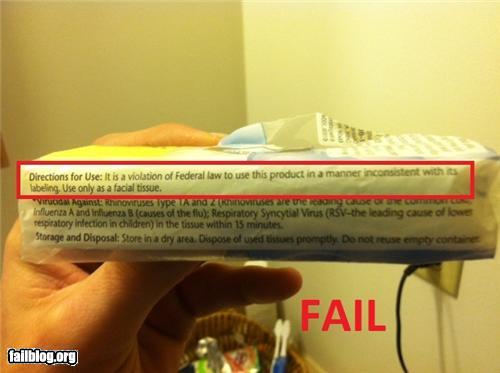
Click the picture to enlarge.

Original here. The relevant text reads, “Directions for use: it is a violation of Federal law to use this product in a manner inconsistent with its labeling. Use only as a facial tissue.”

Tissue abuse must be rampant if there needs to be a law on the books to prevent it.

Yes, Regulation Does Keep Unemployment High

Over at RealClearMarkets, my colleague Wayne Crews and I argue that the law of demand holds. Hard to believe that’s actually controversial, but that’s Washington for you. Here’s our conclusion:

Eberly was put in an uncomfortable position when she came to Washington. Just as a lawyer’s job is to vigorously defend clients even if she knows they are guilty, Eberly’s job is to vigorously defend policies that are obviously harmful to the economy. Try as she might, she cannot argue against the law of demand.

Regulations make hiring costlier and thus make jobs scarcer. And regulatory uncertainty makes companies reluctant to hire employees they might not be able to afford down the road. Case closed.

Read the whole thing.

Regulation Roundup

Yet another batch of regulatory bloopers:

  • Motorists entering Tacoma, Washington with criminal intent are required to telephone the chief of police.
  • It is illegal to catch fish with your bare hands in Kansas.
  • It is illegal for a man to curse in front of a woman in Nebraska. Women can cuss away, though.
  • Turtle racing is illegal in Key West, Florida.
  • You can’t play checkers in public in La Crosse, Wisconsin.
  • In Hartford, Connecticut, you may not cross a street while walking on your hands. Feet only, please.
  • The U.S. Code requires the federal government to employ a Construction Metrication Ombudsman. His job is to encourage federal contractors to use the metric system.
  • Don’t ride your bicycle faster than 65 mph in Danbury, Connecticut. You could be arrested.

The Revolving Door

Judge who Ruled against Raw Milk in Wisconsin quits to work for Monsanto law firm

Regulation Roundup

Enjoy a fresh batch of regulatory bloopers:

  • In Belvedere, California, “No dog shall be in a public place without its master on a leash.” Think about that for a minute.
  • It is against the law to eat more than three sandwiches at a wake in Boston, Massachusetts.
  • Tennessee law specifically forbids catching fish with a lasso.
  • It is illegal for St. Louis, Missouri firefighters to rescue a woman if she is wearing a nightgown.
  • In Providence, Rhode Island, drugstores are allowed to sell toothpaste on Sundays, but not toothbrushes.
  • In Ohio, it is illegal for donkey riders to go faster than 6 miles per hour.
  • In Tennessee, it is illegal to buy or sell cotton after dark.
  • It is illegal to slurp your soup in New Jersey restaurants. You can be arrested, fined, and even jailed.

Regulatory Capture in Action

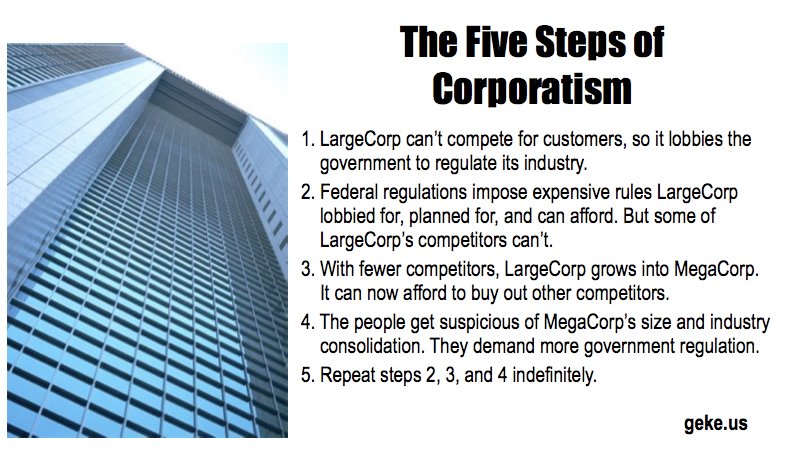
This picture has been making the rounds on the Internet. Click to enlarge. Keep in mind that it does not describe capitalism; it describes cronyism.

CEI Podcast for October 6, 2011: How to Deregulate the Economy

Have a listen here.

Vice President for Policy Wayne Crews is author of the new CEI study, “The Other National Debt Crisis: How and Why Congress Must Quantify Regulation.” He discusses a few of his many ideas for deregulating the economy, including a regulatory budget, improved cost analysis, and lowering the threshold of “economically significant” regulations from $100 million to $25 million. This would require OMB to review more than the roughly 5 percent of new rules that it currently analyzes. The other 95 percent should not slip through the cracks.