Category Archives: regulation

On the Radio – Regulation

In about ten minutes, I’ll be on Twin Cities News Talk AM1130’s “This Week in Regulation” to talk about, well, regulation.

You should be able to listen live from here.

CEI’s Battered Business Bureau: The Week in Regulation


Just another week in the world of regulation:

  • 65 new final rules were published last week, up from 58 the previous (holiday-shortened) week. That’s the equivalent of a new regulation every 2 hours and 35 minutes — 24 hours a day, 7 days a week. All in all, 1,629 final rules have been published in the Federal Register this year. If this keeps up, the total tally for 2012 will be 3,726 new rules.
  • 1,298 new pages were added to the 2012 Federal Register last week, for a total of 34,127 pages. At this pace, the 2012 Federal Register will run 76,863 pages.
  • Rules are called “economically significant” if they have costs of $100 million or more in a given year. The 24 such rules published so far in 2012 have compliance costs of at least $14.5 billion. Two of the rules do not have cost estimates, and a third cost estimate does not give a total annual cost. We assume that rules lacking this basic transparency measure cost the bare minimum of $100 million per year. The true cost is almost certainly higher.
  • No economically significant rules were published last week. So far, 187 significant final rules have been published in 2012.
  • So far this year, 311 final rules affect small businesses. 50 of them are significant rules.

Highlights from final rules published last week:

For more data, updated daily, go to TenThousandCommandments.com.

Stigler on the Regulatory Mindset

George Stigler was a Nobel-winning economist who applied the economic way of thinking to regulation at a time when doing so was even more unfashionable than it is today. He was also known for his wit.

Near the end of his paper “The Economists’ Traditional Theory of the Economic Functions of the State,” which appears as chapter 7 in his 1975 collection The Citizen and the State: Essays on Regulation, he has a pithy public choice-style insight (p. 112):

We have a long, long list of market failures. These should be corrected if possible, and there are only two alternatives to the market: the state, and prayer. It turns out the two were merged in one.

There’s a lot packed into that bit of pith. Intentionally or not, Stigler was referring to what Harold Demsetz called the Nirvana fallacy. The relevant comparison isn’t between market outcomes and perfection; it’s between market outcomes and possible improvements. This is where economists’ never-ending focus on perfect competition models comes back to bite them in the rear end. Economists and regulators alike pray fervently.

Unable to escape from Hayek’s knowledge problem and public choice concerns such as regulatory capture, regulations not only routinely fail to improve on market outcomes, they often make make matters worse.

As Arnold Kling pointed out, the lesson learned isn’t the idealistic Chicago school motto, “Markets work well. Use markets,” nor is it the Nirvana fallacy-prone MIT-Harvard dictum, “Markets fail. Use government.” It’s the realist GMU-style “Markets fail. Use markets.”

Ten Thousand Commandments and Growing

Over at The Washington Times, Wayne Crews and I praise President Obama’s recent regulatory reforms. They’re small, but they’re better than nothing:

The estimated savings total up to about $10 billion over five years. Cass Sunstein, who heads Mr. Obama’s Office of Information and Regulatory Affairs at the Office of Management and Budget, sees this as a significant achievement. Of course, federal regulations cost more than 500 times that much – more than a trillion dollars annually – so this is a curious use of the word “significant.”

We also lay out some potential next steps:

  • Implement a bipartisan, annual Regulatory Reduction Commission to vote up or down on a package of rules to eliminate in one sweep.
  • Institute a freeze on federal rule-making in order to rediscover federalism. Many health and safety matters are best left to states.
  • Hold hearings on Sen. Mark R. Warner’s “one-in, one-out” requirement for any new rule, which, for some reason, he isn’t talking about much lately but should be.
  • Increase exemptions for small businesses, which can least afford regulatory costs.

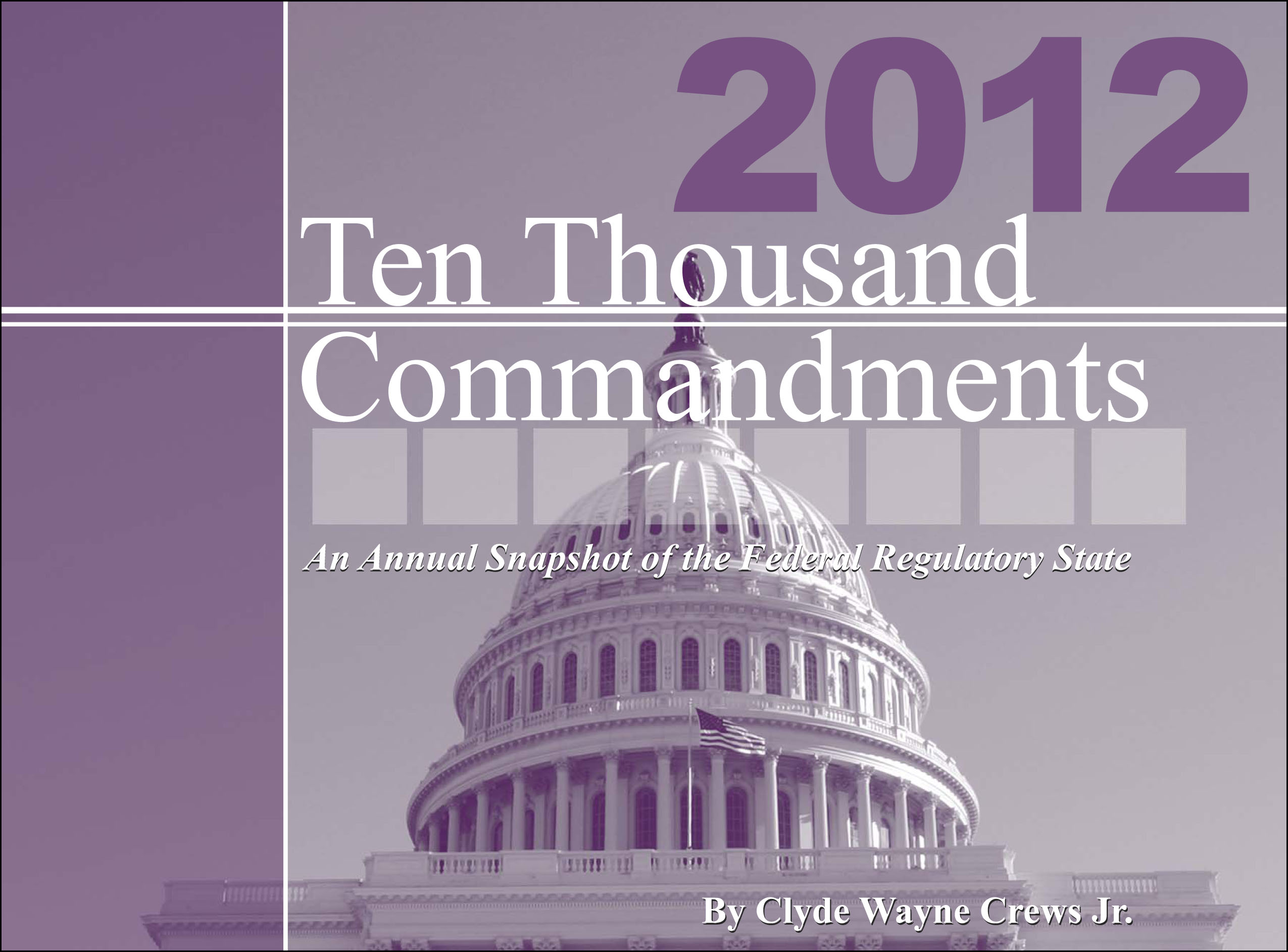
Read the whole thing here. More reform ideas are in the new 2012 edition of Wayne’s “Ten Thousand Commandments” study.

Washington’s Ten Thousand Commandments

The 2012 edition of “Ten Thousand Commandments” is out now. If you don’t feel like reading all 66 pages (though I recommend you do!), Wayne Crews and I sum up the main findings and offer a few institution-level reforms in a short piece at The American Spectator:

Politicians love to blame unregulated markets for America’s economic troubles. But… those unregulated markets are hard to find. The federal government lists all of its regulations in the Code of Federal Regulations. It is more than 169,000 pages long and growing. Last year alone, 3,807 new final rules were published in the Federal Register — more than 10 per day. In 2010, it was 3,573 new rules.

And here’s just one of our reform ideas:

Just as Congress is supposed to pass a budget every year for what it spends, it should pass a regulatory budget. If it caps regulatory burdens at, say, $1 trillion, it would then have to prioritize which rules it believes provide the most bang for the buck. Voters would also know when Congress votes to increase regulatory costs, giving members at least some incentive to keep regulation in check.

The fight for real regulatory reform is a long one, not least because neither party has shown the seriousness needed to see it through. But the only way to win is to fight.

Read the whole thing here.

CEI’s Battered Business Bureau: The Week in Regulation


Just another week in the world of regulation:

  • 58 new final rules were published during the short work week last week, down from 95 the previous week. That’s the equivalent of a new regulation every 2 hours and 54 minutes — 24 hours a day, 7 days a week. All in all, 1,564 final rules have been published in the Federal Register this year. If this keeps up, the total tally for 2012 will be 3,741 new rules.
  • 1,347 new pages were added to the 2012 Federal Register last week, for a total of 32,829 pages. At this pace, the 2012 Federal Register will run 77,427 pages.
  • Rules are called “economically significant” if they have costs of $100 million or more in a given year. The 24 such rules published so far in 2012 have compliance costs of at least $14.5 billion. Two of the rules do not have cost estimates, and a third cost estimate does not give a total annual cost. We assume that rules lacking this basic transparency measure cost the bare minimum of $100 million per year. The true cost is almost certainly higher.
  • Two economically significant rules were published last week. So far, 180 significant final rules have been published in 2012.
  • So far this year, exactly 300 final rules affect small businesses. 48 of them are significant rules.

Highlights from final rules published last week:

  • The two new economically significant rules come from the Energy Department. One rule sets new energy efficiency standards for dishwashers, the other for washing machines.
  • If you’re a lobster fisherman in Maine, you should be aware of some new regulations from the National Oceanic and Atmospheric Administration.
  • HHS issued a correction to its health care bill-related rules for creating health insurance exchanges. If states continue to refuse to create the exchanges, and depending on how the Supreme Court case goes, it may end up a moot point.

For more data, updated daily, go to TenThousandCommandments.com

CEI Podcast for May 31, 2012: Ten Thousand Commandments


Have a listen here.

Congress passed 81 bills last year, while agencies passed 3,807 regulations. This, according to Vice President for Policy Wayne Crews, is regulation without representation. Crews discusses this and other findings from the just-released 2012 edition of his annual report, “Ten Thousand Commandments: An Annual Snapshot of the Regulatory State.”

CEI’s Battered Business Bureau: The Week in Regulation


Just another week in the world of regulation:

  • 95 new final rules were published last week, up from 84 the previous week. That’s the equivalent of a new regulation every hour and 46 minutes — 24 hours a day, 7 days a week. All in all, 1,583 final rules have been published in the Federal Register this year. If this keeps up, the total tally for 2012 will be 3,968 new rules.
  • 1,628 new pages were added to the 2012 Federal Register last week, for a total of 31,432 pages. At this pace, the 2012 Federal Register will run 77,040 pages.
  • Rules are called “economically significant” if they have costs of $100 million or more in a given year. The 22 such rules published so far in 2012 have compliance costs of at least $14.3 billion. Two of the rules do not have cost estimates, and a third cost estimate does not give a total annual cost. We assume that rules lacking this basic transparency measure cost the bare minimum of $100 million per year. The true cost is almost certainly higher.
  • No economically significant rules were published last week. So far, 172 significant final rules have been published in 2012.
  • So far this year, 292 final rules affect small businesses. 40 of them are significant rules.

Highlights from final rules published last week:

  • Good news on the international trade front: the International Trade Administration published a rule withdrawing a tariff quota on imported fabric that expired in 2009 (timely!). The rule also repeals rules for short supply procedures. “Short supply procedures” means that when domestic supply falls short of demand, the government blocks fewer imports than usual to ease the shortage. Now the ITA will stay out of the way entirely, as far as cotton is concerned. This bit of housecleaning came about through President Obama’s January 2011 Executive Order, “Improving Regulation and Regulatory Review.”
  • The official legal meaning of the term “unblockable drain” has been revised, thanks to the Consumer Product Safety Commission.
  • It is against federal rules for a commercial driver to make entries to an automatic on-board recording device while his vehicle is in motion. A new Federal Motor Carrier Safety Administration rule specifies that it’s ok for anyone else in the vehicle to do so.
  • Morelet’s crocodile is no longer an endangered species, though the crocs “will remain protected under the provisions of the Convention on International Trade in Endangered Species of Wild Fauna and Flora.”

For more data, updated daily, go to TenThousandCommandments.com.

CEI’s Battered Business Bureau: The Week in Regulation


Just another week in the world of regulation:

  • 62 new final rules were published last week, down from 70 the previous week. That’s the equivalent of a new regulation every 2 hours and 43 minutes — 24 hours a day, 7 days a week. All in all, 1,384 final rules have been published in the Federal Register this year. If this keeps up, the total tally for 2012 will be 3,838 new rules.
  • 1,577 new pages were added to the 2012 Federal Register last week, for a total of 28,191 pages. At this pace, the 2012 Federal Register will run 76,606 pages.
  • Rules are called “economically significant” if they have costs of $100 million or more in a given year. The 20 such rules published so far in 2012 have compliance costs of at least $15.4 billion. Two of the rules do not have cost estimates, and a third cost estimate does not give a total annual cost. We assume that rules lacking this basic transparency measure cost the bare minimum of $100 million per year. The true cost is almost certainly higher.
  • One economically significant rule was published last week. There were a total of 5 significant actions last week, as defined by Executive Order 12866. So far, 152 significant final rules have been published in 2012.
  • 12 of last week’s final rules affect small business. So far this year, 259 final rules affect small businesses. 40 of them are significant rules.

Highlights from final rules published last week:

  • An economically significant rule from the Centers for Medicare and Medicaid Services implements section 2401 of the Affordable Care Act. It increases this year’s federal Medicaid spending by $820 million, and this year’s state Medicaid spending by $480 million. Since these costs are government spending instead of compliance costs, I am scoring it as zero-cost for this year’s compliance cost tally.
  • Just in time for summer, the FDA published a rule delaying implementation of an earlier rule amending its surprisingly detailed sunscreen regulations.
  • The EPA is liberalizing its [alpha]-[p-(1,1,3,3-Tetramethylbutyl)phenyl]-[omega]- hydroxypoly(oxyethylene) tolerance requirements for pesticides. A separate rule liberalizes “residues of α-(p-nonylphenol)-ω-hydroxypoly(oxyethylene) mixture of dihydrogen phosphate and monohydrogen phosphate esters and the corresponding ammonium, calcium, magnesium, potassium, sodium, and zinc salts of the phosphate esters and α-(p-nonylphenol)-ω-hydroxypoly(oxyethylene) sulfate, ammonium, calcium, magnesium, potassium, sodium, and zinc salts” in pesticides.
  • If you want to get a commercial driver’s license, you should be aware of new federal minimum standards.

For more data, updated daily, go to TenThousandCommandments.com.

CEI’s Battered Business Bureau: The Week in Regulation


Just another week in the world of regulation:

  • 70 new final rules were published last week, down from 81 the previous week. That’s the equivalent of a new regulation every 2 hours and 24 minutes — 24 hours a day, 7 days a week. All in all, 1,265 final rules have been published in the Federal Register this year. If this keeps up, the total tally for 2012 will be 3,704 new rules.
  • 1,307 new pages were added to the 2012 Federal Register last week, for a total of 26,614 pages. At this pace, the 2012 Federal Register will run 76,478 pages.
  • Rules are called “economically significant” if they have costs of $100 million or more in a given year. The 19 such rules published so far in 2012 have compliance costs of at least $15.4 billion. Two of the rules do not have cost estimates, and a third cost estimate does not give a total annual cost. We assume that rules lacking this basic transparency measure cost the bare minimum of $100 million per year. The true cost is almost certainly higher.
  • One economically significant rule was published last week. There were a total of 8 significant actions last week, as defined by Executive Order 12866. So far, 147 significant final rules have been published in 2012.
  • 4 of last week’s final rules affect small business. So far this year, 247 final rules affect small businesses. 36 of them are significant rules.

Highlights from final rules published last week:

For more data, updated daily, go to TenThousandCommandments.com.