
Category Archives: regulation

This Week in Ridiculous Regulations

The spring 2020 Unified Agenda was published on August 17. Due four months ago, it collects every rulemaking agency’s plans for upcoming regulations. The fall 2020 edition is due in October, and this analyst is skeptical that it will appear on time. The number of new rules this year surpassed 2,000 last week. The 2020 Federal Register surpassed 50,000 pages, and is on pace to exceed last year’s edition by more than 12 percent. Regulatory agencies issued new regulations ranging from cooking with energy to contact lens prescriptions.

On to the data:

  • Last week, 78 new final regulations were published in the Federal Register, after 51 the previous week.
  • That’s the equivalent of a new regulation every two hours and nine minutes.
  • Federal agencies have issued 2,061 final regulations in 2020. At that pace, there will be 3,161 new final regulations. Last year’s total was 2,964 regulations.
  • There were 24 proposed regulations in the Federal Register last week, for a total of 1,380 on the year. At that pace, there will be 2,169 new proposed regulations in 2020. Last year’s total was 2,146 proposed regulations.
  • Last week, agencies published 392 notices, for a total of 13,911 in 2020. At that pace, there will be 21,117 new notices this year. Last year’s total was 21,804.
  • Last week, 2,082 new pages were added to the Federal Register, after 1,863 pages the previous week.
  • The 2020 Federal Register totals 52,024 pages. It is on pace for 79,792 pages. The 2019 total was 70,938 pages. The all-time record adjusted page count (which subtracts skips, jumps, and blank pages) is 96,994, set in 2016.
  • Rules are called “economically significant” if they have costs of $100 million or more in a given year. Three such rules have been published this year. Four such rules were published in 2019.
  • The running cost tally for 2020’s economically significant regulations ranges from net savings of between $1.38 billion and $4.19 billion. 2019’s total ranges from net savings of $350 million to $650 million, mostly from estimated savings on federal spending. The exact number depends on discount rates and other assumptions.
  • Agencies have published 46 final rules meeting the broader definition of “significant” so far this year. 2019’s total was 66 significant final rules.
  • So far in 2020, 411 new rules affect small businesses; 18 of them are classified as significant. 2019’s totals were 501 rules affecting small businesses, with 22 of them significant.

Highlights from last week’s new regulations:

For more data, see Ten Thousand Commandments and follow @10KC and @RegoftheDay on Twitter.
This Week in Ridiculous Regulations

Kamala Harris was announced as the Democratic dvice-presidential candidate, a massive storm swept through the Midwest, and Congress is out of session until September. The number of new final regulations is also set to pass 2,000 this week. Regulatory agencies issued new regulations ranging from powerline vegetation to risky plywood.

On to the data:

  • Last week, 51 new final regulations were published in the Federal Register, same as the previous week.
  • That’s the equivalent of a new regulation every three hours and 18 minutes.
  • Federal agencies have issued 1,982 final regulations in 2020. At that pace, there will be 3,176 new final regulations. Last year’s total was 2,964 regulations.
  • There were 30 proposed regulations in the Federal Register last week, for a total of 1,356 on the year. At that pace, there will be 2,169 new proposed regulations in 2020. Last year’s total was 2,146 proposed regulations.
  • Last week, agencies published 392 notices, for a total of 13,911 in 2020. At that pace, there will be 21,011 new notices this year. Last year’s total was 21,804.
  • Last week, 1,863 new pages were added to the Federal Register, after 1,476 pages the previous week.
  • The 2020 Federal Register totals 49,939 pages. It is on pace for 79,018 pages. The 2019 total was 70,938 pages. The all-time record adjusted page count (which subtracts skips, jumps, and blank pages) is 96,994, set in 2016.
  • Rules are called “economically significant” if they have costs of $100 million or more in a given year. Three such rules have been published this year. Four such rules were published in 2019.
  • The running cost tally for 2020’s economically significant regulations ranges from net savings of between $1.38 billion and $4.19 billion. 2019’s total ranges from net savings of $350 million to $650 million, mostly from estimated savings on federal spending. The exact number depends on discount rates and other assumptions.
  • Agencies have published 43 final rules meeting the broader definition of “significant” so far this year. 2019’s total was 66 significant final rules.
  • So far in 2020, 388 new rules affect small businesses; 17 of them are classified as significant. 2019’s totals were 501 rules affecting small businesses, with 22 of them significant.

Highlights from last week’s new regulations:

For more data, see Ten Thousand Commandments and follow @10KC and @RegoftheDay on Twitter.
New CEI Video: Eliminating Never Needed Regulations to Help with Recovery

In a new CEI video, Kent Lassman talks about three things agencies can do rein in regulations that are hindering the COVID-19 response and making economic recovery even harder. Congress should establish an independent regulatory reduction commission. Agencies should go over their own rules and policies and prune them. And new rules should have automatic sunsets

On their own, members of Congress have neither the incentive nor the ability to thoroughly trim regulations. So, they should do what they did the last time they hit an impasse like this—establish an independent commission. When the Cold War ended and the military needed fewer bases, no one representative would vote to close the one in his or her district, even if the base’s resources would do more good if used differently, because they didn’t want to face the political backlash.

The Base Realignment and Closure (BRAC) commission solved the problem. It studied the situation and sent Congress a plan for which bases to keep and which to shrink or close. This was then put to an up-or-down vote, without possibility for amendment. The streamlining of the military worked. Individual members of Congress could avoid blame for specific base closures. And voters understood that if their base was affected by BRAC, it was a fair decision made for a good reason. Four rounds of BRAC saved billions of dollars.

We should do something similar for regulation. In fact, the idea has been around since the early 1980s, when Sen. Phil Gramm proposed a version of it. After other occasional proposals from both parties, Rep. Virginia Foxx (R-NC) has just proposed her version of a regulatory BRAC. It’s a good idea, and it’s being taken seriously. With regulations harming the coronavirus response and the economy, now is the time to act on it.

Agencies should also so their own housework. Executive orders from President Trump have required agencies to get rid of two old rules for each new rule they enact; publish guidance documents in a single, searchable place in order to fight against the problem of regulatory “dark matter;” and most recently, to encourage agencies to use their emergency powers to wave rules that are getting in the way of an effective COVID response.

Finally, new regulations should have automatic sunsets. Just as cartons of milk have an expiration date, so should regulations. Times change; regulations often don’t. This rule would give agencies an incentive to periodically revisit and modernize their rules. Letting obsolete or harmful ones go is as simple as doing nothing; this is a fitting setup for a Congress that is rarely brave enough to take a stand on anything.

Please share the video on social media. For more on these proposals, see my recent paper “How to Make Sure Reformed #NeverNeeded Regulations Stay That Way.” More ideas are at neverneeded.cei.org.

This Week in Ridiculous Regulations

August’s 2020 disaster list so far includes a massive warehouse explosion in Beirut that killed more than 100 people and Hurricane Isaias. In positive news, Congress is out on its August recess, but could reconvene once the next COVID spending bill is negotiated. Bob and Doug, who in June became world social distancing champions by piloting SpaceX’s Dragon vehicle to the International Space Station, returned safely to Earth. They may well wish their trip had lasted longer. Regulatory agencies issued new regulations ranging from patent fees to squid specifications.

On to the data:

  • Last week, 51 new final regulations were published in the Federal Register, after 54 the previous week.
  • That’s the equivalent of a new regulation every three hours and 18 minutes.
  • Federal agencies have issued 1,931 final regulations in 2020. At that pace, there will be 3,160 new final regulations. Last year’s total was 2,964 regulations.
  • There were 41 proposed regulations in the Federal Register last week, for a total of 1,326 on the year. At that pace, there will be 2,169 new proposed regulations in 2020. Last year’s total was 2,167 proposed regulations.
  • Last week, agencies published 444 notices, for a total of 13,159 in 2020. At that pace, there will be 21,502 new notices this year. Last year’s total was 21,804.
  • Last week, 1,467 new pages were added to the Federal Register, after 1,473 pages the previous week.
  • The 2020 Federal Register totals 48,072 pages. It is on pace for 78,550 pages. The 2019 total was 70,938 pages. The all-time record adjusted page count (which subtracts skips, jumps, and blank pages) is 96,994, set in 2016.
  • Rules are called “economically significant” if they have costs of $100 million or more in a given year. Three such rules have been published this year. Four such rules were published in 2019.
  • The running cost tally for 2020’s economically significant regulations ranges from net savings of between $1.38 billion and $4.19 billion. 2019’s total ranges from net savings of $350 million to $650 million, mostly from estimated savings on federal spending. The exact number depends on discount rates and other assumptions.
  • Agencies have published 41 final rules meeting the broader definition of “significant” so far this year. 2019’s total was 66 significant final rules.
  • So far in 2020, 380 new rules affect small businesses; 15 of them are classified as significant. 2019’s totals were 501 rules affecting small businesses, with 22 of them significant.

Highlights from last week’s new regulations:

For more data, see Ten Thousand Commandments and follow @10KC and @RegoftheDay on Twitter.

On the Radio – COVID-19 and Economic Recovery

Tomorrow morning (August 9), I’ll be on the Bab Zadek show from 8:00-9:00 PT (that’s 10-12 CT and 11-12 ET) for the whole hour. It airs on most of the West Coast, and live online here.

This Week in Ridiculous Regulations

What a week. COVID-19 deaths passed 150,000, and are on pace to be 2020’s third-leading cause of death in the United States. Second-quarter GDP declined  9.5 percent from a year ago and 7 percent from the previous quarter. This was the steepest drop in U.S. history. The same day that was announced, President Trump proposed delaying the election, which is a power no incumbent politician should have. Congressional Republicans quickly shot down the proposal. In more uplifting news, NASA launched the Perseverance Mars rover, which will land in February, hopefully without the coronavirus on board. It will search for evidence of microbial Martian life. Here on Earth, regulatory agencies issued new regulations ranging from crop marketing campaigns to Occupational Safety and Health Administration (OSHA) officials accessing people’s medical records.

On to the data:

  • Last week, 54 new final regulations were published in the Federal Register, after 79 the previous week.
  • That’s the equivalent of a new regulation every three hours and seven minutes.
  • Federal agencies have issued 1,877 final regulations in 2020. At that pace, there will be 3,171 new final regulations. Last year’s total was 2,964 regulations.
  • There were 38 proposed regulations in the Federal Register last week, for a total of 1,284 on the year. At that pace, there will be 2,169 new proposed regulations in 2020. Last year’s total was 2,191 proposed regulations.
  • Last week, agencies published 406 notices, for a total of 13,049 in 2020. At that pace, there will be 22,650 new notices this year. Last year’s total was 21,804.
  • Last week, 1,473 new pages were added to the Federal Register, after 1,374 pages the previous week.
  • The 2020 Federal Register totals 46,530 pages. It is on pace for 78,598 pages. The 2019 total was 70,938 pages. The all-time record adjusted page count (which subtracts skips, jumps, and blank pages) is 96,994, set in 2016.
  • Rules are called “economically significant” if they have costs of $100 million or more in a given year. Three such rules have been published this year. Four such rules were published in 2019.
  • The running cost tally for 2020’s economically significant regulations ranges from net savings of between $1.38 billion and $4.19 billion. 2019’s total ranges from net savings of $350 million to $650 million, mostly from estimated savings on federal spending. The exact number depends on discount rates and other assumptions.
  • Agencies have published 41 final rules meeting the broader definition of “significant” so far this year. 2019’s total was 66 significant final rules.
  • So far in 2020, 368 new rules affect small businesses; 15 of them are classified as significant. 2019’s totals were 501 rules affecting small businesses, with 22 of them significant.

Highlights from last week’s new regulations:

For more data, see Ten Thousand Commandments and follow @10KC and @RegoftheDay on Twitter.

This Week in Ridiculous Regulations

Confirmed COVID-19 cases in the United States surpassed 4 million last week. Deaths surpassed 140,000. Congress returned to session after its July 4 break and is putting together another stimulus package. The 2020 Federal Register also surpassed 45,000 pages. It is averaging 315 pages per day than in past years, about 10 percent more than last year. On the bright side, baseball is back, the NBA is about to resume its season, and this analyst has missed them both. Regulatory agencies issued new regulations ranging from small satellites to lithograph emissions.

On to the data:

  • Last week, 79 new final regulations were published in the Federal Register, after 71 the previous week.
  • That’s the equivalent of a new regulation every two hours and eight minutes.
  • Federal agencies have issued 1,811 final regulations in 2020. At that pace, there will be 3,166 new final regulations. Last year’s total was 2,964 regulations.
  • There were also 59 proposed regulations in the Federal Register last week, for a total of 1,246 on the year. At that pace, there will be 2,178 new proposed regulations in 2020. Last year’s total was 2,191 proposed regulations.
  • Last week, agencies published 444 notices, for a total of 12,639 in 2020. At that pace, there will be 21,624 new notices this year. Last year’s total was 21,804.
  • Last week, 1,374 new pages were added to the Federal Register, after 1,773 pages the previous week.
  • The 2020 Federal Register totals 45,055 pages. It is on pace for 78,768 pages. The 2019 total was 70,938 pages. The all-time record adjusted page count (which subtracts skips, jumps, and blank pages) is 96,994, set in 2016.
  • Rules are called “economically significant” if they have costs of $100 million or more in a given year. Three such rules have been published this year. Four such rules were published in 2019.
  • The running cost tally for 2020’s economically significant regulations ranges from net savings of between $1.38 billion and $4.19 billion. 2019’s total ranges from net savings of $350 million to $650 million, mostly from estimated savings on federal spending. The exact number depends on discount rates and other assumptions.
  • Agencies have published 39 final rules meeting the broader definition of “significant” so far this year. 2019’s total was 66 significant final rules.
  • So far in 2020, 346 new rules affect small businesses; 14 of them are classified as significant. 2019’s totals were 501 rules affecting small businesses, with 22 of them significant.

Highlights from last week’s new regulations:

For more data, see Ten Thousand Commandments and follow @10KC and @RegoftheDay on Twitter.

New #NeverNeeded Paper: Price Gouging

Massive shortages happened almost instantly when it became clear that the coronavirus would require a nationwide lockdown. Grocery stores almost instantly cleared out of frozen foods, non-perishables, hand sanitizer, and, bizarrely, toilet paper. Stores dealt with the shortages in different ways. But one of those ways, raising prices, is almost universally unpopular. In fact, 36 states have anti-price gouging legislation on the books. Both Commerce Secretary Wilbur Ross and an Amazon vice president have called for federal price gouging legislation.

In a new paper, I explain that price gouging legislation is a bad idea, regardless of one’s feelings about price gouging. The main reasons are:

  • Private companies have their own anti-price gouging responses. Moreover, they can evolve in ways regulation cannot, and more quickly. For example, Amazon’s artificial intelligence (AI) algorithms for policing price gouging among its third-party sellers turned out to have unintended consequences. But unlike Congress, they don’t have to wait until the political winds blow just right before doing something about it. Part of trial is error, and that’s okay. Without mistakes, there is no learning.
  • Price controls make shortages worse.
  • Rent-seeking. Big companies such as Amazon have already invested in AI algorithms and other anti-price gouging measures to prevent their third-party sellers from price gouging. Their smaller competitors have not. Amazon’s call for federal legislation likely has a bit more than good PR behind it.
  • Anti-price gouging measures don’t actually reduce prices. They reduce money prices at a tradeoff: non-money prices go up even more. These non-money price increases include worse shortages, longer searches, waiting lines, longer shipping times, lower quality, and in some cases, more black market activity.
  • There is no objectively correct mix of money- and non-money prices during a crisis. Different people have different needs and different preferences. Legislation, by imposing one single standard, does no favors to people’s diverse situations.

The whole paper is here. I touched on a few other price gouging tradeoffs here. CEI’s #NeverNeeded website is here.

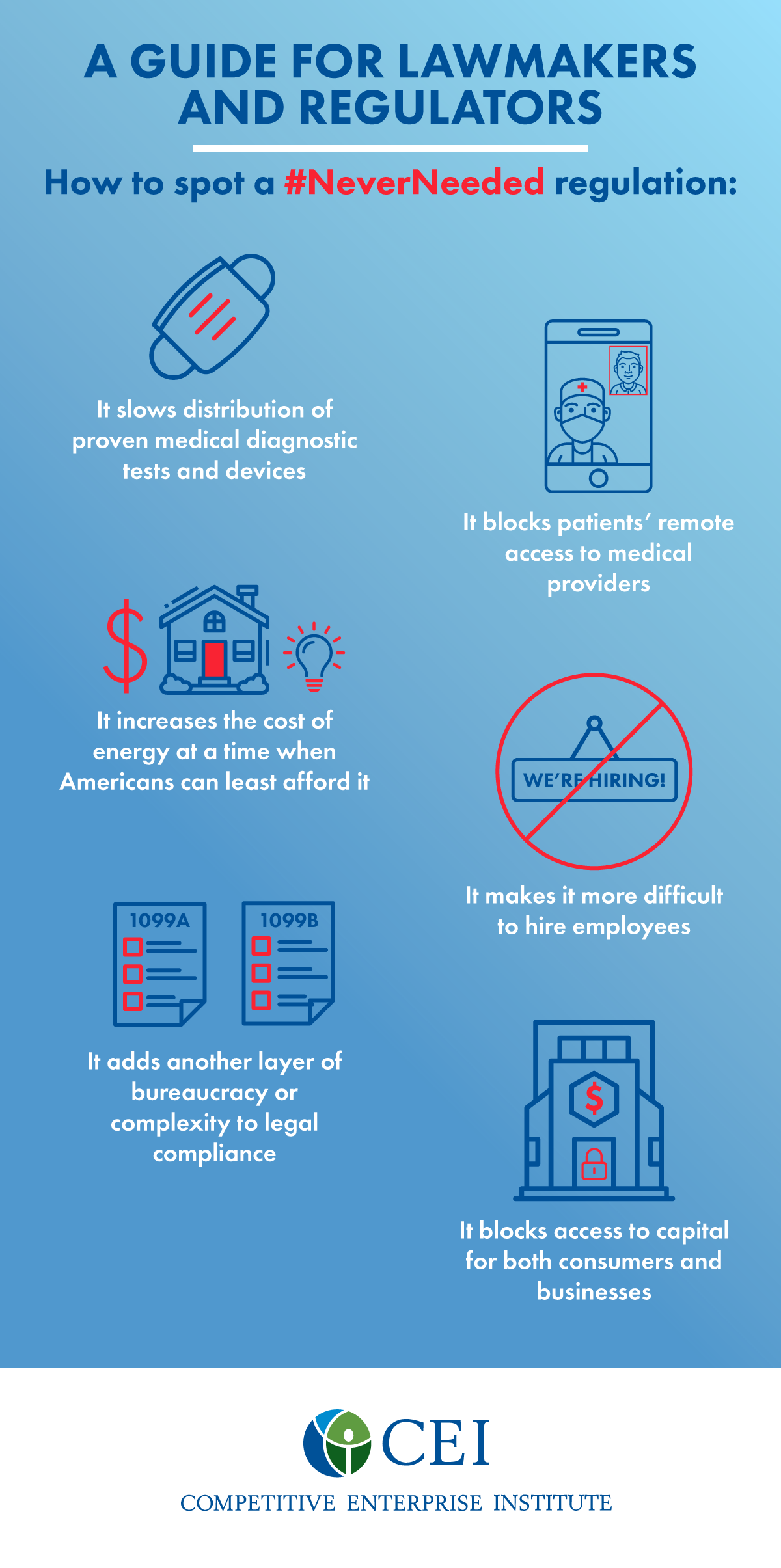
How to Spot a #NeverNeeded Regulation

Regulatory reform is one of the most important weapons there is for fighting COVID-19 and for aiding the economic recovery after the worst passes. But with 1.1 million regulatory restrictions and 185,000 pages of rules at the federal level alone, where should policy makers start? This handy infographic shows policy makers and regulators what to look for. If a rule meets one or more of these guidelines, it is probably a #NeverNeeded regulation.

  • It slows distribution of proved medical diagnostic tests and services.
  • It blocks patients’ remote access to medical providers.
  • It increases the cost of energy at a time when people can least afford it.
  • It makes it more difficult to hire employees.
  • It adds another layer of bureaucracy or complexity to legal compliance.
  • It blocks access to capital for both consumers and businesses.

A good rule of thumb is that if a regulation isn’t needed now, during a pandemic, then it probably was never needed in the first place.

Getting rid of #NeverNeeded regulations should be a top priority for lawmakers and regulators. But it is also not enough. Regulatory sludge has been building up for decades. Federal agencies issue more than 3,000 new regulations in most years, and usually remove old or outdated rules only when forced to. Reforming the rulemaking process itself, so that it generates fewer #NeverNeeded rules going forward, will be essential to resilience against the next crisis. If net neutrality rules hadn’t been repealed, for example, people in the U.S. would have had to deal with congested, throttled networks, such as many Europeans have been dealing with. The transition to new technologies, such as telemedicine and Zoom meetings for students and workers, would have been more difficult, or even impossible.,

For more resources on identifying and reforming #NeverNeeded regulations, see neverneeded.cei.org.

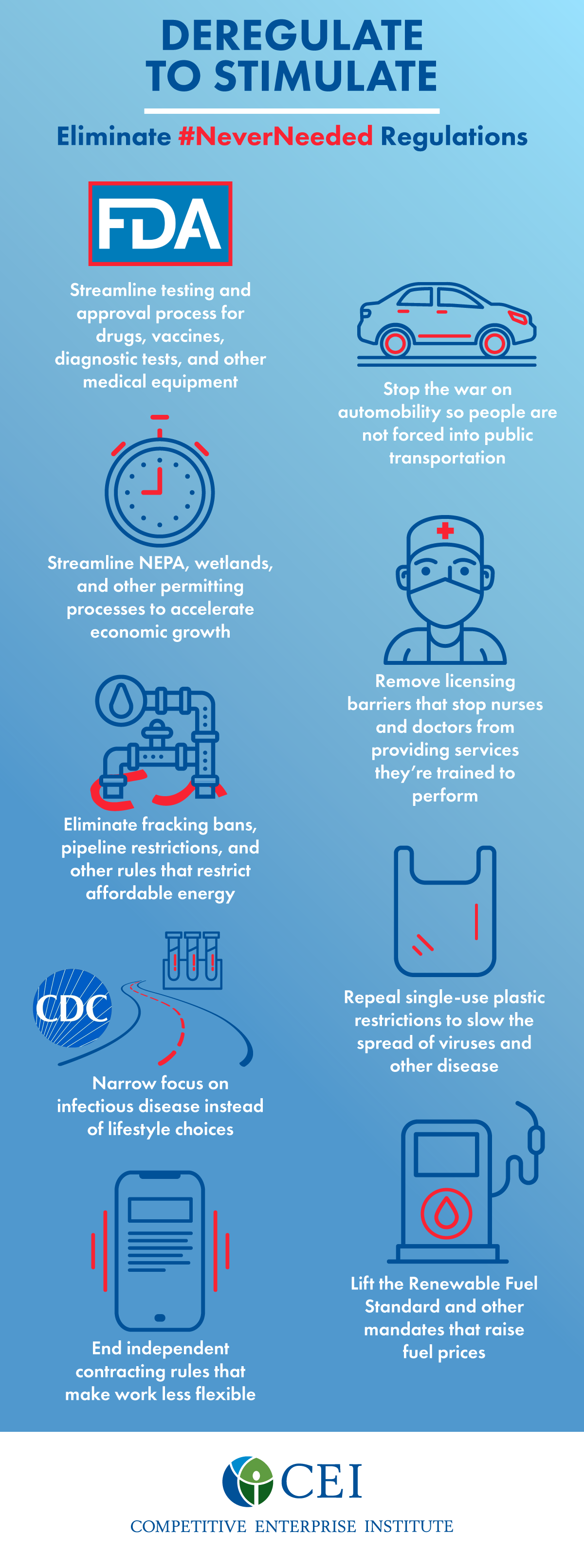
Deregulate to Stimulate: #NeverNeeded Regulations Are Harming Health and Economy

The Code of Federal Regulations contains more than 1.1 million regulatory restrictions spread out over 185,000 pages. State and local governments have additional rules. Some of those rules have a valid purpose. Many others are making the COVID-19 crisis worse than it has to be. They get in between sick people and the health care they need. They make it harder for people to keep their jobs or educate their children during lockdown. If these rules are harmful during a crisis, they were probably never needed in the first place—hence CEI’s #NeverNeeded campaign.

CEI has produced a slew of studies, events, and commentary on everything from the Center for Disease Control and Prevention’s (CDC) mission creep to the Jones Act, which makes shipping slower and more expensive. There is also the #NeverNeeded hashtag on social media, which has brought together policy experts, policy makers, activists, and media outlets.

There are a lot to important reforms keep track of, so we put together an infographic that collects in one place the most urgent #NeverNeeded regulations that need reform. These focus on fighting COVID itself, and on making the economic recovery easier once it is safe to do so:

  • First and foremost, the Food and Drug Administration needs to speed up its approval process. For the average drug, this process can take a decade and cost several hundred million dollars. COVID-19 treatments must not take this long.
  • Public transportation is not exactly conducive to social distancing. Urban planners should stop trying to shoehorn people into it with a complicated web of subsidies, taxes, building and street regulations, and more. Right now, cars are safer. When the pandemic passes, people should be allowed choose their transportation options for themselves, on the level.
  • The recent decision to liberalize the Environmental Protection Agency’s rules related to the National Environmental Policy Act was a wise one. Permitting processes and environmental inspections long ago crossed from being a reasonable precaution into a politicized, ideological weapon.
  • Doctors and nurses face licensing restrictions that keep qualified people out. Loosening them to reasonable levels would make health care more abundant and more affordable. This is good policy during good times; right now, it is essential.
  • Higher utility bills are the last thing people need when record numbers of people are on unemployment insurance and small businesses are going under at alarming rates. Restrictions on fracking and other affordable energy technologies might be a burden people can bear during a boom, but not now.
  • Some cities have already rolled back their bans on single-use plastics, such as bags and straws. More need to. Plastics are vital for sanitation and preventing the spread of diseases, including COVID.
  • The Centers for Disease Control recently spent $125 million on a campaign against vaping. This and its many other other lifestyle-focused programs left the agency distracted and underprepared for the coronavirus outbreak. The CDC should get out of the lifestyle business and focus on its core mission of controlling diseases.
  • People spend more on gas than they need to, thanks to ethanol requirements in gasoline. Economists and environmentalists agree that the program has dubious environmental benefits. Instead, it raises gas and food prices while increasing the need for farmland. That means less habitat for wildlife and less money left over for families who need to stretch every dollar during lockdown.
  • Rules that discriminate against independent contractors, such as California’s AB5 legislation, had already put thousands of people out of work before COVID-19 hit. At a time when many people, especially high-risk individuals, need to work from home when possible, AB5 and similar proposals make that difficult or impossible. Rules that harm both public health and the economy need to go.

For more reform ideas and resources, see neverneeded.cei.org.