Category Archives: Political Animals

The Politics of SpongeBob

Spongebob-squarepants
Two unrelated news stories caught my eye this morning that capture the depth of today’s political discourse. The first is a Politico story explaining, apparently in all seriousness, why SpongeBob Squarepants is becoming a Republican icon. In the name of balance, the story even includes a negative quote from Al Sharpton, presented without irony.

In the second story, a wit presented HHS Secretary Kathleen Sebelius with a copy of Websites for Dummies at an event, as a tactful reminder of the difficulties her department has had getting various insurance exchange websites to work properly.

This is why I work in policy, and not politics.

The Trouble with Federal Grants

Is summed up perfectly by Gordon Tullock:

In passing, I may note an amusing plaque which, at least some years ago, was set in the cement at the entrance to the Toledo, Ohio, airport. This plaque was a letter from President Eisenhower to the City of Toledo in which he congratulated the city on having built their airport entirely on their own without federal funds. He made it clear that he thought this was a highly meritorious, and even noble, act. In order not to raise any misunderstanding in other parts of the country, however, he then went on to say that, of course, those communities which could not provide their own airport must receive federal aid. I take it that the citizens of Toledo never again found it possible to build their own airport.”

-Gordon Tullock, “Competing for Aid,” Virginia Political Economy: Selected Works, Vol. 1, 205-6.

CEI Podcast for October 3, 2013: The Federal Shutdown

washington-united-states-capitol-washington-d-c-dc154
Have a listen here.

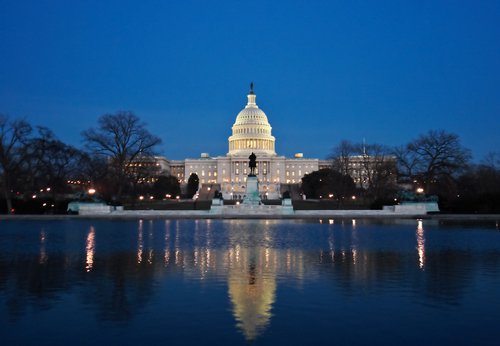
For the 17th time since 1976, the federal government has shut down over a partisan fiscal squabble. Vice President for Strategy Iain Murray gives his thoughts on how it happened, what the consequences will be, and what is at stake.

Literally True

Politico: Obama: I’m Not Cheney

Though they are very distant cousins, Barack Obama and Dick Cheney are different individuals. Unfortunately, their preferred privacy and national security policies are similar.

This is why Obama felt compelled to make a public statement that he is not, in fact, the former vice president. If you are forced to say something to that effect for PR reasons, it’s a good indication that you really are being Dick Cheney, at least regarding certain illiberal policies.

This is sad to see. When Obama was elected, I was optimistic that he would roll back some of Bush and Cheney’s post-9/11 excesses regarding civil liberties and privacy violations, security theater, and wars abroad. The last five years have proven me very wrong. Obama’s experience makes me skeptical that the next president, even if he or she campaigns as a civil libertarian, will grow into the office in a more healthy way, regardless of party.

The tragedy of 9/11, contrary to my thoughts at the time, has turned out to be a transformative event in the relationship between government and citizen. That transformation has been almost entirely negative. Despite this post’s unrelenting pessimism, I remain confident that this course will right itself someday. Transparency, and not just of the Edward Snowden variety, is an important first step in that long process.


The Median Voter Theorem Explained

There is a good reason for the time-tested presidential election strategy of candidates taking relatively progressive or conservative positions during the primaries, and then moving to the center for the general election. It’s because the way to win an election is to appeal to the median voter. In a partisan primary, that median voter is relatively ideological. But in a general election, the median voter is centrist.

This is the median voter theorem, and it plays a key role in understanding how politicians behave during election season. It explains why the two parties can be so hard to tell apart — they’re chasing after the same voter. Utah State University economics professor Diana Thomas ably explains the median voter in this short Learn Liberty video (click here if the embed doesn’t work):

New Cato Video on the IRS Scandal

Well worth five minutes of your time. Features the ACLU’s Michael MacLeod-Ball, David Keating from the Center for Competitive Politics, and Cato’s John Samples and Gene Healy (Gene’s column on the same subject is also worth reading). Click here if the video embedded below doesn’t work.

IRS Apologizes for Targeting Conservative Groups

richard nixon pointing finger
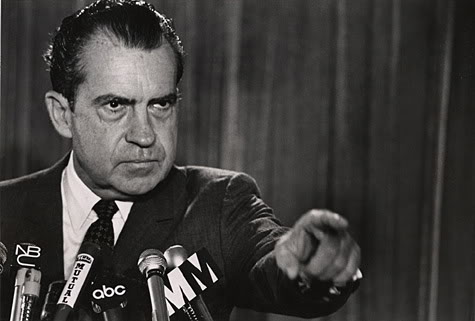
The only surprising part of this story is that the IRS apologized. Whichever party is in power, its critics can expect more IRS attention than usual. Since  the executive branch is currently run by a Democrat, tax-exempt groups with phrases like “tea party” and “patriot” in their names were targeted. But the tables turn when a Republican is president. Charlotte Twight gives a historical example on p. 271 of her book Dependent on D.C.:

Republican President Richard Nixon in 1971 expressed his intention to select as IRS commissioner “a ruthless son of a bitch,” who “will do what he’s told,” will make sure that “every income tax return I want to see I see,” and “will go after our enemies and not go after our friends.”

President Bill Clinton, a Democrat, is also alleged to have abused his position to punish political enemies.

Conservatives are right to be outraged by today’s news. But they shouldn’t be surprised by it. Nor should they direct their ire at President Obama or the IRS staffers who initiated the unnecessary investigations. They should be outraged that politics has become such a high-stakes game in the first place that officeholders view this type of behavior as a legitimate political tactic. The problem is systemic, not partisan.

Margaret Thatcher vs. Today’s GOP

I am neither a Thatcherite nor a Reaganite, but I’d still take either of them over today’s Republican Party in a heartbeat. Reflecting on Thatcher’s recent passing, Warren Brookes Fellow Matthew Melchiorre and I explore that theme in today’s American Spectator:

In pursuing what she described as an “enterprise society,” Thatcher revolutionized politics on both the right and the left. In fact, her policies were so popular with the working class its support for the Conservative Party was 51 percent higher than normal during her term, according to our calculations of polling data. Thatcher’s restoration of the Conservative Party as a credible alternative to Labour gave Tony Blair no choice but to re-brand Labour into the more market-oriented “New Labour” to win national elections again.

What can today’s Republicans learn from comparing Thatcher’s legacy with their own? The GOP’s failure to match tax cuts with spending cuts hasn’t worked — in the economy or at the ballot box. A better approach to encourage entrepreneurship would be to make real spending cuts, lighten regulation to free up access to credit, and restore government finances through a simpler tax code instead of higher rates.

Thatcher certainly earned her nickname, the Iron Lady. It is a shame that, across the board, today’s politicians are made of much more malleable material. Read the whole thing here.

Slow News Day

Washington Post: Rep. Steve Cohen to hold news conference to discuss Cyndi Lauper tweets

A Story with Neither Style nor Substance

President Obama Nominee’s ‘Ugly’ Hair Investigated