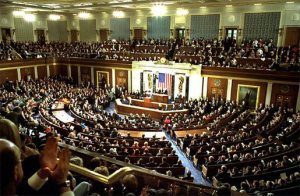
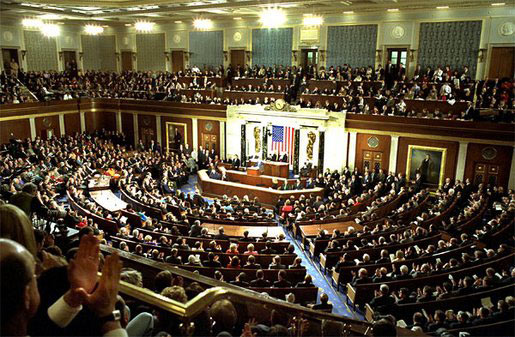
As promised, here is my live-blog of last night’s State of the Union address:
8:17 In line with recent tradition, the full text of President Obama’s speech leaked early. National Journal is hosting it – http://nationaljournal.com/whitehouse/exclusive-obama-to-declare-the-rules-have-changed–20110125
8:18 Here are excerpts from Rep. Paul Ryan’s response – http://budget.house.gov/News/DocumentSingle.aspx?DocumentID=221278
8:41 Here comes Biden. Introduced as President of the Senate, not as Vice President.
8:42 Just turned on the tv. Curious to see which Ds and Rs will be sitting together. I hear Pelosi declined Cantor’s offer.
8:47 CNN is using the music from the John Adams miniseries. Inappropriate?
8:48 If you’re bored while waiting for the speech to start, you can read last year’s State of the Union live-blog here – http://www.openmarket.org/2010/01/27/state-of-the-union-live-blog/
8:53 CNN poll – Which is more important? 78% say not cutting social security is more important than reducing the deficit. 21% say the reverse.
Remember, in a democracy, the people get what they want in the long run. This is why neither party is willing to take on entitlement reform.
8:53 Wolf Blitzer looks like he just got out of a wind tunnel.
9:00 Important People continue to file in.
9:01 The Supreme Court is front-and-center. I’m guessing there will not be a repeat of Scalia’s mouthing “that’s not true.”
9:05 There sure are a lot of Important People in Washington. They’re still arriving.
9:05 Here he is.
9:06 Much applause.
9:08 I’m guessing this is as much “face time” as most of these Congress-critters will get.
9:08 Nice acknowledgment of Coburn’s missing beard.
9:10 CNN is debating the political significance of the color of Obama’s tie. It’s not news, it’s CNN.
9:11 Here we go!
9:11 But first, much applause and many thank yous.
9:12 That’s two standing ovations already.
9:12 Hearts to you, Rep. Giffords.
9:13 Please recover quickly.
9:14 Oh, dear. He’s blaming the Tucson tragedy on partisan bickering. But it wasn’t that. It was the act of a crazy person. Tone had nothing to do with it.
9:15 “We need to work together tomorrow.”
Somehow, I don’t see this happening.
9:16 “We will move forward together, or not at all.”
Given how politicians move, let’s hope for the latter.
9:16 [Comment From KevinKevin: ]
Hello from Elyria Ohio !
9:17 Congress didn’t actually pass tax cuts in December. Tax cuts are when rates go down. Congress voted to keep them the same.
9:18 People don’t have the same job for life, anymore. A reference to the decline of American manufacturing.
9:19 One problem with that is that U.S. manufacturing output is near an all-time high.
9:19 Another is that few people want their children to grow up to be factory workers.
9:19 India! China! Scary!
9:20 “The competition for jobs is real.”
Except there isn’t a fixed number of jobs to be fought over between different countries.
9:21 Lots of talk about the future. A way of avoiding talking about the present?
9:22 “We need to out-innovate the rest of the world.” Get out of the way, then!
9:22 Curious to hear his thoughts about how he wants to make America a better place to do business.
9:23 Needs to encourage innovation. Sounds to me like an open invitation to rent-seeking and lobbying for politically popular industries.
9:23 First mention of Facebook in a State of the Union address?
9:23 [Comment From KevinKevin: ]
Blah Blah stop the bs
9:24 Ah, Sputnik.
9:24 [Comment From KevinKevin: ]
yes stop the spending Obama !
9:25 The Soviet Union launched a satellite in 1957. Therefore the federal government needs to invest in green jobs.
9:26 Yes, take money out of the economy, waste some of it on bureaucracy, then put it back into the economy. Maybe that’ll work!
9:26 [Comment From KevinKevin: ]
We need less goverment !
9:26 [Comment From KevinKevin: ]
didnt he cut NASA money ?
9:27 Kevin — don’t believe so. The shuttle program is ending soon, but budget remains the same
9:28 End oil subsidies — good! Government-sponsored innovation — yeesh.
9:28 How about ending all energy subsidies, period?
9:29 If it’s commercially viable, it doesn’t need a subsidy. If it isn’t commercially viable, no amount of subsidy will make it so.
9:29 Education.
9:30 Family rhetoric. Trying to appeal to Republicans, no doubt.
9:30 Much applause.
9:31 [Comment From KevinKevin: ]
not teachers ?
9:31 Race to the Top as meaningful reform.
9:32 Do people in Washington really know how to educate kids in California, Texas, Maine, and beyond? This is properly a state and local issue. Get the feds out of it.
9:33 Is anyone against good schools across the country?
9:33 Teachers unions have to be loving this.
9:33 Merit pay! maybe not.
9:34 100,000 new teachers, in the fields of his choice. Echoes of Clinton, except not in a good way.
9:35 Student debt for all!
9:36 I like that he’s giving two-year colleges some respect. But they are also properly state and local issues, not federal.
9:36 [Comment From KevinKevin: ]
Yes !!!!!!!!!!!!!!!!!!!!!
9:36 [Comment From KevinKevin: ]
NO jobs for teachers ! local schools are broke
9:37 Much applause.
9:37 Immigration.
9:37 Sounds good so far…
9:38 “Protect our borders.” Yeesh. Sounds like a Republican.
9:39 The best way to end the problem of illegal immigration is to make the legal channels easier, faster, and cheaper.
9:39 Prohibition doesn’t work.
9:39 Infrastructure.
9:40 Paid for by…
9:40 Good luck keeping politics out of this!
9:40 Especially with high-speed rail.
9:41 Nice pat-down joke. Please do something about those, Mr. President. They don’t make the country safer.
9:41 [Comment From KevinKevin: ]
Yes I need the votes !
9:41 [Comment From KevinKevin: ]
taxes !
9:41 [Comment From KevinKevin: ]
get the shovels its getting thick
9:42 If the government spends more on education, innovation, and infrastructure, good things will happen.
9:43 Lower corporate tax rate, with an allusion to the Laffer Curve.
9:43 Makes sense — who knows about the revenue, but U.S. corporate tax rates are now the highest in the developed world.
9:44 Not the way to encourage businesses to locate in the U.S.
9:44 Korea FTA – no specifics
9:44 I hear it may implemented by July. Let’s hope.
9:45 Increase exports! Fewer goods and less direct foreign investment for all!
9:45 Ah, regulation.
9:45 They are why food is safe and air is clean. I’d wager that wealth has more to do with it.
9:46 Child labor laws didn’t hit the books until that vile practice was well in decline.
9:46 Ditto with Clean Air Act, Clean Water Act, etc.
9:46 The health care bill. The elephant in the room.
9:47 The reactions are very partisan.
9:47 Anecdote!
9:47 Another anecdote!
9:47 How about some data?
9:48 “Fix what needs fixing, let’s move forward.” Curious as to his definition of what needs fixing.
9:48 National debt.
9:48 Blames Bush for beginning the spending binge. Right on.
9:49 Not sustainable. Quit sustaining it, then! His presidency has been Bush’s third term in almost every respect.
9:49 Spending freeze.
9:49 $40 billion per year. That’s roughly 1 percent of federal spending.
9:50 Deficit is something like 25%+ of federal spending. Try harder, please.
9:50 Curious to see how fast people spin this into spending cuts.
9:50 Oh wait, he just did.
9:51 A cut is when spending goes down. He is proposing that 12% of the budget stay the same, while the rest continues to increase.
9:51 [Comment From KevinKevin: ]
never going to happen
9:51 [Comment From KevinKevin: ]
Lip service !!!!!!!!!!!!
9:51 [Comment From KevinKevin: ]
more TAXES !!!!!!!!!!!!! lost jobs!!!!!!!
9:51 Taxes.
9:52 Reduce Medicare and Medicaid? Don’t see this happening in the current political environment.
9:52 Medical malpractice reform to rein in frivolous lawsuits. Much applause. Rightfully so!
9:53 Bi-partisan solution to Social Security reform. In other words, punt it down the road.
9:53 Distrusts IRAs, apparently.
9:53 Not just personal accounts.
9:54 Millionaire tax break equals taking scholarships away from children. How about reducing spending on frivolities?
9:54 Simplify the tax code. Yes! If only either party had any interest in this.
9:55 Government should be affordable, competent, and efficient.
9:55 Brave stance.
9:55 Nice job poking fun at salmon regulations!
9:55 [Comment From KevinKevin: ]
how many jobs is the health care reform making ?
9:56 Sell off unused federal real estate.
9:56 “I will send a vague proposal to Congress in the near future.”
9:57 People need to believe in their government.
9:57 Good transparency rhetoric. Put it online.
9:57 Earmark ban! I’m guessing the definition of ‘earmark” will change, or else Congress will be, shall we say, less than cooperative.
9:58 [Comment From KevinKevin: ]
BLAH BLAH !!!!!!!!!!!
9:58 Foreign policy. New threats could emerge at some point! EVERYBODY PANIC
9:59 [Comment From KevinKevin: ]
God bless the troops !
9:59 [Comment From KevinKevin: ]
get them HOME !!!!!!
9:59 Right on, Kevin.
10:00 Armies can fight wars. but they can’t build nations.
10:01 Don’t hate Muslims. Blame the individual, not the ideology. Hopefully this is widely heeded. Sound advice.
10:02 Congress likes it when he gets belligerent towards foreigners.
10:03 [Comment From ChrisChris: ]
I’ll believe the part about N Korea abandoning nukes when I see it.
10:04 South American tour. Hopefully this means action on the Colombia and Panama free trade agreements?
10:06 Democracy for all! I hope he realizes that freedom and democracy are not the same thing. They often correlate. But they are not the same thing.
10:07 Sounds like he wants to spend more on defense.
10:09 Franken looks bored.
10:09 He is not alone.
10:10 Constitutional rhetoric.
10:11 Biden and Boehner are quite the pair.
10:11 Anecdote!
10:11 [Comment From GuestGuest: ]
McCain applauds like there is no tomorrow.
10:12 [Comment From ChrisChris: ]
This seems like it’s falling flat.
10:14 Just like last year, this was a long one. Much applause.
10:15 On to Rep. Paul Ryan’s response.
10:21 This will be an important speech for Paul Ryan.
10:24 His style is policy-heavy. I don’t always agree with his voting record, but here’s hoping he stays true to form. Policy is far more important than rhetoric, even if it is less glamorous.
10:25 It also helps that President Obama takes him seriously, even when they disagree.
10:25 Here he is.
10:25 Oops, they cut out his first few words.
10:26 Nice words about Tucson.
10:26 Necessary. But get on with it.
10:27 House as cut its own budget. Nice symbolism,but small potatoes.
10:27 Debt is growing.
10:27 “No economy can sustain such levels of spending and taxation.”
10:28 It’s a bipartisan problem. Yes. See the Bush years as well the Obama years.
10:28 Obama has increased domestic spending by 25%, added $3 trillion to the debt.
10:29 Doesn’t like the health care bill. It will increase costs.
10:29 Washington should not pick winners and losers.
10:29 Regulatory reform. CEI has many, many ideas for that.
10:30 What was a challenge is now crisis. Hyperbole, but with a grain of truth.
10:30 Unlike last year, Congress will actually propose a budget.
10:31 I like his ambition, but I doubt he’ll get all he wants.
10:31 Founders rhetoric alert.
10:31 Definitely trying to appeal to conservatives.
10:32 “Individual liberty requires limited government.”
10:32 Dems want to increase government, even though it’s already at an all-time high.
10:33 But not just over the last two years. His own party is just as guilty when they hold the reins.
10:33 Transform the social safety net into a hammock.
10:33 We still have time, but not much. Cf. Greece, et al.
10:34 Day of reckoning?
10:35 Spirit of initiative should triumph over political clout. hear, hear. Too bad two major political parties disagree with him.
10:36 American exceptionalism. no, it’s actually institutional exceptionalism that has made America great.
10:36 Nice and brief!
10:36 Sometimes it’s good to be the opposition. You can be more honest, less flowery, and mercifully brief.
10:38 Well, that’s all for tonight. Thanks for following along, and thanks for your comments. My CEI colleagues will have more in-depth analysis for you tomorrow. Good night!







 Inertia Wins!