Category Archives: Political Animals

There Is Nothing Left to Cut

There are currently four living ex-presidents. All of them are wealthy. According to Politico, all of them are also accepting taxpayer largesse:

George W. Bush may have raked in $15 million from speeches alone in 2010, but he still expensed $1.3 million to taxpayers, including $80,000 in phone bills, ABC News’s Jonathan Karl reported in “Spinners and Winners.”And Bill Clinton also made it big on the speech circuit — bringing in $10 million — and billed more than $1 million in expenses to taxpayers. Jimmy Carter, meanwhile, received over half a million in expenses, including $15,000 for postage, and taxpayers also paid $830,000 for George H.W. Bush.

Entitlement reform is what it will ultimately take to balance the books, and should be one of Congress’ highest priorities. But wasteful spending such as George W. Bush’s phone bill should be reined in, too. Fortunately, a bill from Rep. Jason Chaffetz would end taxpayer giveaways to ex-presidents with incomes over $400,000 per year.

“Politics Is Weird. And Creepy.”

I have little love for Fox News, or for cable news in general. But Shepard Smith is both hilarious and spot-on in this 30-second clip. Click here if the embedded video doesn’t work.

In Which Penguins Earn My Admiration and Respect


Politico: Newt Gingrich bitten by a penguin

In Which I Actually Agree with Sen. Orrin Hatch

Sen. Hatch, on libertarians, in a recent NPR interview:

“These people are not conservatives. They’re not Republicans,” Hatch angrily responds. “They’re radical libertarians and I’m doggone offended by it.”

Then Hatch, a former boxer, turns combative. “I despise these people, and I’m not the guy you come in and dump on without getting punched in the mouth.”

Given how offended I am by his big-government establishment conservatism, glad to see the feeling is mutual.

Van Jones, Meet Sun Tzu

Sun Tzu’s most famous advice in The Art of War is to know your enemy. Van Jones, in a recent speech excoriating libertarians, proved that he does not.

For one, he believes libertarians are “anti-immigrant, bigots.” He must be unaware that libertarians favor open immigration. This doesn’t bode well for his argument. The Huffington Post‘s Radley Balko tweeted, “Dear Van Jones: I’m a libertarian. I’m for open immigration. You support Obama. Last year, he set the all-time US record for deportations.”

If Jones is pro-immigration, he’ll find a lot to like about the work that libertarian groups like CEI and Cato have been putting out for years (see here, here, and here). And he’ll also be more critical of both parties for their stances on the issue.

He must also not know that you can’t be a libertarian and a bigot at the same time. It’s a logical impossibility. Libertarians are individualists. Bigotry is a crude form of collectivism. Bigots also tend not to favor liberalizing immigration.

Jones also argued that libertarians are homophobic. He must not know that libertarians are strong supporters of gay rights, including gay marriage (see here, here, and here, for starters). People who actually are bigoted against gays, such as Rick Santorum, are in fact openly critical of libertarianism.

Van Jones was never on my radar even when he was regularly in the news; he made it clear early on that he is not a serious thinker. This post marks the first time his name has appeared in this blog. And it will probably be the last. But his errors demand correction, not least because they are so common.

Think about it for a minute. Can you really imagine radical anti-government ideologues arguing for more government control over immigration and marriage? Me neither. This is pretty basic stuff. And he got it dead wrong.

The reason is that Jones has the bad cognitive habit of taking everything he disagrees with and simply giving it the name “libertarian” (or progressive, or conservative; all sides fall for the same fallacy). If Jones wants to argue against libertarianism, he would do much better to argue against positions that libertarians actually take.

The most effective thinkers and activists are the ones who at least try to pass the ideological Turing test. That’s really just a fancy way of saying, as Sun Tzu does, to know your enemy. That Jones has clearly taken no such trouble speaks volumes.


Are Republicans Learning Tolerance?

Tolerance is a virtue. And many Republicans do not practice that virtue when it comes to gay people and foreigners. It’s a big reason why under-30 voters went 66 percent for Obama in 2008. Sensing political reality, it looks like the GOP is starting to come around. They’re not there yet — not even close — but maybe one day they will be. Baby steps.

A Politico article describes the GOP’s small, tentative about-face on same-sex marriage:

It’s not like the GOP has become a bastion of progressiveness on gay rights, but there has been an evolution in the political approach — and an acknowledgment of a cultural shift in the country. Same-sex relationships are more prominent and accepted. There are more gay public figures — including politicians — and it’s likely that many Washington Republicans have gay friends and coworkers. Just as important — there’s also a libertarian streak of acceptance on people’s sexuality coursing through the House Republican Conference.

I think it was Radley Balko who pointed out that in twenty years’ time, almost everyone who today opposes gay marriage will be for it, and will be embarrassed by their former hostility. It’s a long process. In the short run, I think politics are trumping any imaginary libertarian streak:

But there’s also a political strategy at work: The economy has displaced moral issues in today’s politics. Ask most House Republicans today if they have deep convictions about gay relationships, and it hardly registers.

This lighter approach is an international phenomenon. Over in the UK, the Conservative Party is actually outflanking Labour by proposing legalizing same-sex marriage nationwide.

Conservative hostility to immigration is another electoral loser, and the GOP seems to be discovering a little tolerance there, too. Sen. Marco Rubio, himself the son of Cuban immigrants, is on board with the DREAM Act, which would offer legal residency to undocumented immigrants who satisfy certain conditions (the bill is actually a mixed bag instead of an unmitigated good; more information in this podcast).

I don’t see the entire party coming around on either issue anytime soon, but it’s good that there glimmers of hope here and there. May they become more frequent.

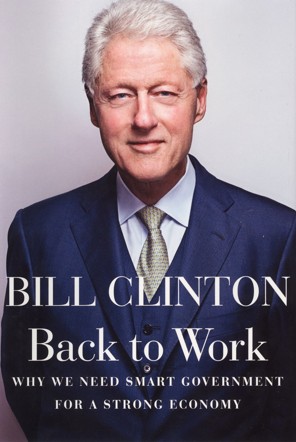
Back to Work


Over at RealClearPolicy, I review Bill Clinton’s latest book, Back to Work.

One of the book’s main themes is contrasting the philosophies of “you’re on your own” and “we’re all in this together.” This is, of course, a false dichotomy.

This immediately made me think back to that bible of “you’re on your own” free-market thought, Adam Smith’s The Wealth of Nations. It spends over 1,000 pages proving that if man were on his own, he would starve. People need to cooperate and exchange to prosper. Free trade, division of labor, and other Smithian concepts are inherently “we’re all in this together.” People can only achieve great things by working together. I have yet to see anyone actually argue “you’re on your own,” ever.

The review is mostly about the book’s philosophy and rhetoric. I have further thoughts about its suggested economic policies, which I will post about soon.

Why Does Santorum Oppose Cross-Party Voting?

I don’t often play political analyst. I’m more interested in actual policy issues, and I don’t prefer one party over the other. But it’s fun to do now and then. So here’s why I think Rick Santorum is wrong to oppose open primaries that states like Michigan have.

In an open primary, people don’t have to be Republicans to vote in a Republican primary. Independents and Democrats can vote, too. Closed primaries exclude non-party members from voting in a given party’s primary.

Rick Santorum’s goal is to win the GOP’s presidential nomination. He will not be getting this blog’s endorsement, to understate the case. But I’ll give him some free advice anyway.

Santorum’s social issue stances are, to be polite, polarizing. That makes him an easy general election kill; he doesn’t appeal to independents or Democrats. That gives independents, and especially Democrats, an incentive to vote for Santorum in the primaries, at least in open-primary states where the rules allow it. A Santorum-Obama contest will probably end in Obama’s favor.

So if Santorum wants the nomination, and at least a small shot at the White House, he should court hostile voters in open-primary states like Michigan.

Romney, for his many faults, probably has the best shot of winning a general election of anyone in the GOP field. That means Democrats want him to lose, and someone polarizing like Santorum to win. They’ll turn out for Santorum, if only he’d ask them to. That’s probably his best shot at winning something most people would rather he wouldn’t.

It’s a cynical strategy. Then again, politics is nothing if not applied cynicism.

UPDATE: Looks like the Santorum campaign didn’t need any prompting from me. Turns out they’ve been doing robocalls.

Feel-Good Headline of the Day

Politico: Congress set for do-nothing year

Rising Voter Apathy

I don’t always agree with Peggy Noonan — and I certainly disagree with much of what she writes in her column today — but she makes a good point about why voter turnout and cable news ratings are down in this election year:

Maybe the story the political class is missing is not “They don’t like the Republican field,” or “They don’t like Obama.” Maybe the story is that people are tuning out altogether. Maybe they’re bored with politics, and most especially with politicians. Maybe they don’t think our government can’t (sic) solve anything. Maybe, even, our political class has done such a good job depicting the crisis we’re in that the American people, with their low faith in institutions, think nothing, really, can be done about it. So let’s check out. Let’s watch the game.

Businesses that treat their customers as badly as the Republican and Democratic parties treat theirs tend to go out of business. This may be exactly what we’re seeing.