Politico: @PaulRyansMom is not Paul Ryan’s mom
Twitter strikes again.

Politico: @PaulRyansMom is not Paul Ryan’s mom
Twitter strikes again.
Comments Off on Slow News Day
Posted in Elections, Political Animals
Revolving-door veteran Peter Orszag, formerly of OMB and currently of Citigroup, proposes making voting mandatory in a piece over at Bloomberg.
Some poll results show why this is a bad idea:
In short, the median voter in America is a boob.
And the median voter is precisely who decides elections. Politicians, at least successful ones, must pander to people who have roughly the same politico-economic acumen as my cats. Hence the slew of unwise policies in both the Republican and Democratic party platforms.
Keep in mind that the least educated people are also the least likely to vote. Mandatory voting, by bringing the uneducated to the polls, would make the median voter an even bigger boob than he already is. This could well lead to even worse policy outcomes than we have now.
But consequentialism isn’t all there is to it. There is also the principle of the thing. This is a free country. Voting is a choice, not a duty or an obligation. People should be able to choose for themselves whether or not to vote. Peter Orszag shouldn’t make that decision for you.
Posted in Elections, Political Animals
When votes are at stake, truth takes a distant second to electoral success. This was just as true in Benjamin Constant’s 1815 as it is in our 2012:
“Everyone is more concerned to hit hard than accurately.”
-Benjamin Constant, Principles of Politics Applicable to All Governments, p. 4.
Comments Off on Politics 101
Posted in Elections, Pith, Political Animals, Public Choice
I have little love for Fox News, or for cable news in general. But Shepard Smith is both hilarious and spot-on in this 30-second clip. Click here if the embedded video doesn’t work.
Comments Off on “Politics Is Weird. And Creepy.”
Posted in Elections, Media, Political Animals
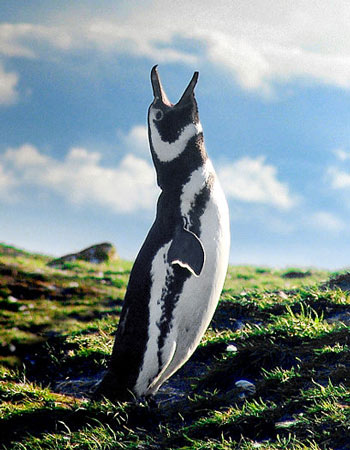
Politico: Newt Gingrich bitten by a penguin
Posted in Elections, General Foolishness, Political Animals
I don’t often play political analyst. I’m more interested in actual policy issues, and I don’t prefer one party over the other. But it’s fun to do now and then. So here’s why I think Rick Santorum is wrong to oppose open primaries that states like Michigan have.
In an open primary, people don’t have to be Republicans to vote in a Republican primary. Independents and Democrats can vote, too. Closed primaries exclude non-party members from voting in a given party’s primary.
Rick Santorum’s goal is to win the GOP’s presidential nomination. He will not be getting this blog’s endorsement, to understate the case. But I’ll give him some free advice anyway.
Santorum’s social issue stances are, to be polite, polarizing. That makes him an easy general election kill; he doesn’t appeal to independents or Democrats. That gives independents, and especially Democrats, an incentive to vote for Santorum in the primaries, at least in open-primary states where the rules allow it. A Santorum-Obama contest will probably end in Obama’s favor.
So if Santorum wants the nomination, and at least a small shot at the White House, he should court hostile voters in open-primary states like Michigan.
Romney, for his many faults, probably has the best shot of winning a general election of anyone in the GOP field. That means Democrats want him to lose, and someone polarizing like Santorum to win. They’ll turn out for Santorum, if only he’d ask them to. That’s probably his best shot at winning something most people would rather he wouldn’t.
It’s a cynical strategy. Then again, politics is nothing if not applied cynicism.
UPDATE: Looks like the Santorum campaign didn’t need any prompting from me. Turns out they’ve been doing robocalls.
Comments Off on Why Does Santorum Oppose Cross-Party Voting?
Posted in Elections, Political Animals
Tagged cynicism, michigan primary, politics, rick santorum, santorum, santorum michigan
I don’t always agree with Peggy Noonan — and I certainly disagree with much of what she writes in her column today — but she makes a good point about why voter turnout and cable news ratings are down in this election year:
Maybe the story the political class is missing is not “They don’t like the Republican field,” or “They don’t like Obama.” Maybe the story is that people are tuning out altogether. Maybe they’re bored with politics, and most especially with politicians. Maybe they don’t think our government can’t (sic) solve anything. Maybe, even, our political class has done such a good job depicting the crisis we’re in that the American people, with their low faith in institutions, think nothing, really, can be done about it. So let’s check out. Let’s watch the game.
Businesses that treat their customers as badly as the Republican and Democratic parties treat theirs tend to go out of business. This may be exactly what we’re seeing.
Comments Off on Rising Voter Apathy
Posted in Elections, Political Animals
Tagged peggy noonan, voter apathy, voter turnout
The two political parties have only so much money to spend on campaigns. Dollars spent on one race cannot be spent on another. They have to prioritize important campaigns, even if that means conceding others.
That’s why, if I were a partisan Democrat, I would be upset with my party over the recall elections in Wisconsin. Millions of dollars are being taken away from close races around the country to go towards unseating a governor who will be up for re-election in two years anyway.
The recall may well succeed; one measure of enthusiasm is the roughly one million signatures on the recall petition, twice what was needed. But the most this expensive campaign would buy is two years in the governor’s mansion.
And this campaign will be spectacularly expensive. Labor interests view their livelihood as being at stake. That’s hyperbole in my opinion, but people do feel that way. And they will be pouring millions into the race. Tempers are running high, and strategists for the blue team have to be disappointed that so many on their side have lost theirs.
Activists are so passionate about unseating Walker that they fired before they aimed. There is no Democratic candidate to unify behind, giving Republicans a built-in advantage. Not only will there be a bruising (and expensive) primary, but many Democratic voters will be on the wrong side of the enthusiasm gap if their preferred candidate loses the primary or the nominee has low name recognition.
No one knows how it will play out yet. But even if it succeeds, this particular temper tantrum could well cost Democrats a few Congressional seats. Maybe even the White House, if it takes enough resources away from the ground game in swing states.
Posted in Elections, Political Animals
Tagged recall walker, scott walker, walker recall, wisconsin recall, wisconsin recall elections
Nick Gillespie and Matt Welch point out that duopolies rarely endure because they tend to abuse their customers. That creates an opening for competitors to enter the market.
Political markets are different than economic ones, but duopolies still have many of the same qualities — particularly regarding customer abuse. That’s why I was pleased to see a writeup in this morning’s Politico that the percentage of political independents is at an all-time high in a long-running Gallup poll. A full 40 percent of Americans have now opted out of the Republican-Democrat duopoly.
Comments Off on The Dying Duopoly
Posted in Elections, Political Animals, The Partisan Mind
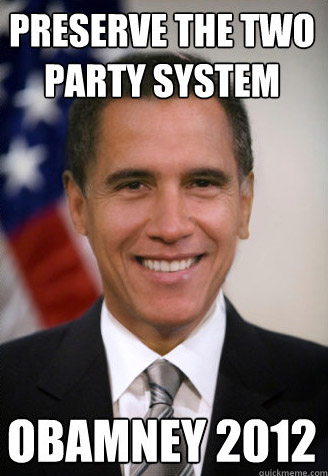

 Inertia Wins!