Category Archives: Philosophy

The Origins of Envy

A bit of good advice from p. 259 of Rolf Dobelli’s delightful book The Art of Thinking Clearly:

Like all emotions, envy has its origins in our evolutionary past. If the hominid from the cave next door took a bigger share of the mammoth, it meant less for the loser. Envy motivated us to do something about it. Laissez-faire hunter-gatherers disappeared from the gene pool; in extreme cases, they died of starvation, while others feasted. We are the offspring of the envious. But, in today’s world, envy is no longer vital. If my neighbor buys himself a Porsche, it doesn’t mean that he has taken anything from me.

When I find myself suffering pangs of envy, my wife reminds me: “It’s okay to be envious–but only of the person you aspire to become.”

A Lesson in Humility

An important bit of wisdom from p. 25 of Rolf Dobelli’s The Art of Thinking Clearly:

There are about one million trained economists on the planet, and not one of them could accurately predict the timing of the 2008 financial crisis (with the exception of Nouriel Roubini and Nassim Taleb), let alone how the collapse would play out, from the real estate bubble bursting to credit swaps collapsing, right through to the full-blown economic crunch. Never has a group of experts failed so spectacularly. The story from the medical world is much the same: Up until 1900 it was discernibly wiser for patients to avoid doctor’s visits; too often the “treatment” only worsened the illness, due to poor hygiene and folk practices such as bloodletting.

The lesson to be learned is a familiar one: beware the rule of experts. No matter how clever you are, be a student of society. Don’t try to be its savior. That is well beyond any one person.

The Limits of Human Understanding

The knowledge problem is more than a pet theory among economists. It is a biological fact:

[T]he capacity of any explaining agent must limited to objects with a structure possessing a degree of complexity lower than its own. If this is correct, it means that no explaining agent can ever explain objects of its own kind, or of its own degree of complexity, and, therefore, that the human brain can never fully explain its own operations.

-F.A. Hayek, The Sensory Order, 185.

This implies that the human brain is therefore incapable of fully understanding society, currently comprised of more than 7 billion separate human brains–none of which can fully understand themselves, not to mention their 7 billion colleagues.

The Sensory Order is a work of theoretical psychology. But it has very clear empirical implications for economics, not to mention policymakers and regulators. Think of this limitation as a reason why the law of unintended consequences continues to have so many real-world examples.

Great Insults from History

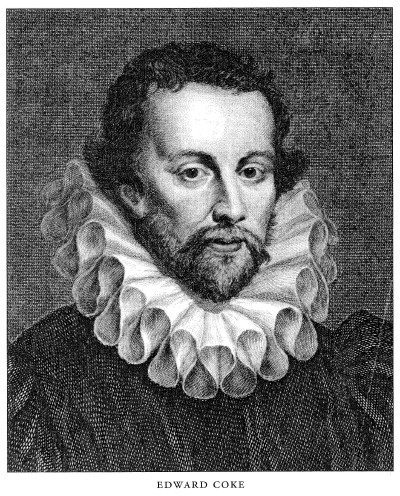
edward coke
Francis Bacon and Edward Coke were intellectual rivals. Bacon was a father of the scientific method, and a hero to top-down engineering types. Coke was more from the bottom-up evolutionary common law tradition. When Bacon presented a copy of his New Organon to Coke, Coke inscribed this couplet on the title page:

It deserveth no to be read in Schooles
But to be freighted in the ship of Fooles

(F.A. Hayek, The Trend of Economic Thinking, 72.)

How to Shut Off a Great Debate

Aaron Ross Powell has an excellent, thought-provoking  post over at libertarianism.org on how many of classical liberalism’s opponents tend to argue against libertarian caricatures that have very little to do with the real thing. This talking past one’s target instead of to it hurts both sides. Progressive and conservative thinkers would benefit from testing their ideas against quality opponents. And libertarians/classical liberals are unfairly tarred. Ad hominem attacks are getting in the way of what could be an enlightening intellectual discussion for everyone involved.

Aaron held his fire to one common attack fallacy, that state equals society. But there are more. One of them has been around for at least 80 years, when Hayek made his first public lectures in the 1930s at the London School of Economics. One of those lectures later became the title chapter of volume 3 of his collected works, The Trend of Economic Thinking. His familiar lament appears on pp. 14-15 of that book:

 No serious attempt has ever been made to show that the great liberal economists were any less concerned with the welfare of the poorer classes of society than were their successors. And I do not think that any such attempt could possibly be successful.

Instead, (classical) liberal apathy towards the poor is simply assumed. The argument can be summarized as follows:

  1. The primary concern of many progressives is helping the poor.
  2. Libertarians tend to favor different economic policies than progressives.
  3. Therefore, libertarians do not care about the poor. QED.

This is not a rigorous argument. Steps 1 and 2 are mostly true. But an Olympic-caliber long jumper couldn’t make the leap to step 3. It denies the possibility that the two sides simply prefer different means to similar ends.

This is a shame. There is a wonderful debate just waiting to be had on a number of fronts. Are the poor better served by letting economic processes emerge from the bottom up, or by expertly managing the economy from the top down? Which focus is more important to bettering the lot of the poor, absolute poverty or relative poverty? Is it better to approach the economy as a biologist, seeking merely to understand evolving market processes, or is it better to be an engineer, with an aim to tinker, fix, and improve specific outcomes?

Classical liberals tend to prefer the first answer to each of those questions; progressives tend to favor the second answer to each. But to the extent that the two sides engage each other at all, it tends to be of roughly the same tenor and quality as the “they don’t care about the poor” argument outlined above. An honest debate requires the end of such reflexive ad hominem attacks.

Adam Smith himself, painted by people who haven’t read him as the ultimate atomist individualist, based his whole defense of free markets on his belief that they would bring the masses out of poverty and into prosperity. This was his highest priority. His belief in the deep interconnectedness of people across the world, brought together by our shared natural tendency to truck, barter, and exchange, is also why economics is inherently a social science.

But reading Adam Smith can be a chore, which is why few people bother. Let’s look instead at the raw data, as provided by Jim Gwartney and many others in the annual Economic Freedom of the World report. They find that, in absolute terms, poor people are far less poor in relatively free-market countries than in more controlled economies.

This opens up an entirely new area for honest intellectual debate. Nothing close to a pure free-market economy exists on Earth. So is this free-market prosperity due to the free-market elements that do exist, or is it due to the mixed economy’s more constructivist elements? To my knowledge, this debate has not happened. This is largely because of thought-closing fallacies such as Powell takes on in his post, and the ones I discuss here and elsewhere.

Utilitarianism vs. Natural Rights

Most classical liberals use a combination of utilitarianism and natural rights in their philosophical framework. Some, like Jeremy Bentham, reject rights altogether in favor of a purely “greatest good for the greatest number” approach. This is all well and good, except for the fact that it is impossible to calculate a person’s utility function.

Even if you could, you can’t meaningfully compare different people’s utility functions to each other. You can make ordinal comparisons (order of preference), but not cardinal (strength of preference) comparisons. This throws a rather large wrench into the pure utilitarian enterprise.

Bentham’s faux pas led to a Hayekian riposte from the mid-18th century philosopher and theologian Bishop Butler, shared by George H. Smith on page 155 of his excellent new book The System of Liberty:

Bishop Butler expressed a similar concern when he said that although God is probably a utilitarian, it is better that men not be, for they are likely to commit serious errors in calculating what will promote the greatest happiness for the greatest number.

Certainty with a Capital C

One criticism I face fairly often is the assertion that I must be dishonest — I must be cherry-picking my evidence, or something — because the way I describe it, I’m always right while the people who disagree with me are always wrong. And not just wrong, they’re often knaves or fools. How likely is that?

But may I suggest, respectfully, that there’s another possibility? Maybe I actually am right, and maybe the other side actually does contain a remarkable number of knaves and fools.

Paul Krugman

Evidence of a closed mind. Always such a sad thing to see.

Not the Strongest Argument for Income Equality

From Gordon Tullock’s 1986 essay “Industrial Organization and Rent Seeking in Dictatorships,” in particular on p.124 of Vol. 5 of his collected works, The Rent-Seeking Society (footnote omitted):

I have currently been reading a series of articles in The Washington Post in which a communist official in Vietnam is quoted as saying that their society is stabler than other South East Asian countries’ because although it is extremely poor, the poverty is evenly spread. The reporter clearly thought this was a significant argument.

Odd though this thinking is, it is also common. I humbly submit that it is more humane to be concerned with how to better the lot of the poor, rather than the mathematical ratio between the poor and the wealthy. This is literally the difference between caring about people versus numbers.

Everyone Is an Anarchist, Sometimes

Ben Powell makes a great point:

Consider Cambodia in the late 1970s. The Khmer Rouge government intentionally killed more than two million of its own citizens. That’s an average of eight percent of the population killed each year while government simultaneously inflicted countless other horrors. Do you think the Cambodian people, faced with that government, would have been better off with no government at all? Congratulations. You are, sometimes, an anarchist.
When a state is as purely predatory as it was in Cambodia and many other places during the 20th century, even a worst-case Hobbesian war of all against all would seem more humane.

John Locke Anticipates Public Choice

While James Buchanan’s simple insight that politicians are just as self-interested as the rest of us may have shocked the economic discipline, it strikes the rest of humanity as simple common sense. John Locke, writing well before the rise of Samuelson and Nordhaus, shows such common sense towards the beginning of chapter 12 of his Second Treatise:

And because it may be too great a temptation to human frailty, apt to rasp at power, for the same persons, who have the power of making laws, to have also in their hands the power to execute them, whereby they may exempt themselves from obedience to the laws they make, and suit the law, both in its making, and execution, to their own private advantage, and thereby come to have a distinct interest from the rest of community, contrary to the end of society and government: therefore in well-ordered commonwealths, where the good of the whole is so considered, as it ought, the legislative power is put into the hands of divers persons, who duly assembled, have by themselves, or jointly with others, a power to make laws, which when they have done, being separated again, they are themselves sunject to the laws they have made; which is a new and near tie upon them, to take care, that they make them for the public good.

That incredibly long sentence says two things, and both of them are true: legislators act in their own interest, and we should design our political institutions with that in mind to minimize the harm they can do. Buchanan would agree on both fronts.