Category Archives: Philosophy

Robert Reich Gets It

robert_reich

Some of the consequences of increasing government’s role in health care are easy to predict. One is that cutting costs requires cutting the amount of care. That means rationing. People judged not deserving of care would be denied it.

Another is that if government uses its increased bargaining power to lower drug prices, there will be less money for R&D. That means less innovation. That could well mean the end of increasing life expectancies.

Some people see these consequences and oppose more government in health care (I refuse to call President Obama and Congress’ proposal a reform; that word implies improvement). Others see those same consequences as reasons for supporting proposed legislation.

Today’s issue of OpinionJournal’s Political Diary (requires paid subscription) shows that Robert Reich, who supports government-run health care, realizes its effects on rationing and innovation, supports it anyway, and said so in a public speech at UC Berkeley in 2007.

Mr. Reich told the Berkeley youngsters: “You — particularly you young people, particularly you young healthy people — you’re going to have to pay more. And by the way, if you’re very old, we’re not going to give you all that technology and all those drugs for the last couple of years of your life to keep you maybe going for another couple of months. It’s too expensive . . . so we’re going to let you die'”

Reich goes on:

“I’m going to use the bargaining leverage of the federal government in terms of Medicare, Medicaid — we already have a lot of bargaining leverage — to force drug companies and insurance companies and medical suppliers to reduce their costs. What that means, less innovation and that means less new products and less new drugs on the market which means you are probably not going to live much longer than your parents.”

Whether you support more government in health care or not is up to you. But it is not disputable that those consequences exist. They should be factored into your opinion. Supporters of proposed legislation should acknowledge the effects of their ideas. Instead, they usually run away from them.

Kudos to Robert Reich for the intellectual honesty he displayed in his speech. More, please.

Regulation of the Day 61: Big Screen TVs – Mankind’s Doom!

bi screen tv

On November 4, California regulators may vote to ban big-screen televisions. The large sets use more energy than they would prefer.

Commissioner Julia Levin claims the ban “will actually save consumers money and help the California economy grow and create new clean, sustainable jobs.”

It is easy to imagine the ban costing tv manufacturing jobs; less so the jobs that would take their place.

Fortunately, the ban isn’t terribly enforceable. Consumers can just drive to Arizona, Nevada, or Oregon to get the kind of tv they want.

A final point on semantics: what does “sustainable” even mean, anyway? It is a meaningless buzz term, right up there with “synergy” and “paradigm.” This decade’s equivalent of “social justice.”

If anything, use of the word “sustainable” signals that a person knows not of what they speak. If you’re unable to defend a proposal on the merits, just use fashionable buzz words that poll well.

In Which My Colleague Drew Tidwell Hits a Home Run

“The increase in the world’s population represents our victory against death.”
-Julian Simon

Eloquently expressed in a minute and change.

Rose Friedman, 1910-2009

Rose Friedman died today at age 98 after a life well lived. Sincerest condolences to her family and friends from all of us at CEI.

The body of work that Milton and Rose Friedman put together over many years was one of the most influential of the 20th century. It continues to resonate in the 21st. From technical works like A Monetary History of the United States to popular works like the Free to Choose book and television series, the Friedmans made valuable contributions to economics, politics, philosophy, and, most importantly, human freedom.

Milton got most of the credit, and the Nobel prize. But even works without Rose’s name next to Milton’s on the cover bear her stamp. They were a team.

I had the opportunity to meet Mrs. Friedman and her husband when I was about 22. I was reading Capitalism and Freedom at the time. Both were kind enough to sign it. The gesture was almost meaningless to them — just a few scribbles on the title page — but not to me. Both of the Friedmans were kind, gracious, and took seriously what an unaccomplished nobody like me had to say, even though they certainly didn’t have to.

The sincere interest the Friedmans took in young people has assured that their ideas will not be forgotten by the next generation. The world could use more people like Rose Friedman. Especially now that the original is lost to us.

Economic Hubris

The failure to predict the current economic crisis has lowered the public’s esteem of economists, as The Economist makes plain. The hit to our reputation is well-deserved.

This is not to sell economics short. The explanatory power of the economic way of thinking is incredible. Reading and understanding Bastiat’s “What Is Seen and What Is Not Seen” will change the way you see the world.

Knowing what opportunity costs are, and that incentives matter, allows you to almost literally see the unseen. It is almost magical. It is the stuff of poetry.

The fact that cities of millions like Paris and New York are fed every day without fail – overfed, even – while producing almost no food themselves, and without anyone directing the process, can be explained with two words: spontaneous order.

Pretty cool. But economists, just like other mortals, cannot predict the booms and busts of the business cycle. That some have claimed this miraculous power is a sign that economists have fallen prey to hubris. Our shaming in the public eye is a direct result of overstepping our boundaries.

Turn your tv to CNBC or some other business channel. Some mystic parading as an economist will try to predict which way the stock market will move tomorrow, or which stocks are will beat the market. Nobody knows that. Nobody could possibly know that.

If a stock really is a good buy, then people will buy it, driving up its price until it is no longer a good buy. Anyone claiming they can beat the market long-term probably also has some snake oil to sell you. The fact that a few people have had inordinate success, like Warren Buffett, is an artifact of the laws of probability.

Think about it. We can’t predict if the stock market will go up or down. How can we presume to think we can understand longer-term, macro-level movements like business cycles? There are more theories than there are economists.

Still, some people have said that they understand. And they shall give unto us of their wisdom. Some of these people hold political office, or advise people who do. They are putting their theories to the test; they are finding no effect. No wonder people are thinking so ill of economists lately.

Our hubris deserves all the public scorn it gets and more. My deeply held fear is that this disdain will trickle down to from where it is deserved to where it is not deserved.

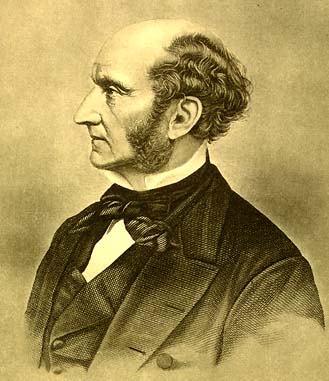
Happy 203rd Birthday, John Stuart Mill

John Stuart Mill was born on this day in 1806. He is best known for classical liberal writings like On Liberty and The Subjection of Women. College students today also learn about his philosophy of utilitarianism, inherited from father James Mill and family friend Jeremy Bentham.

Mill had an unusual life story, told in one of the most compelling autobiographies in literature. John’s father gave him an intensive education that, for example, had him reading ancient Greek at age three. John never had any formal schooling, and the only children with whom he was allowed contact were his siblings.

His father’s pedagogical experiment worked in that it gave John one of the most formidable intellects of his age. But it failed in other ways. His strict upbringing resulted in a nervous breakdown at age 20 that set him back years. He was always socially awkward, and didn’t marry until age 45 — itself an interesting story.

Mill made important contributions to economics, political science, and philosophy. A deep love of liberty runs through them all. I don’t personally agree with everything he wrote (utilitarianism leads to absurd conclusions when taken too far), but he remains one of brightest lights in the classical liberal pantheon. Happy birthday, John Stuart Mill.

(Cross-posted at Open Market)

Hubris and Humility

I’m not proud of it, but I watched most of Independence Day on the tv tonight. Worse, I actually found one of the commercials intellectually stimulating. It — probably unintentionally — touched on a profound insight into human nature.

The 30-second spot promotes a show where paranormal investigators visit haunted houses looking for evidence of supernatural activity. Unexplained noises and happenings abound.

One of the hosts said something along the lines of, whether believer or skeptic, you have to admit that we don’t have answers for everything. This is true.

The unsaid, though unsubtly-hinted-at implication was that some creepy phenomena therefore have other-worldly causes.

That’s the insight. People hate to admit not knowing something; often they would rather just make up an answer.

It takes a big man (or woman) to say, “I don’t know,” mean it, and be ok with it. There is a certain hubris built into the human psyche.

On one hand, it gives us courage. We can go up against overwhelming odds, and our disproportionate self-regard tells us, “I can overcome.” And sometimes, we do. Overconfidence does have its uses.

On the other hand, it makes us say really weird things. If I can’t explain this weird noise coming out of my basement, well, I can’t admit that! I have to say something, anything, so I don’t feel dumb. Er, uh, it must be a ghost, then!

Of course, the logic does not follow from “I don’t know” to “therefore it is a ghost.” But it sure feels good to say, “I know the answer!” And just as important, I look and feel good because of it.

We humans are strange, wonderful, and arrogant creatures. One of these days I hope to find out what makes us tick. Until then, I will grudgingly admit that I do not know.

Advice for Conservatives

Cato Institute President Ed Crane says to conservatives, you’re doing it wrong. I couldn’t agree more.

Conservatives are supposed to be the opposition to progressives. Their problem is that opposing something requires philosophical disagreement. At heart, left and right are variations of the same theme.

There are three main currents of conservative thought. All three have their progressive analogues:

Supply-side conservatives have a laser-like focus on tax cuts and economic growth. Both are good things, true. But they forgot about spending, and about philosophy. Means became ends. Hence the Reagan deficits and the Bush spending explosion.

Look at the deficits, philosophical as well as fiscal, of the new administration’s First One Hundred Days. Congress and President Obama have quickly established serious supply-side credibility.

Then there are neo-conservatives. Crane says, “All they give us is a war against a country that never attacked us and schemes for ‘national greatness’ like going to Mars.”

Not too different from progressive clarion calls for our country to unite under a common purpose, however vaguely defined. Or the push for mandatory volunteering programs, formerly known as the draft.

Finally, there are social conservatives. Often deeply religious, they can sometimes be less than tolerant of other people. They are the right-wing equivalent of the green movement.

Environmentalism is really a conservative philosophy at heart, anyway. At a fundamental level, greens want to conserve, both in the Rousseauian sense and in the Burkean sense.

Conservatives are in no shape to be a viable opposition movement. They resemble their enemy too much.

Where else to turn, then? Crane sums up his own philosophy in two sentences. “Politics is about man’s relationship to the state. That relationship, to be healthy, should be minimal.”

I think we’ve found a winner.

That’s exactly why CEI, Cato, Reason, and other classical liberal groups are so important. We see through the left-right false dichotomy, and we get the word out. Nowhere does this matter more than in a democracy. In the long run, the people get what they want, good or bad.

The last several elections have proven that in some years, people want bad conservative policies. In other years, people want bad progressive policies.

We can do better. These groups exist to see that we do.

(Full disclosure: I work at CEI, and used to work at Cato.)

Think Tanks and Tea Parties

Think tanks don’t have as much impact as they could, or should. Economists talking to each other has its uses. It is the first stage in generating ideas and trickling them down to the masses. Trouble is, in subsequent stages, those ideas tend to get lost.

Case in point: we live in a democracy. In the long run, the people get what they want. Good or bad. Looking at polling data, people tend to want bad economic policies. And that’s exactly what we’re getting.

Sound policy needs to become popular policy. Think tanks should increase their popular outreach. Going on cable news is great, but most people don’t watch cable news. Getting published in the Wall Street Journal or New York Times is great, too. But most people don’t read them.

That’s why there’s been a push toward grassroots-style activism lately. Maybe that could aid in trickling good ideas down to the masses. The tea parties that happened on tax day are only the latest example.

I would be hard pressed to find a less effective form of activism.

Many kind, sane people were there, holding up their signs and saying their peace with a quiet dignity.

They were drowned out by nuts, cranks, and assorted loons; such people are drawn to protests like moths to a flame. They make for more exciting media coverage than the average attendee. They’re louder, for one, visually and sonically. The crazies are also very good at making any event at which they appear look bad.

They hijacked an event that was supposed to be about taxes and spending. A taxing-and-spending message that I generally agree with quickly became something else entirely.

Abortion kills! End the Fed! No gay marriage! Then the conspiracy theorists. We must stop the cabal of five Jewish bankers who run the world financial system from impoverishing us all for the benefit of Israel!

Where do these people come from? They were everywhere.

It almost made me embarrassed that I favor lower taxes and spending. Are these my fellow travelers? What am I thinking?

By comparison, even the loftiest, most disengaged think tank is an effective agent of change. People do listen to economists, even if they don’t understand them. We can be taken seriously. Meanwhile protesters are politely ignored, or a nuisance.

Yes, we think tankers need to spend more time speaking to ordinary folks. A lot more time. But at least we do have some influence.

Which is better than none at all.

Clarity in the Immigration Debate

Immigration is not always the clearest of issues. Just watch the talking heads on the tv. Both sides have the maddening tendency to claim the same argument as their own — “I am for legal immigration, and against illegal immigration.”

Sounds reasonable enough. That’s probably why so many people say it in the first place. But where does that kind of thinking take us?

The quota on H1-B visas for highly skilled workers is currently 65,000 per year. Remember the pro-legal, anti-illegal argument. That requires being for 65,000 visas, and against 65,001 visas. Think about that for a minute. Isn’t that weird? 0.0015% is the difference between saying yes and no.

It gets stranger. Congress constantly changes the definition of “legal immigration.” Restrictions are tightened in one bill. Loosened in the next. Do people then change their mind every time Congress passes new immigration legislation?

This is not a rigorous line of thought. That’s why I don’t think very many people actually think that way, even if they say they do. Most people have some optimum immigration level they’d like to see. This is where the real immigration debate lies.

My preference is on the high side. For a lot of reasons, I favor letting in more immigrants. Morally and economically, in my heart and my head, that is what I believe to be right.

Others would prefer to have fewer immigrants. They have their own reasons, just as sincerely held.

Being for legal immigration and against illegal immigration may sound sane and pragmatic. Really, it is neither. It reduces a debate over the well-being of millions to semantics.

Combatants in the immigration debate should base their opinions on what they feel is just. Not on whatever happens to be legal this year.