The link is here. The speakers include my colleagues Kent Lassman, Iain Murray, and me.
For the next several weeks, there will be new online events each Tuesday featuring CEI experts on a variety of reform areas. More information is at cei.org.

The link is here. The speakers include my colleagues Kent Lassman, Iain Murray, and me.
For the next several weeks, there will be new online events each Tuesday featuring CEI experts on a variety of reform areas. More information is at cei.org.
Comments Off on CEI #NeverNeeded Panel Event Now on YouTube
Posted in #NeverNeeded, Media Appearances, Reform, regulation, Uncategorized
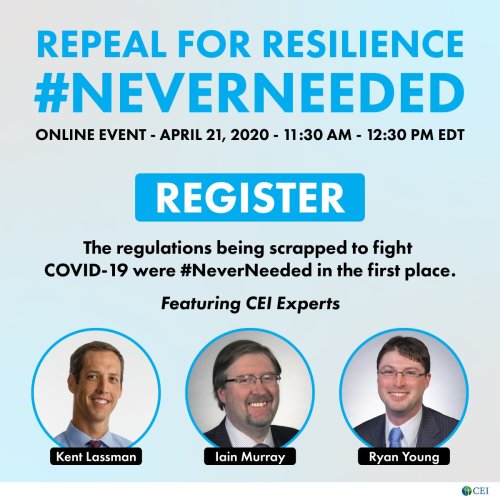
This coming Wednesday, April 21 at 11:30 ET, I’ll be speaking in an online event with my colleagues Iain Murray and Kent Lassman. We’ll be discussing how regulatory reform can help keep people safe during the pandemic while helping minimize the economic damage.
The event will be held using the Zoom video conferencing program. If you would like to attend, the link to signup is here.
Comments Off on Repeal for Resilience: CEI #NeverNeeded Online Event on April 21
Posted in #NeverNeeded, Reform, regulation, Uncategorized
California’s AB5 law was already backfiring before the COVID-19 pandemic hit. The legislation intends to reclassify many California-based independent contractors as formal employees in an attempt to raise their wages and benefits. It has instead cost thousands of jobs—many of which are home-based and quarantine-friendly.
California legislators have reportedly been mulling an “oops” bill that would offer exemptions from AB5 requirements. Over in the Orange County Register, I argue that exemptions are not enough. AB5 should be repealed outright:
While offering exemptions has the virtue of requiring politicians to admit their policies are hurting people, it has three significant problems.
One, exemptions take time to process. We don’t have that right now. …
Two, the officials who grant exemptions would gain great power. There is a risk some would use this power to enrich themselves. California legislators would also be tempted to bully companies for campaign contributions by dangling AB5 exemptions.
Three, exemptions would give favored businesses a government-granted advantage over competitors.
Read the whole piece here. I weighed in earlier on AB5 here. Ryan Radia’s CEI study on AB5 is here.
Comments Off on California’s #NeverNeeded AB5 Is Harming the Coronavirus Response
Posted in #NeverNeeded, labor, Publications, regulation, Uncategorized
Not every regulation on the books is directly harming the COVID-19 response. There are a lot of other regulations that need reform, but the #NeverNeeded set deserves urgent action. To help policy makers identify which regulations are the most pressing, the Competitive Enterprise Institute has prepared the following guide:

A regulation is #NeverNeeded if:
It slows distribution of proven medical diagnostic tests and devices. Regulations such as trade barriers and Buy American provisions raise prices at a time of distress and keep needed equipment out of the country. At the same time, lengthy permits and approvals for factories switching over to making medical equipment such as masks, ventilators, and tests mean that first responders sometimes have to make do without lifesaving equipment or personal protection.
It blocks patients’ remote access to medical providers. Telemedicine was highly restricted until regulators realized how serious the coronavirus pandemic would become. Medical professionals have also traditionally been banned from practicing across state borders—even though human anatomy does not vary from state to state. Such rules keep doctors out of virus hotspots where they are most needed. Many such regulations have already been eased. They must now be permanently repealed.
It increases the cost of energy at a time when Americans can least afford it. People have bills to pay, and with unemployment potentially reaching record levels, not everyone can afford green mandates and other regulations that raise people’s energy bills. A recent easing of fuel economy standards is a good start.
It makes it more difficult to hire employees. A new National Bureau of Economic Research study finds that the higher a minimum wage is, the more often people dodge it. Virginia Governor Ralph Northam is also seeking to delay a minimum wage increase in that state. California should repeal its AB5 bill that makes it harder for people to work as independent contractors. Not only are many such jobs readily available during a time of social distancing, but many contractors can work from home and away from contagion. Many occupational licenses at the state and local level keep willing workers out of work so incumbents can limit the number of their competitors.
It adds another layer of bureaucracy of complexity to legal compliance. A good rule of thumb for public policy is that simplicity is beautiful. If regulators are after a certain result, they should give people as much flexibility as they can in how they achieve that result. During the current crisis, complexity and bureaucracy also cost time. Time is a luxury we do not have. If someone has a way to help, they should be allowed to do so. Factories around the country are retooling as fast as possible to make emergency supplies. Distilleries are making sanitizer. Clothing companies are making masks. The Evans drumhead company is making face shields. The Gates Foundation is spending billions of dollars to speed up coronavirus vaccine development and mass distribution. In many cases, regulations are stopping these helpers from doing all that they could. These range from denaturing requirements for sanitizer alcohol to state and local permit regimes to the Food and Drug Administration’s lengthy approval process.
It blocks access to capital for consumers or businesses. Crowdfunding is a useful tool for keeping small businesses afloat. Due to regulations, many such campaigns have to be done informally, in person, or via a social media campaign. Crowdfunding through more formal channels, such as banks or financial institutions, could be cheaper in many cases for the business and less risky for the investors. Regulations should not prevent this. Other regulatory caps and conditions on loans are just as harmful, as are other regulations similar to the Obama-era Operation Chokepoint, which prevent many small businesses from even having bank accounts, let alone access to loans and other capital. John Berlau has more on this.
If a regulation fits any of these categories, it was probably #NeverNeeded in the first place. Quickly removing these rules would help keep people safe, and make virus-related economic distress less painful. Going forward, it is also important to reform the regulatory process itself. If that system remains in place, new #NeverNeeded rules will continue to be enacted indefinitely, harming future crisis responses. CEI has some ideas for that, too. For more, see neverneeded.cei.org, our recent #NeverNeeded paper, and the #NeverNeeded hashtag on Twitter.
Comments Off on How to Spot a #NeverNeeded Regulation
Posted in #NeverNeeded, regulation, Uncategorized
Over at RealClearMarkets, Iain Murray and I outline the major points of CEI’s just-released #NeverNeeded paper, which identifies regulations harmful to the coronavirus response:
During a pandemic, regulations should not get between sick people and health care, or between hungry people and food. This also applies in normal times. …
As Congress gears up for a Phase 4 stimulus, it is crucial that regulatory reform be part of the package. The top two priorities now are keeping people safe and minimizing economic damage, in that order. Regulatory sludge, as legal scholar Cass Sunstein calls it, is harming both objectives.
Read the whole thing here. The #NeverNeeded paper is here. CEI’s #NeverNeeded wesbsite is here. And you can contribute your ideas to the #NeverNeeded hashtag on Twitter.
Comments Off on Deregulation Is an Effective Pandemic Defense
Posted in #NeverNeeded, Publications, regulation, Uncategorized
Tomorrow I am doing an interview on #NeverNeeded regulations with the John Batchelor Show. Not sure when the segment will air, but keep an eye out.
Comments Off on On the Radio: #NeverNeeded
Posted in #NeverNeeded, Media Appearances, regulation, Uncategorized
My CEI colleagues have quickly compiled a short paper full of #NeverNeeded regulations that should be repealed in the wake of the coronavirus. These rules not only prevent effective response right now, but they make the country less able to deal with future crises. Now is the time to do some serious regulatory housekeeping. I contributed a few bits here and there, but this paper is a joint effort by CEI’s entire staff, ranging from transportation to health care to internet access to the regulatory process itself.
Read the whole thing here.
Comments Off on CEI Releases #NeverNeeded Paper
Posted in #NeverNeeded, Publications, regulation, Uncategorized
CEI has a new website up dedicated to #NeverNeeded policy ideas. The address is neverneeded.cei.org. We’ve collected proposals ranging from healthcare to restaurants to crowdfunding, and more. The list is constantly growing. We also invite people to join the conversation on Twitter by using the #NeverNeeded hashtag.
Comments Off on New #NeverNeeded Website
Posted in #NeverNeeded, regulation, Uncategorized

 Inertia Wins!