
Category Archives: Law

The Kagan Nomination: What Matters, What Doesn’t

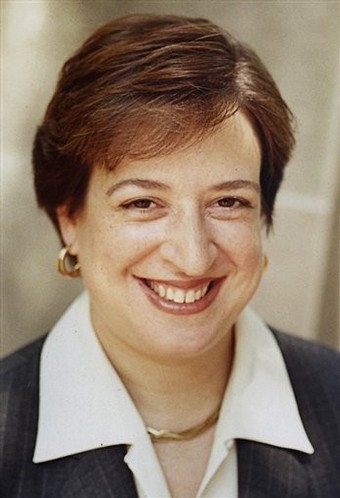
One of the criticisms being hurled at Elena Kagan from the right is that she might be a lesbian. This concerns me.

Not the lesbian part; few things are less important to one’s judicial qualifications. My worry is that Republicans have so atrophied intellectually that this is their loudest reason for opposing her.

A thoughtful soul (I forget who) recently remarked that twenty years from now, almost everyone currently on the wrong side of gay rights issues will be embarrassed to admit it. Yet the obsolete epithets being hurled at Kagan — which may or may not be accurate, and frankly, who cares — are what many of Kagan’s opponents seem to care about the most.

And people wonder why I often take visible offense when someone tries to call me a conservative.

There are substantive reasons to be skeptical about Kagan. One of them is how she views the executive branch. “She is certainly a fan of presidential power,” one scholar remarks. This is important.

Chief Justice Roberts has similar views. He was picked in part because the Bush administration knew he wouldn’t strike down that administration’s more controversial power grabs. Harriet Miers was not rejected for her views, which are utterly conventional. Her nomination was only struck down because her lack of subtlety in expressing those views was considered gauche.

While I have never been an Obama fan, one of my hopes for his administration was that he would repudiate Bush-era excesses such as the PATRIOT Act. He embraced them instead. Having all those cool powers at his disposal was just too much to pass up.

President Obama’s Supreme Court nominees so far seem no different from Roberts or Miers: what the other branches of government want, they shall get. The exceptions, such as the Citizens United decision, are so rare that they garner weeks worth of headlines; such outbursts must be kept to a minimum. Hence Kagan.

What the Supreme Court needs is a healthy dose of judicial activism. Kagan, like Roberts, Sotomayor, and other recent nominees, is a judicial passivist. They reflexively defer to the executive and legislature, right or wrong.

What we need are Justices who will stand up and say “no” when Congress passes a law that is unconstitutional, or when the president abuses his powers. That’s why judicial review exists in the first place. This tradition goes all the way back to Marbury v. Madison, often the very first case that students read in undergraduate constitutional law classes.

As Kagan goes through the pomp and circumstance of the confirmation process, maybe she’ll prove better than her likely soon-to-be colleagues. Maybe she won’t. But so long as her Republican opponents are fixated on something so trivial as her sexual orientation, we may never find out. Given her relative youth, three decades or more of jurisprudence are at stake.

A Quick Thought on Judicial Activism

Judges routinely defer to the will of the legislature and the executive. This is exactly opposite of their intended duty. A judge’s job is to be a thorn in the side of the other two branches; he is to be their conscience, if political animals can be said to have such a thing.

How about some more judicial activism, then? Most of the laws Congress passes are unconstitutional. A judge who defers to Congress isn’t doing his job. More activism on that front would be most welcome.

What a shame then, that progressives and conservatives so often misuse the word “activist” as a slur to describe any judge they disagree with, no matter how submissive that judge actually is. Their intellectual sloppiness has cost a useful word its true meaning.

A Good Day for Freedom of Speech

“If the First Amendment has any force, it prohibits jailing citizens for engaging in political speech.”

Justice Anthony Kennedy, introducing today’s Citizens United decision.

Precisely. The correct way to rebut unwelcome speech is not to silence it. It is to counter it with more speech. Let the best arguments win. Advocating speech restrictions is a fancy way of saying, “my arguments are too weak to withstand criticism.” Get better arguments, then!

Free speech issues aside, there is a reason why McCain-Feingold is informally known as the Incumbent Protection Act. It stacks the deck against challengers. No wonder so many incumbent politicians from both parties have come out against today’s decision. It’s bad for their job security.

Do Corporations Have Human Rights?

Intel’s defense in its EU antitrust case has taken the surprising line that the company’s human rights were violated. Over at Real Clear Markets, CEI colleague Hans Bader and I take a closer look. We conclude that Intel actually has a pretty good argument.

Corporations have human rights because doing so greatly reduces transaction costs: “suppose your company wants to buy some computer chips from Intel. You could have each shareholder sign the sales contract – good luck finding them all – or you could treat Intel as a person with the right to sign a contract, and the obligation to honor it. To deal with one person or millions? That is why corporations have legal standing as individuals.”

In short: no corporate rights, no modern economy. No exaggeration. There is a reason why legal conventions emerge as they do, even if they appear strange at first glance.

Iain Murray was kind enough to point out to me that the idea of corporate human rights has very deep roots. The 18th-century legal scholar William Blackstone, in his revered analysis of the English common law, wrote that corporations have the right “[T]o sue or be sued,, implead or be impleaded, grant or receive, by its corporate name, and do all other acts as persons may.”*

*William Blackstone, Commentaries on the Laws of England, Volume 1: Of the Rights of Persons, (Chicago: University of Chicago Press, 1979 [1765]), p. 463.

Regulation of the Day 49: Political Speech

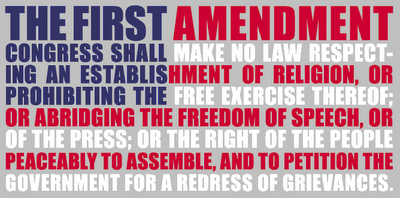
The First Amendment famously reads, “Congress shall pass no law… abridging the freedom of speech, or of the press.”

Congress, ever sneaky, has looked very closely at the First Amendment’s wording. If they can’t pass laws abridging the freedom of speech or of the press, maybe they can pass laws abridging the freedom of speech and of the press.

I kid, of course. No lawyer in their right mind would use that argument in court. The real justifications for most speech and press-abridging laws — collectively known as campaign finance regulations — are actually much flimsier.

They mainly have to do with protecting politicians from criticism. For example, a group called Citizens United released a partisan documentary last year called Hillary: The Movie. Basically a feature-length missive against then-Sen. Hillary Clinton and her presidential candidacy, the FEC blocked the movie from pay-per-view television during the 2008 primary season.

The movie was effectively censored because corporations (and unions) are not allowed to engage in certain types of political speech when an election is near. Citizens United lists some corporations among its donors, and thus was not allowed to show the movie as widely as they would have liked.

Citizens United got upset about all this, naturally. So they sued. Their case made it to the Supreme Court last year. Unwilling to make too hasty a decision, the Court re-heard oral arguments yesterday. The early bets are that Citizens United will win a partial victory, though one never knows until the decision is actually handed down.

Had the movie not been about politics, it would have faced no such obstacles. Political speech is treated very differently from other types of speech these days. This is a troubling trend. At heart, campaign finance regulations are a roundabout way of saying: no criticizing candidates!

Perhaps the First Amendment is a bit wordy. “Congress shall pass no law” is quite enough.

FCC to Nullify Millions of Contracts?

My colleague Alex Harris is drooling over the latest version of Apple‘s iPhone. In true CEI spirit he added, “Regulators better not get in my way.” Sorry to say, Alex, but tomorrow the FCC is holding a hearing that may do just that.

Here’s what’s happening. Monthly service is cheap, but phones themselves are expensive. A good one costs hundreds of dollars. Many people can’t afford to buy them outright, or don’t want to. Since phone companies want to sell phones, they’ve found a way around that: spread the cost out over time.

Providers often sell their phones cheaply, sometimes even at a loss. Then they make their money back by locking the customer in for a set period of time, usually a year or two. If the customer wants out before then, they have to pay an early termination fee.

The FCC ‘s hearing tomorrow will discuss ways to regulate early termination fees. The fees are unpopular, even though they allow more people to afford better phones.

Some people have complained because they found out about the fees only after signing a legally-binding contract; not everyone can be bothered to read fine print. The FCC claims it is looking out for these people.

They are not. The fees are a good thing. They lower the cost of entry into the cell phone market. Without early-termination clauses, a lot of people would be priced out of cell phone ownership, period. Others would only be able to afford a low-end phone. The FCC’s proposals would hurt these people.

That doesn’t matter when there’s a chance to be seen “doing something.” Ergo, the FCC is considering violating the sanctity of millions of contracts. In Washington, good publicity trumps the rule of law. I wish it were for a better reason than people not reading what they sign.

Reducing Frivolous Lawsuits

A London man slipped on a grape in a store and sued for 300,000 pounds ($600,000).

He lost. This highlights a key difference between the U.S. legal system and most others: the man now has to pay his opponent’s legal costs. This is part of almost every legal system on Earth, except ours.

The “loser pays” system gives plaintiffs a powerful incentive not to sue unless they have a good case. This one reform alone would do much to reduce the amount of frivolous lawsuits in the U.S. Something to think about.

Anonymity and Free Speech

In the Kentucky state legislature, “Rep. Tim Couch, R-Hyden, filed a bill that would require anyone posting on interactive Web sites to first register using their legal names, addresses and valid e-mail addresses.”

I can see Alexander Hamilton, James Madison, and John Jay – known to history by the collective pseudonym Publius – rolling in their graves.

Fortunately, “Couch, however, said he won’t push the bill — he just wants to draw attention to the growing presence of anonymous and often mean-spirited comments on Web sites.”

I see his point, but couldn’t disagree more with the way he makes it.

Barry Bonds Indicted

The indictment is online here.

I’m no fan of Barry Bonds, but I fail to see why there should be legal consequences for his (alleged, but highly probable) steroid use. Upon proving his guilt, Major League Baseball should punish him for breaking the rules of the game.

But what Bonds decides to put in his body should not be a criminal matter. The prosecutors should drop their case.