Category Archives: Great Thinkers

Out Come the Crazies

“When I see those who espouse my cause, I begin to wonder about the validity of my position.”

-Joseph Schumpeter, in Thomas K. McCraw, Prophet of Innovation: Joseph schumpeter and Creative Destruction, p. 221.

Funny, but true. I feel much the same way every time I attend an event with a high “wacko” factor. I have to remind myself that every political movement, not just mine,  contains some people who do nothing but make it look bad.

One’s opinions are best based on data and logic, and not on who else shares that opinion.

In Which Greed Is Good

The great economist Joseph Schumpeter wrote that “[F]ree trade is the cement that holds together the idea of peace.”*

His logic is sound. To put it bluntly, killing the customer is bad for business. And money talks. Commerce gives people who may hate each other a powerful incentive to get along; greed can be a force for good.

*Thomas K. McCraw, Prophet of Innovation: Joseph Schumpeter and Creative Destruction, (Cambridge, MA: Harvard University Press, 2007), p. 110.

Happy 203rd Birthday, John Stuart Mill

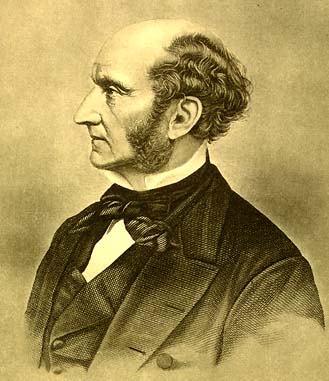
John Stuart Mill was born on this day in 1806. He is best known for classical liberal writings like On Liberty and The Subjection of Women. College students today also learn about his philosophy of utilitarianism, inherited from father James Mill and family friend Jeremy Bentham.

Mill had an unusual life story, told in one of the most compelling autobiographies in literature. John’s father gave him an intensive education that, for example, had him reading ancient Greek at age three. John never had any formal schooling, and the only children with whom he was allowed contact were his siblings.

His father’s pedagogical experiment worked in that it gave John one of the most formidable intellects of his age. But it failed in other ways. His strict upbringing resulted in a nervous breakdown at age 20 that set him back years. He was always socially awkward, and didn’t marry until age 45 — itself an interesting story.

Mill made important contributions to economics, political science, and philosophy. A deep love of liberty runs through them all. I don’t personally agree with everything he wrote (utilitarianism leads to absurd conclusions when taken too far), but he remains one of brightest lights in the classical liberal pantheon. Happy birthday, John Stuart Mill.

(Cross-posted at Open Market)

Power and Poetry

The man
Of virtuous soul commands not, nor obeys.
Power, like a desolating pestilence,
Pollutes whate’er it touches.

-Percy Bysshe Shelley, Queen Mab

The Durants on Democracy

Will and Ariel Durant are two of my favorite writers. Perceptive, pithy, and always eloquent, they only rose in my esteem when they described democracy as merely “a count of noses after a contest of words.” (The Age of Napoleon, p. 286)

Couldn’t have said it better myself.

Putting Faith in Our Leaders

The economist Hernando de Soto, writing about his native Peru in 1989, makes a point that holds true twenty years later and a continent away. Echoes of F.A. Hayek:

“Those who expect things to change simply because rulers with greater determination and executive skills are elected are guilty of a tremendous conceptual error.”

The Other Path, p. 237.

How We Choose Our Leaders

There is a great deal of romance in politics. Why else would we spend $170 million on an inauguration? H.L. Mencken had a more sober view of political animals. They are rarely chosen for their merit, or their stances on the issues of the day. The successful candidate actively avoids such things in his speeches. No:

“They are chosen normally for quite different reasons, the chief of which is simply their power to impress and enchant the intellectually underprivileged. It is a talent like any other… [B]ut it is obviously not identical with a capacity for the intricate problems of statecraft.”A Mencken Chrestomathy, pp. 148-49.

Make-Work Bias

Politicians always talk about creating jobs. It is a borderline obsession, especially in these troubled times. Their fixation is an old one – a really old one.

How old? The Roman historian Suetonius wrote of the emperor Vespasian in 117 A.D.(!):

To a mechanical engineer, who promised to transport some heavy columns to the Capitol at small expense, he gave no mean reward for his inventions, but refused to make use of it, saying: “You must let me feed my poor commons.” (Lives of the Caesars, Book VIII, Chapter XVIII)

Vespasian made a common mistake. Had he used the labor saving device, he would have had his columns and another project besides. Instead, he got only the columns. Saving labor doesn’t reduce employment. It creates new employment opportunities.

Today’s politicians are getting set to make the same old mistake with their own public works programs.

So it goes.

Putting Religious Intolerance in Proper Context

“It is very important not to mistake hemlock for parsley, but not at all important whether or not you believe in God.”

Diderot, in a letter to Voltaire (June 11, 1749).

Legislative Hubris

“Usually a custom refuses to be changed by a law.”

-Will and Ariel Durant, The Age of Voltaire, p.351.