Category Archives: Export-Import Bank

Ex-Im Has Officially Expired

ex-im authority has lapsed

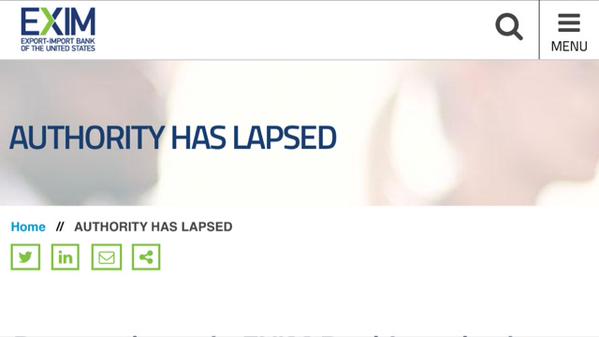
Today is a victory day of sorts. Ex-Im’s charter has expired, and Congress declined to reauthorize it. The agency will remain open and will service its existing loan guarantees, but cannot make new ones. As of this writing, its website also says “authority has lapsed” in big capital letters (see picture above).

This victory was a team effort all the way. Over at the Cato Institute blog, Dan Ikenson celebrates (cross-posted at the Foundation for Economic Education) and gives kudos to a lot of the team’s key players. I am honored that he lists me among them.

This fight is far from over, but today marks an important milestone. More to say on that soon.

Reasons to Oppose the Ex-Im Bank, Part 4: False Economic Catastrophism

The Export-Import Bank’s charter expires on June 30. This series of posts makes the case for closing Ex-Im, one argument at a time. See also parts 1, 2, and 3.

General Electric CEO Jeffrey Immelt is claiming that closing the Export-Import Bank would mean “economic catastrophe.” He must use the term differently than most people do. A bit of math shows why.

According to page 6 of Ex-Im’s 2014 annual report, the bank did $27.5 billion of business in 2014. The Bureau of Economic Analysis estimates GDP in the fourth quarter of 2014 to be $17.7037 trillion (see Table 3, page 8). This means Ex-Im’s business last year was equivalent to about one sixth of one percent of GDP. This is par for the course.

Confining the comparison just to America’s $2.35 trillion of exports, everything Ex-Im did all of last year is equivalent to less than 1.2 percent of exports. Seeing as many Ex-Im-financed projects would still happen without the bank’s involvement including GE, by Immelt’s own admission—its true net impact is almost certainly much smaller than that.

If anything, by redirecting billions of dollars of capital towards the politically connected and away from deserving entrepreneurs, Ex-Im is preventing the economy from reaching its true potential.

Reasons to Oppose the Ex-Im Bank, Part 3: It Favors Big Business

The Export-Import Bank’s charter expires on June 30. This series of posts makes the case for closing Ex-Im, one argument at a time. See also parts 1 and 2.

Ex-Im officials claim the vast majority of its lending activities go to smaller businesses. This is true by number of loans—in 2013, 2,160 out of 2,775 businesses receiving Ex-Im financing were small businesses, or just more than 78 percent. But Ex-Im’s claim is false by the more important metric of dollar value of loans. In most years, more than 80 percent of Ex-Im financing, measured in dollars, goes to big firms. Also worth noting: Ex-Im’s in-house definition of “small business” covers firms with up to 1,500 employees.

Ex-Im’s charter states “the Bank shall make available, from the aggregate loan, guarantee, and insurance authority available to it, an amount to finance exports directly by small business concerns … which shall be not less than 20 percent of such authority for each fiscal year.”

Small business’ actual share of Ex-Im financing has failed to meet that 20 percent threshold in 2011 (18.45 percent), 2012 (17.11 percent), and 2013 (18.96 percent). 2014 was the first year Ex-Im met that threshold since at least 2010.

Small business advocates who favor keeping or expanding Ex-Im should note that Ex-Im gives financing to approximately one in 10,000 small businesses. Considering approximately 20 other agencies give subsidies to small business, Ex-Im’s closure would have very little effect on the amount of subsidies small businesses receive. Most of its closure’s impact would be felt by its top ten beneficiaries, all of which are large companies by anyone’s definition of the term.

Reasons to Oppose the Ex-Im Bank, Part 2: Its Favors for Some Businesses Hurt Other Businesses

The Export-Import Bank’s charter expires on June 30. Unless Congress votes to reauthorize that charter, Ex-Im will soon cease to exist. This would be a major victory in the fight against corporate welfare. Ex-Im’s beneficiaries often tar their opponents as anti-American, anti-business, and anti-jobs. This series of posts will instead stick to the merits of the issue, which overwhelmingly favor closing Ex-Im, one argument at a time. For more arguments, see my recent paper. For the first installment of this series, see here.

The Export-Import Bank has given financing to more than 20 foreign airlines, many of them state-owned or state-supported. Ryanair, Air India, Korean Air, and fourteen other airlines have each received more than $1 billion in financing during the period 2000-13. Emirates Airlines saves as much as $20 million per plane purchased with Ex-Im financing, according to Congressional testimony by Delta Airlines CEO Richard Anderson. Air India, with Ex-Im’s help, was able to drive Delta out the Indian market entirely, costing Delta and related businesses up to 1,000 jobs.

Ex-Im does not engage in a great deal of direct lending. Instead, most of its activity consists of guaranteeing loans companies secure from third-party banks. If a foreign airline is unable or unwilling to pay back the third-party loan, Ex-Im will step in and repay it with U.S. taxpayer dollars. Ex-Im’s loan guarantees allow those airlines to secure extremely favorable interest rates, saving them a great deal of money. The quid pro quo, naturally, is that the airlines buy planes from Boeing instead of Airbus or Embraer.

Delta Airlines, understandably, is upset at the Export-Import Bank for giving direct assistance to its foreign competitors. They sued Ex-Im in 2011 and again in 2013, with Hawaiian Airlines and the Air Line Pilots Association joining as plaintiffs. Other domestic airlines probably have similar sentiments, but have been less vocal about it for various reasons.

No doubt some politicians will use this example to argue that Delta and other aggrieved companies should receive their own subsidies to balance out the favors Ex-Im does for its foreign competitors. A better policy would be for government to neither help nor hinder. Good companies that satisfy their customers will win out in the end.

Ex-Im’s activities don’t just harm domestic companies. They also harm domestic workers. In 2005, General Electric used a $3 million Ex-Im grant to move one of its factories from Bloomington, Indiana to Celaya, Mexico. “My taxes are paying to ship my job to Mexico,” quipped one of the 470 laid-off workers.

Ex-Im’s benefits to some companies are obvious enough. But those benefits come at a cost to other companies. This fact should be included in Congress’ calculus as it decides whether or not to continue the bank.

Reasons to Oppose the Ex-Im Bank, Part 1: It’s Pro-Business, Not Pro-Market

The Export-Import Bank’s charter expires on June 30. Unless Congress votes to reauthorize that charter, Ex-Im will soon cease to exist. This would be a major victory in the fight against corporate welfare. Ex-Im’s beneficiaries often tar their opponents as anti-American, anti-business, and anti-jobs. This series of posts will instead stick to the merits of the issue, which overwhelmingly favor closing Ex-Im, one argument at a time. For more arguments, see my recent paper.

The upcoming Ex-Im reauthorization vote provides the perfect litmus test for which members of Congress are pro-business, and which are pro-market. The distinction is an important one. Pro-business thinkers are concerned with the fates of particular firms. The General Motors bailout is an example of a pro-business policy aimed at helping a specific business. Pro-market thinkers are less concerned with which firms prosper, focusing instead on maintaining an open and fair competitive market process, under which companies succeed or fail on their merits. Pro-market thinking is neither pro-business nor anti-business.

Ex-Im is a classic example of pro-business policy. In most years, a ingle business, Boeing, alone accounts for more than 40 percent of the Ex-Im Bank’s business. A literal top-ten list of Ex-Im beneficiaries accounted for 76 percent of its business in 2013.While Ex-Im clearly helps certain businesses, it is harmful to the competitive market process as a whole.

Because there is only so much investment capital to go around, every time the Ex-Im Bank secures favorable terms for one of its beneficiaries, another company elsewhere in the economy has to pay more for financing, or may lose access to it entirely. The best possible economic result is a wash. But more likely, the Export-Import Bank causes real economic harm on net. Its politically-directed financing decisions are not subject to market discipline. Over the years, Ex-Im has secured financing for companies such as Enron and Solyndra. It also has a policy of giving special treatment to politically favored sectors, such as renewable energy and other green industries. In fact, 10 percent of Ex-Im’s authorizations are required to go to renewable energy projects, and has restrictions on financing “High-Carbon Intensity” projects.

Another merit-unrelated variable is political access. It is difficult for companies to get Ex-Im financing unless they invest in political connections. This creates an additional deadweight loss, diverting activity away from entrepreneurship and towards lobbying.

Businesses and consumers are better served by pro-market policies. Politics should be left out of financial decisions. Investors would get higher returns, and deserving companies would have easier access to capital. Consumers would be the ultimate beneficiaries of a financial system that rewards value creation over political connections. Such a financial system would not include an Export-Import Bank.

Abolish Ex-Im Bank, Don’t Reform It

Over at the American Spectator, University of Chicago lecturer Frank Schell recently published a column arguing that the Export-Import Bank should be reformed, not abolished. Today, I have a piece disagreeing for two reasons:

First, Congress has no appetite for substantive changes. Second, corruption and favoritism are inevitable consequences of Ex-Im’s very mission. As such, Congress should let the agency’s charter expire…

America’s entrepreneurs are talented and resourceful enough to compete in global markets without having to spend time influence-peddling in Washington. They deserve the opportunity.

Read the whole thing here.

Bad Tradeoff: Ex-Im vs. a Weak Dollar

At this point, it looks like Congress will let the Export-Import Bank’s charter expire on June 30. This is not a big deal in the grand scheme of things. Ex-Im would continue to service its existing loan guarantees and other financial products, and Ex-Im employees would also review applications for new loans and loan guarantees, though they would not be able to act on them. But suppose Ex-Im does have to shut down operations for good. What other options do export-oriented policymakers have?

Tyler Cowen brings up one option: mess with the price system.

Even a slight depreciation likely would offset the effects of Ex-Im expiration by more than a factor of one hundred, perhaps by more than a factor of one thousand.  Ex-Im is a relatively small program and it has nothing to do with more than 98 percent of American exports.  Many of its foreign beneficiaries, such as Pemex and Chinese state-owned enterprises, don’t need the subsidy to fund their imports.  Boeing is still reporting a robust demand for its planes.

If the goal is to increase exports, a weak dollar is far more effective than any Ex-Im project could ever hope to be. As Cowen says, Ex-Im is involved with less than 2 percent of U.S. exports. Altering the price system itself would affect 100 percent of transactions, exports or not.

Renewing Ex-Im’s charter is a bad idea. Weakening the dollar is a worse idea by at least a factor of 50, even ignoring imports and purely domestic transactions. Every export made cheaper equals an import made more expensive. Every business helped means another one hurt. There is no net benefit.

Many people believe American businesses should export as much as possible, and import only when necessary. But as the Cato Institute’s Dan Ikenson noted in recent congressional testimony:

As Milton Friedman used to say: imports are the goods and services we get to consume without having to produce; exports are the goods and services we produce, but don’t get to consume.

Ex-Im’s very mission, intentionally or not, is to impoverish the U.S. to the greatest extent it can. Imagine working as hard as you can to make something. Then, instead of consuming it and getting value from it, you send it overseas so someone else. Exports do have value, but only because they can be exchanged for imports. Exports are the price we pay for imports. They are not a good thing in and of themselves.

Politicians, especially the populist Lindsey Grahams and Sherrod Browns of the world, would do well to remember that. Ex-Im helps some businesses, but only at others’ expense. The program is a wash at best, and almost certainly harms the American economy on net. Congress should let Ex-Im’s charter expire. More importantly, Congress should also resist the temptation to weaken (or strengthen) the dollar to influence the balance of trade.

Both Parties Should Oppose the Export-Import Bank

Rep. Jeb Hensarling (R-Texas) chairs the House Financial Services Committee. The Export-Import Bank’s reauthorization falls under his jurisdiction, and he has been one of the bank’s most consistent critics. He also called for closing Ex-Im in a recentWall Street Journal op-ed, making a number of well-reasoned arguments. But his closing clarion call is rather narrow for my taste:

If Republicans can’t stand up to corporate interests in this skirmish, how will we ever stand up to the myriad special interests warring against adoption of a simplified, pro-growth tax code? How will we earn the moral authority to reform the social welfare state unless we first reform the corporate welfare state? Let the Democrats own corporate welfare by themselves.

I prefer a more ecumenical approach. Opposing corporate welfare is something on which both parties should agree—and outside the Beltway, they often already do. People favoring a level economic playing field should put pressure on Republicans and Democrats alike to end their cronyist habits, not just the GOP. After all, Ex-Im’s traditional critics come from the left, not the right. The two sides’ role reversal is a recent, and puzzling phenomenon.

Hensarling is doing some impressive yeoman’s work in getting his party on the right side of the Ex-Im issue, but that’s only half the battle—or slightly more than half, given the House’s current composition. Still, progressives are natural allies in the fight against Ex-Im, and for several decades they were the free market’s only allies in that battle. They should not be ignored.

Henry Hazlitt and the Ex-Im Bank

Henry Hazlitt is most famous for his book Economics in One Lesson. Export-Import Bank supporters have consistently ignored a very important part of Hazlitt’s simple lesson: don’t just look at how a policy affects some people; look at how it affects all people. Ex-Im subsidizes loans that benefit a number of businesses. But supporters’ case-making usually begins and ends with those businesses, systematically ignoring almost everyone else. As Hazlitt points out, this is a basic analytical mistake.

There is much more to the story. For example, if a company benefits from Ex-Im financing, any of its competitors who don’t also use Ex-Im are put at an artificial disadvantage, through no fault of their own. This is hardly fair play.

There is another cost to competitors: Ex-Im is in a powerful position, able to pick winners and losers. This is an open invitation to corruption—an area where cheaters have a distinct advantage over honest companies. At least 74 potential corruption cases involving Ex-Im became public between 2009 and 2014. This is a genuinely impressive feat for an agency with only 400 employees. Part of Ex-Im’s costs to all of us can be put in terms of ethics and virtue, not just dollars.

Beneficiaries’ direct competitors are not Ex-Im’s only victims. Ex-Im harms other domestic businesses in a number of ways. As I’ve noted before, Delta Airlines has complained that Ex-Im’s Boeing-related subsidies to foreign airlines has caused it direct harm. Ex-Im has made deals with airlines all over the world, including countries such as Australia, China, and India (for a full list, see pp. 45-49 of Ex-Im’s 2014 annual report). Many Ex-Im subsidized airlines directly compete with U.S.-based airlines.

One last “affects everyone” point is there is only so much capital to go around. If an Ex-Im loan guarantee to a foreign company persuades a bank to make a billion-dollar loan that Ex-Im client, that’s a billion dollars that cannot go to other companies that might be able to create more value for consumers, whether here or abroad. Every time Ex-Im makes a financing decision, it potentially hurts global innovation. The same argument holds for Ex-Im’s many foreign counterparts.

Ex-Im has had an easy time building its reauthorization case because the benefits it creates for specific companies are easy to see. But as Hazlitt reminds, a full picture of Ex-Im’s merits requires looking not just at its favored few beneficiaries, but at how the bank affects everyone, even when those costs are hard to see. Adding up the merits and demerits on a more complete ledger leaves one with no choice but to favor an end to Ex-Im and its favoritism.

Ex-Im and Boeing, Sitting in a Tree

In most years, nearly half of the Export-Import Bank’s business is for Boeing’s benefit. The relationship between the two is so cozy that Ex-Im’s informal nickname around Washington is the “Bank of Boeing.” Yet, in an interview with Politico, Ex-Im president and chairman Fred Hochberg said, “We don’t lend a single penny to Boeing.”

Oddly enough, both assertions are true—Boeing really is by far Ex-Im’s biggest beneficiary, despite no direct loans. That’s why Hochberg’s statement is misleading. Ex-Im does make loans, but most of its business is in guaranteeing loans made by other banks. As Hochberg puts it, Ex-Im does this “so that Egyptian Airways can choose a Boeing plane over an Airbus plane. That way they can make their choice on the basis of the product, not because somebody’s offered cut-rate financing on one side of the deal and the other one is cash only. That would make it a very un-level playing field.”

In other words, even if Ex-Im doesn’t give Boeing direct loans, Ex-Im still gives the company an artificial assist. Contrary to Hochberg’s claim about preventing an un-level playing field, this creates one.

Of course, the counterargument Ex-Im defenders make is that other countries do their own un-levelling with their export agencies, so the U.S. needs to fight back. If other countries want to distort their capital markets and redirect billions of dollars of scarce capital to politically connected companies, that’s their business. But just because other countries make mistakes doesn’t mean, therefore, the U.S. should make the same mistake.

Then again, Ex-Im may not even help U.S. businesses on net. What helps Boeing hurts other U.S. businesses. Delta Airlines complained that Ex-Im’s favorable deals with foreign airlines make it artificially difficult for Delta to compete abroad, and even pushed it out of India, the world’s second-largest country, altogether.

Hochberg’s remark is similar to Ex-Im officials’ earlier deflections when the agency was accused of giving loans to companies such as Enron and Solyndra. As I explained in footnote 10 of my earlier paper:

The Bank notes that it did not provide direct financing to either Enron or Solyndra. Instead, it provided “export financing support to the company’s foreign customers who purchased services or products from Enron,” and “provided a loan guarantee to a Belgian bank that in turn financed the purchase of solar panels from Solyndra.” This still qualifies as giving Enron and Solyndra special favorable treatment, which is the larger point.

Hochberg and other Ex-Im defenders can play semantic games all they like, which they no doubt will do at both Senate and House hearings this week. The reason they must play such games is that on the merits, the agency remains one of the U.S. government’s largest corporate welfare programs. Congress should refuse to reauthorize Ex-Im on those grounds.