Category Archives: Spending

There Is Nothing Left to Cut

Politico: CDC to Fight HIV with Comic Books

CEI Podcast for September 8, 2011: The Infrastructure Bank


Have a listen here.

In a speech tonight, President Obama is expected to announce the creation of a government infrastucture bank as part of his plan to reduce unemployment. Vice President for Policy Wayne Crews explains why it won’t work as planned, and offers an alternative idea: liberalization.

What Creates Jobs?

One way to create jobs is to give workers shovels instead of backhoes — or even spoons. Another way is to ban computers, or farm machinery. None of these are good options. A better way to create jobs is to make it easier to create wealth.

That means repealing regulations that make it expensive to hire new workers. That also means cutting deficit spending that crowds out scarce investment capital that businesses need to grow, and to hire. This new video from Cato makes that point very effectively (click here if the embed doesn’t work).

Stimulating Language

I’ve argued for a long time that stimulus bills are poorly named; it implies that they stimulate the economy. “Spending bill” is a non-loaded term that has the added advantage of being accurate. Both parties have passed spending bills over the years in the hopes of stimulating the economy. Intentions being different than results, Democrats are finally starting to agree with me on this misuse of language, as The Hill reports:

Democrats are now being careful to frame their job-creation agenda in language excluding references to any stimulus, even though their favored policies for ending the deepest recession since the Great Depression are largely the same.

The article continues:

Recognizing the unpopularity of the 2009 package, however, Democratic leaders have revised their message with less loaded language – “job creation” instead of “stimulus” and “Make it in America” in lieu of “Recovery Act” – in hopes of tackling the jobs crisis.

Spending bills work by taking some money out of the economy and then putting it back in, minus transaction costs and political malfeasance; one can see why they don’t have much effect. The thinking is that Congress can invest money more wisely than private investors. If Solyndra is any indicator, that isn’t true.

Public opinion has soured on spending bills after some initial optimism. That same public also wants its politicians to do something, anything to get the economy going.

But the only tool available to Congress is spending. That’s why politicians insist on following the same failed policy over and over – it is their only tool. The only alternatives are doing nothing, or actively paring back spending and regulations. And those don’t look nearly as glamorous on camera.

Stimulus, spending bill, job creation bill – a rose by any other name has thorns just as sharp. And this particular rose refuses to bloom. That means it’s time to try something else. Maybe reducing spending to sustainable Clinton-era levels, which isn’t even particularly austere. Congress should also try a deregulatory stimulus sometime.

Logic Based Reasoning Services

Out of a $3.8 trillion budget, the federal government spends a mere $196,600 on logic based reasoning services.

Hard to tell if that’s a good thing or a bad thing.

Tim Carney on Rick Perry

Washington Examiner columnist (and former CEI Warren Brookes Fellow) Tim Carney has a must-read column today on Texas Governor and presidential candidate Rick Perry’s economic policies. They appear suspiciously similar to Bush and Obama’s policies:

“I’m a pro-business governor — I don’t make any apologies about it,” Rick Perry told the crowds in Iowa this week. He’s right, but we can get more specific. Perry is pro-Merck, pro-Boeing, pro-Mesa Wind, pro-Texas Instruments, pro-Convergen, and pro-dozens of businesses that donate to his campaigns and hire his aides as lobbyists.

Perry promises to “get Americans back to work,” but his policies — from backroom drug company giveaways to green energy subsidies — eerily mirror the unseemly big business-big government collusion that has characterized President Obama’s presidency. Judging by his record in Texas, Perrynomics might just be low-tax Obamanomics.

Pro-business politicians like Perry and Obama are a dime a dozen. What the economy needs to recover are more pro-market politicians. Instead of putting their thumbs on the competitive scales to favor one business or another, Congress and the president should allow an open, competitive market process.

That means the rules of the game would be both clear and few; they would also be consistently enforced. Unlike Perry and Obama, markets respect no special interest. If they did, no company would bother with a Washington office.

Consumers do a much better job of picking winners and losers than politicians with campaigning and fundraising on the brain. They should be allowed to try it sometime.

What a shame that no presidential aspirant is likely to admit that; such is the curse of “do-something” bias.

Worth a Thousand Words

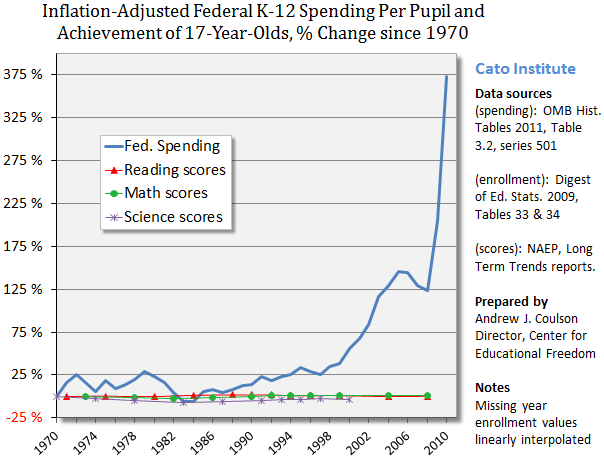
Click to enlarge; original here.

Remember this graph the next time someone proposes spending more federal dollars in education.

Also remember how far removed Washington is from most state and local jurisdictions. Maybe those jurisdictions should have more say, and Washington less.

Did Spending Cuts Cause the UK Riots?

Here’s a letter I recently sent to The New York Times:

TO THE EDITOR:

 Richard Sennett and Saskia Sassen worry in their August 11 op-ed that government spending cuts may be causing the UK riots. They also hint at what that could imply for the U.S.

A problem with their argument is that government spending in the UK has gone up sharply over the last decade. Government spending there is currently about 45 percent of GDP. In 2000, it was only 34 percent. There were no riots then.

A similar story has played out in America. When President Clinton left office, federal spending was 18 percent of GDP. Now it is 24 percent.

If spending cuts cause riots, then we should have nothing to worry about. The fact that we do means something else must be behind the looting.

RYAN YOUNG
Washington, D.C. Aug. 11, 2011
The writer is a fellow at the Competitive Enterprise Institute.

How Not to Improve Traffic Conditions

In Arlington, Virginia, “Neighbors wanted $16,000 worth of speed humps, she said. What they got was $200,000 worth of concrete dividers and narrowed lanes that they said increased the risk of drivers being rear-ended while turning into the neighborhood.”

They Aren’t Math Majors

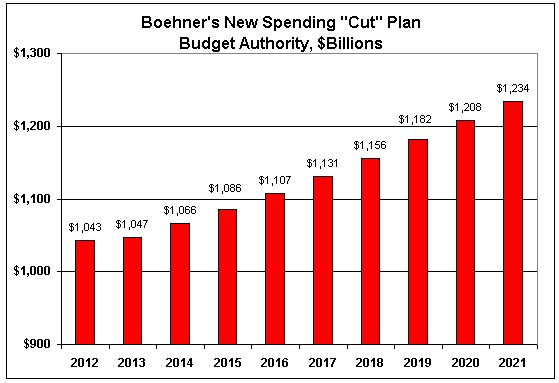
Eleven people were arrested for staging a sit-in today inside the U.S. Capitol. They were protesting budget cuts. They must not have known that spending is set to increase every year for at least the next decade, even under the Boehner plan.

Take a look at this handy discretionary spending chart that Cato’s Chris Edwards put together: