Category Archives: Spending

Sequestration: Not a Cut

the-terror-of-spending-cuts

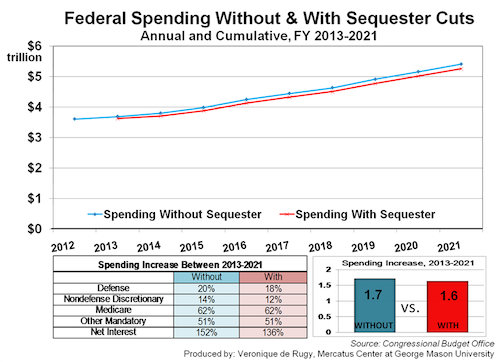
A very important point is being almost entirely overlooked in the sequestration debate: sequestration wouldn’t actually cut spending. As I’ve pointed out before, a cut is when spending goes down. Under sequestration, projected spending increases would merely be a little smaller. Federal spending is set to go up every year through at least 2021, sequestration or not.

It says a lot about the power of political inertia that something as inconsequential as sequestration generates months of dire headlines and heated debate. This is not a cause for optimism. If you prefer a slightly sunnier view, read Peter Suderman’s insightful Hit & Run post (from which I also poached the above chart).

There Is Nothing Left to Cut

The State Department has created a time travel-themed video game.

You can play it here.

CEI Podcast for November 13, 2012: The Fiscal Cliff at Home and Abroad


Have a listen here.

Phrases like “austerity” and “the fiscal cliff” are dominating news coverage not just here in the U.S., but in Europe as well. Warren Brookes Journalism Fellow Matthew Melchiorre explains what both sides of the Atlantic need to do to avoid fiscal catastrophe.

CEI Podcast for September 20, 2012: The Economic Development Administration

Have a listen here.

CEI Policy Analyst David Bier is author of the new study “The Case for Abolishing the Economic Development Administration.” The agency’s impact goes well beyond its modest $286 million budget. On average, the EDA only pays for about one seventh of its projects. The rest of the burden falls on state and local governments and the private sector. Those projects include $2 million for a wine-tasting room, $35 million for a convention center that is projected to lose money, and other boondoggles.

There Is Nothing Left to Cut


The city of Detroit’s water and sewerage department employs a horseshoer. He makes “$29,245 in salary and about $27,000 in benefits”.

The department does not use any horses.

There Is Nothing Left to Cut


The federal government has a Davy Crockett Resource Advisory Committee.

CEI Podcast for July 24, 2012: Unfunded Mandate Reform


Have a listen here.

Unfunded mandates are a way for Congress to increase government’s size and scope without increasing the deficit. Of course, this just means that state governments and the private sector are footing the bill instead. Research Associate David Deerson explains why past efforts to rein in unfunded mandates failed, and why new legislation that Congress is set to vote on this week could help.

Time to Reform Unfunded Mandates

When deficits are high, Congress has even more incentive than usual to indulge in unfunded mandates. That way it can deliver the spending programs and other government goodies that voters like, and without adding to the deficit. Of course, this is because states and the private sector bear the burden instead.

Congress passed an Unfunded Mandate Reform Act back in 1995, but it is mostly toothless, and needs to be strengthened. Fortunately, help may be on the way, as Wayne Crews and I explain in today’s Washington Times:

During the last week of July and just before August recess, the House is likely to vote on H.R. 4078, a package of reforms called the Regulatory Freeze for Jobs Act of 2012.

Title IV of the package is H.R. 373, the Unfunded Mandates Information and Transparency Act of 2011, a bipartisan bill long championed by Rep. Virginia Foxx, North Carolina Republican. It would close some of UMRA’s loopholes. The biggest fix is that it would force independent agencies to comply with UMRA.

Another reform is that the Office of Management and Budget would no longer review the rules. That task would move to OMB’s Office of Information and Regulatory Affairs, which specializes, albeit imperfectly, in cost estimates. That office likely is better suited to the job, given a long history of being tasked with regulatory review responsibility, but it doesn’t have much veto power.

Read the whole piece here. Our colleague David Deerson has also blogged about unfunded mandate reform here and here.

 

CEI Podcast for June 13, 2012: Smarter Transportation Funding


Have a listen here.

When the federal government gives out transportation funding to the states, it attaches a lot of strings. The solution, according to Land-use and Transportation Policy Analyst Marc Scribner, is to get the federal government out of the transportation business and devolve it to the states. In the just-released CEI study “Fixing Surface Transportation in Massachusetts: A Path Forward under a Devolved Federal Funding Scenario,” Scribner argues that by following a user-pays, user-benefits principle, states can raise revenue and maintain infrastructure more efficiently than the federal government can.

An Economics Disaster

Even Nobel laureates forget their economic fundamentals sometimes. Paul Krugman, who knows better, recently fell for the broken window fallacy in a post at his New York Times blog. He argues that the tsunami that hit Japan last year has boosted the economy. An error that basic demands correction; my attempt ran today in The American Spectator:

Imagine for a minute that the tsunami never happened. Japan’s GDP growth would probably be slower; Krugman is almost certainly correct on that. And yet, a tsunami-less Japan would be better off. For one, the survivors wouldn’t have 15,000 holes in their hearts where their families, friends, and neighbors used to be.

As far as the economy goes, all that reconstruction spending would instead go to creating brand new wealth, as opposed to merely replacing what people already had to begin with. It is better to build than to rebuild.

Read the whole thing here.