
Category Archives: Economics

Logic Based Reasoning Services

Out of a $3.8 trillion budget, the federal government spends a mere $196,600 on logic based reasoning services.

Hard to tell if that’s a good thing or a bad thing.

Peter Leeson on Pirates, Anarchy, and the Economic Way of Thinking

Here’s an interview with my former professor Peter Leeson. If the video below doesn’t work, try clicking here. His insights on formal versus informal institutions are worth pondering. I also like his enthusiasm for popularizing the economic way of thinking. Too many economists are reluctant to share its insights outside the profession.

Pete’s book about the economics of pirates, The Invisible Hook, is also worth reading.

Tim Carney on Rick Perry

Washington Examiner columnist (and former CEI Warren Brookes Fellow) Tim Carney has a must-read column today on Texas Governor and presidential candidate Rick Perry’s economic policies. They appear suspiciously similar to Bush and Obama’s policies:

“I’m a pro-business governor — I don’t make any apologies about it,” Rick Perry told the crowds in Iowa this week. He’s right, but we can get more specific. Perry is pro-Merck, pro-Boeing, pro-Mesa Wind, pro-Texas Instruments, pro-Convergen, and pro-dozens of businesses that donate to his campaigns and hire his aides as lobbyists.

Perry promises to “get Americans back to work,” but his policies — from backroom drug company giveaways to green energy subsidies — eerily mirror the unseemly big business-big government collusion that has characterized President Obama’s presidency. Judging by his record in Texas, Perrynomics might just be low-tax Obamanomics.

Pro-business politicians like Perry and Obama are a dime a dozen. What the economy needs to recover are more pro-market politicians. Instead of putting their thumbs on the competitive scales to favor one business or another, Congress and the president should allow an open, competitive market process.

That means the rules of the game would be both clear and few; they would also be consistently enforced. Unlike Perry and Obama, markets respect no special interest. If they did, no company would bother with a Washington office.

Consumers do a much better job of picking winners and losers than politicians with campaigning and fundraising on the brain. They should be allowed to try it sometime.

What a shame that no presidential aspirant is likely to admit that; such is the curse of “do-something” bias.

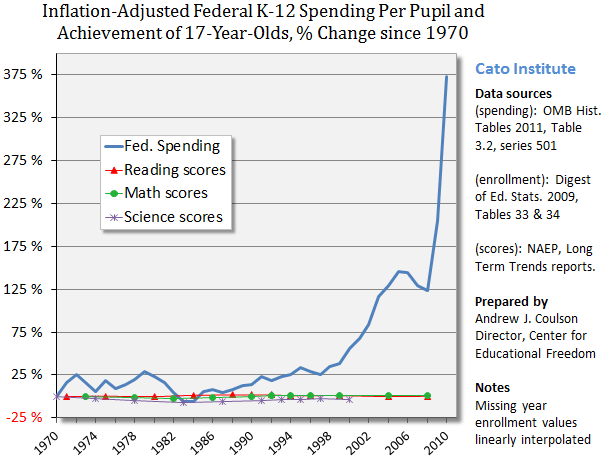
Worth a Thousand Words

Click to enlarge; original here.

Remember this graph the next time someone proposes spending more federal dollars in education.

Also remember how far removed Washington is from most state and local jurisdictions. Maybe those jurisdictions should have more say, and Washington less.

Alien Stimulus

If hostile aliens invade the planet, “this slump would be over in 18 months,” according to New York Times columnist Paul Krugman. It’s a bizarre way to express a bizarre idea: that war is good for the economy.

He draws an analogy with World War II, where the massive military buildup – conscription is left unmentioned – reduced unemployment and caused GDP to skyrocket.

The Independent Institute’s Mary Theroux points out:

The World War II years were a time of shared privation, with virtually every item that we take for granted today either rationed: e.g., meat, gasoline, sugar, clothing; or not available at any cost: e.g., new cars, appliances, etc. The American standard of living throughout World War II remained at an excruciatingly low level that no 21st century American would accept.

War does not create. It can only destroy. True, aggregate numbers like GDP can thrive during such troubled times. Workers were cranking out munitions like nobody’s business. But those workers’ actual standard of living was not high; everyday essentials were being rationed.

That’s the peril of relying on GDP as an economic barometer. It certainly has its uses. But over-reliance on it has made Krugman ignore other, harsher aspects of war. The fighting. The dying. The separated families, in some cases made smaller by the economic stimulus. The privation at home. The lost opportunities, economic and otherwise.

Krugman’s claim that an alien invasion would stimulate the economy is as alien to the economic way of thinking as our new overlords are to us.

Fortunately, not everyone is taking him seriously. A satirical Twitter account, @KrugmanAliens, is poking devastating fun.

Some readers might also be interested in this working paper I wrote a few years ago about the economics of war.

Did Spending Cuts Cause the UK Riots?

Here’s a letter I recently sent to The New York Times:

TO THE EDITOR:

 Richard Sennett and Saskia Sassen worry in their August 11 op-ed that government spending cuts may be causing the UK riots. They also hint at what that could imply for the U.S.

A problem with their argument is that government spending in the UK has gone up sharply over the last decade. Government spending there is currently about 45 percent of GDP. In 2000, it was only 34 percent. There were no riots then.

A similar story has played out in America. When President Clinton left office, federal spending was 18 percent of GDP. Now it is 24 percent.

If spending cuts cause riots, then we should have nothing to worry about. The fact that we do means something else must be behind the looting.

RYAN YOUNG
Washington, D.C. Aug. 11, 2011
The writer is a fellow at the Competitive Enterprise Institute.

Bizarre Taxes

The TurboTax blog has a fun infographic of weird taxes. From soda fountains to household pets, there’s a tax for almost any occasion.

How Not to Improve Traffic Conditions

In Arlington, Virginia, “Neighbors wanted $16,000 worth of speed humps, she said. What they got was $200,000 worth of concrete dividers and narrowed lanes that they said increased the risk of drivers being rear-ended while turning into the neighborhood.”

CEI Podcast for August 4, 2011: Liberalizing Trade


Have a listen here.

Congress is likely to take up stalled free trade agreements with Colombia, Panama, and South Korea when it returns from its August recess. Adjunct Fellow Fran Smith talks about the good and bad parts of the agreements. Billions of dollars of economic benefits are offset by trade-unrelated provisions, such as labor and environmental standards. These erode our trading partners’ lawmaking sovereignty. An increase in trade adjustment assistance also seems likely. This gives money and training to workers who lose their jobs because of international trade.

License to Rent-Seek

Few regulations are more blatantly anti-competitive than occupational licensing. Incumbents place barriers to entry to keep pesky competitors out of the market. Licensed occupations also enjoy an artificial 15 percent wage premium because of the supply restrictions. The Economist recently ran a column on licensing’s rent-seeking aspects:

But the people who care most about this issue—the cartels of incumbents—lobbied the loudest. One predicted that unlicensed designers would use fabrics that might spread disease and cause 88,000 deaths a year. Another suggested, even more alarmingly, that clashing colour schemes might adversely affect “salivation”. In the early hours of May 7th the bill was defeated. If Republican majorities cannot pluck up the courage to challenge a cartel of interior designers when Florida’s unemployment rate is more than 10%, what hope has America? The Licence Raj may be here to stay.