Category Archives: Economics

A Backdoor Tax on the Poor

For some time now, the IRS has been flirting with what’s called a return-free system. Instead of you having to sit down and fill out your 1040, the IRS would fill it out for you and tell you how much you owe.

It’s being touted as a time-saver. But it would also raise taxes on the poor. No matter how much personal information the IRS collects on someone, it is almost certain to miss deductions that person qualifies for.

There is also the tiny little conflict of interest that occurs when one’s tax collector is also one’s tax preparer. In an op-ed in The Hill, I explain why people of all political stripes should oppose a return-free program:

A return-free tax system has something for everyone to hate. Progressives should be up in arms over its disproportionately hurting the poor. So should privacy advocates; the IRS does quite enough snooping as it is. And conservatives should oppose return-free because, even though tax rates would remain unchanged, it is still a tax increase.

There are much better ways to reduce the 26-hour burden Americans face every year. The obvious solution is to simplify the 70,000-page tax code.

Read the whole thing here.


Why Some Economists Are Better Remembered than Others

In this interview, Russ Roberts talks about the Keynes vs. Hayek rap videos he made with John Papola. His best quote:

Keynes seemed immortal—no matter how many times the economics profession buried him, the politicians would bring him back from the dead.

Most likely because he said exactly the things politicians wanted to hear. Had Keynes come to different normative conclusions, he would not be so fondly remembered in Washington.

How Trade Restrictions Hurt America

This new video does a great job of explaining why anti-dumping duties intended to protect American industry from foreign competition have backfired. Badly. Click here if the embedded video doesn’t work.

Hayek and Conservatives

F.A. Hayek is an unlikely conservative hero. After all, this is a man who titled one of his most famous essays “Why I Am Not a Conservative.” He self-identified as a liberal – in the original sense of the word, which more or less means what we would today call libertarian. Since liberalism took on an entirely different meaning during the 20th century, Hayek wrote that he would settle for being called an Old Whig. But he could not stand to be called a conservative.

For one, he believed that “the conservative does not object to coercion or arbitrary power so long as it is used for what he regards as the right purposes. He believes that if government is in the hands of decent men, it ought not be too much restricted by rigid rules.”* Sounds an awful lot like the Bush years.

Sure, No Child Left Behind will radically grow federal involvement in education, which is properly a state and local issue. But we have good intentions! Sure, the PATRIOT Act could easily be abused. But it’s ok, because our guys are in charge! They’d never overstep their boundaries.

Conservatism, Hayek argued, is not a rigorous philosophy. It is “essentially opportunist and lacks principles.”**

That’s why I was surprised to see that the Heritage Foundation, a proudly conservative think tank, published an abridged edition of Hayek’s classic 1944 book The Road to Serfdom. Heritage’s economic policies are reasonably free-market, at least when Democrats are in power. So it makes sense that they would be Hayek fans, even though they aren’t ideological soulmates. But I am wary that they are promoting him as a conservative thinker; he was not.

Still, popularization is one of the most important tasks a think tank can perform. It is also one of the most neglected. Kudos, then.

The heart of The Road to Serfdom is Hayek’s version of a slippery slope argument. It is an easy charge to level at the current administration, which could be another motivation for Heritage.

Hayek and Heritage would agree: government intervention tends not to get the results it seeks; intentions are not results. Frustrated economic planners believe the only solution is more intervention. When that fails, still more meddling ensues. And on, and on. Then one day the people wake up to find they have lost their freedom.

The lesson is to not give in to the urge to use the hammer of government to drive home the nails of social problems. There are better ways, and less destructive hammers with more precise aim.

That’s the popular understanding of The Road to Serfdom. But Hayek pointed out in 1973 that there is more nuance to his book:

What I meant to argue in The Road to Serfdom was certainly not that whenever we depart, however slightly, from what I regard as the principles of a free society, we shall ineluctably be driven to go the whole way to a totalitarian system.  It was rather what in more homely language is expressed when we say:  “If you do not mend your principles you will go to the devil.”

The Bush and Obama administrations have joined together to double the size of government in one short decade. Their spending and regulating has driven debt through the roof, slowed economic growth, and kept millions of jobs from being created.

Worse, this bipartisan binge of government activism is showing no signs of slowing down. Many people think we’re already well down the road to serfdom. It looks bleak. But it isn’t really. It is reversible; the road to serfdom is a two-way street. We can go back, so long as we remember the principles of a free society.

The trouble is that conservatives seem to forget the libertarian portions of their philosophy every time they win an election. That’s why I’m glad that Heritage is popularizing Hayek with an abridged, easy-to-read version of The Road to Serfdom. I just hope they don’t portray him as a symbol of an ideology he publicly rejected.

More people of all political stripes need to read Hayek and be exposed to his arguments. More people need to learn why government does harm, even when it tries to do good. More people need to learn how easy it is to go down the road to serfdom — and that our cars can go in reverse, too.

The more people realize this, the higher the odds that they will keep conservative politicians in check post-election. If the Bush-Obama disaster has taught us anything, it’s that the seduction of power makes even good men go to the devil.

I hope Heritage’s popularization of Hayek sends that important lesson far and wide — while acknowledging that he doesn’t fit into the progressive/conservative spectrum; Hayek was nothing if not an independent thinker.

*F.A. Hayek, The Constitution of Liberty, p.401.

**Ibid.

Advice for Legislators – and Economists

Wise words:

“Whether one is made happy or unhappy by the conclusions of economics does not affect the validity of these conclusions. And these scientific conclusions should not be presented in a manner that might suggest that they did make the economist happy (or otherwise).”

-Israel Kirzner, Ludwig von Mises: The Man and His Economics, p. 165.

Yes, Regulation Does Keep Unemployment High

Over at RealClearMarkets, my colleague Wayne Crews and I argue that the law of demand holds. Hard to believe that’s actually controversial, but that’s Washington for you. Here’s our conclusion:

Eberly was put in an uncomfortable position when she came to Washington. Just as a lawyer’s job is to vigorously defend clients even if she knows they are guilty, Eberly’s job is to vigorously defend policies that are obviously harmful to the economy. Try as she might, she cannot argue against the law of demand.

Regulations make hiring costlier and thus make jobs scarcer. And regulatory uncertainty makes companies reluctant to hire employees they might not be able to afford down the road. Case closed.

Read the whole thing.

For the Children

The people of Illinois don’t expect their government to be corrupt; they insist on it. That’s why nary an eyebrow was raised when it recently came out that two lobbyists for the Illinois Federation of Teachers were able to qualify for generous teachers’ pensions by working as substitute teachers for one day.

One man could receive up to $3.8 million if he lives to age 84. This is in addition to the 401(k) the union gives him as an employee. The Chicago Tribune reports:

Preckwinkle’s one day of subbing qualified him to become a participant in the state teachers pension fund, allowing him to pick up 16 years of previous union work and nearly five more years since he joined. He’s 59, and at age 60 he’ll be eligible for a state pension based on the four-highest consecutive years of his last 10 years of work.

His paycheck fluctuates as a union lobbyist, but pension records show his earnings in the last school year were at least $245,000. Based on his salary history so far, he could earn a pension of about $108,000 a year, more than double what the average teacher receives.

Nationwide spending on K-12 education is around $13,000 per child per year. Not all of that spending is actually for the children, contrary to popular rhetoric. Fortunately, it appears only two people took advantage of this scheme. But the real kicker is that one of the two actually helped write the legislation that made it possible.

CEI Podcast for October 20, 2011: Congress Passes Free Trade Agreements

Have a listen here.

CEI Adjunct Fellow Fran Smith, coauthor of the new CEI study “Free Trade without Apology,” talks about the recently passed free trade agreements with Colombia, Panama, and South Korea. The agreements will lower tariffs and other trade barriers between the U.S. and the other countries, and are expected to reap billions of dollars of economic benefits. The agreements also contain a number of trade-unrelated provisions, such as labor and environmental standards. These erode our trading partners’ sovereign lawmaking power, and are best avoided in future agreements.

Fun Fact of the Day

49 percent of Occupy Wall Street protesters support bank bailouts, according to Douglas Schoen, a partisan Democratic pollster who worked for President Clinton.

I’m as surprised as you are! These protests are supposed to be against cronyism, not 49 percent in favor of it.

Then again, Zuccotti Park is not exactly a fount of policy knowledge, as New York Magazine discovered.

Regulatory Capture in Action

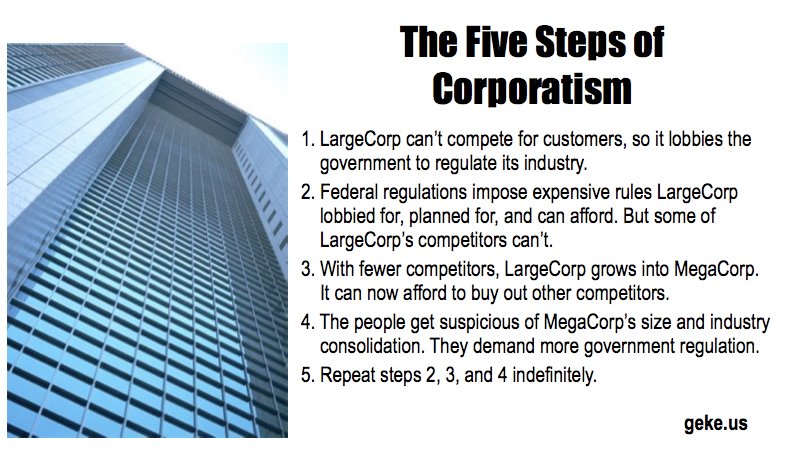
This picture has been making the rounds on the Internet. Click to enlarge. Keep in mind that it does not describe capitalism; it describes cronyism.