Category Archives: Economics

Progressives Should Be Wary of a Minimum Wage Increase

President Obama set off quite a debate when he proposed raising the federal minimum wage from $7.25 $9.00 per hour. Minimum wage hikes poll very well, especially among progressives. Over at the American Spectator, I argue that progressives should look elsewhere for ways to help the poor:

Then there is the matter that high minimum wages help big businesses at the expense of smaller competitors. When states are considering hiking their minimum wages, big companies like Walmart routinely lobby in favor of the increases. They know that while they can afford the extra payroll, the mom-and-pop store down the road might not be able to. Advantage: Walmart.

Just because a progressive proposes a policy doesn’t mean that the policy is, in fact, progressive. A high minimum wage causes regressive income redistribution.

Read the whole thing here.

CEI Podcast for February 21, 2013: The Wages of Sin Taxes

sin tax
Have a listen here.

CEI and the Adam Smith Institute have teamed up to publish a U.S. edition of Christopher Snowdon’s study “The Wages of Sin Taxes.” He argues that sin taxes are an ineffective way to treat the harmful effects of drinking, smoking, and obesity. Fellow in Consumer Policy Studies Michelle Minton wrote the foreword.

Supply-Side Democrats

jfk_anniversary_300
The only significant difference between the Republican and Democratic parties is their rhetoric. When it comes to policies actually enacted, a much better metric, they are remarkably similar. Despite their similarities, the parties will still reliably oppose whatever the other team is proposing.

A case in point is how tax cuts affect total revenues. Reagan-era supply-side economists argued that tax cuts, by sparking economic growth and aggregate spending, could actually increase tax revenues under certain conditions. Their basic insight that tax revenue has dynamic economic effects was, and is, correct. But the dynamic effects were too small to counteract the lower marginal rates, let alone Reagan’s spending hikes in defense and other areas; the deficit grew. Democrats have sneered at supply-side tax ideas ever since.

Of course, twenty years before that, Democrats were proposing exactly the same policy, and for the same reason. In chapter 16 of Passage of Power, the fourth volume of Robert Caro’s Lyndon Johnson biography, Johnson has just assumed the presidency, and is figuring out how to pass as much of the late John F. Kennedy’s legislative program as possible, beginning with the FY 1965 budget. His thinking was this would improve his chances of winning the 1964 election. Caro explains how progressives (he misuses the word “liberal”) and conservatives butted heads in that year’s budget battle:

Liberals wanted a larger role for government, wanted bigger, and new, government social welfare programs and therefore a larger budget. They believed the $11 billion tax cut [proposed by Kennedy] would, by putting more money into people’s pockets, stimulate the economy and thereby increase tax revenues, and the money the government would have available for these programs. Conservatives, uneasy about an expansion in government’s role and about the proposed new programs, were opposed to the higher spending, and believed the deficits would be increased by the tax budgets.

Somewhere, Art Laffer is either smiling or scowling. Not sure which.

On the Interwebs: Minimum Wage

Yesterday I participated in a discussion on President Obama’s proposal to raise the minimum wage on Huffington Post Live. I can’t figure out how to embed the video in this post, but you can watch it here.

CEI Podcast for February 14, 2013: Dodd-Frank’s Constitutionality

dodd and frank
Have a listen here.

CEI General Counsel Sam Kazman discusses a lawsuit in which CEI, the 60 Plus Association, and the State National Bank of Big Spring, Texas argue that parts of the Dodd-Frank financial regulation bill are unconstitutional. Both the bill’s grant of Orderly Liquidation Authority to the Treasury secretary and the Consumer Financial Protection Bureau’s unaccountability fail to pass constitutional muster. The plaintiffs are joined by 11 states.

The Armchair Economist Interviewed

The new issue of RegionFocus, published by the Richmond Fed contains an interview with Steven Landsburg, one of my favorite economists. In this quote, he explains his habit of drawing counterintuitive conclusions from widely accepted basic principles:

Counterintuitive examples do run the risk of just causing some people to shut down. But I like them because, first of all, they’re fun. We laugh at jokes because they’re counterintuitive. They appeal to the sense of playfulness in us. So, partly, it filters the audience. The people who are just not willing to listen to something counterintuitive are probably the people who are not going to learn anything anyway. It brings in the sort of people who have more open minds.

Beyond that, when you are forced to a really counterintuitive conclusion, from what appeared to be completely noncontroversial principles, that’s when you’ve learned something. I mean, if all we ever learned were things we sort of knew anyway, then we wouldn’t really be learning. The fact that a set of noncontroversial principles leads to a very surprising conclusion causes you to become aware that those principles are much more powerful than you thought they were. It causes you to confront your prejudices, causes you to open your mind up and be willing to see the world in a somewhat wider way, and makes you more open to the idea that you might be wrong about other things. It helps you understand that there might be a lot of things that are worth rethinking that you didn’t have exactly right the first time around.

The world would be a better place if more people, economists or not, shared Landsburg’s intellectual humility and open mind. Read the whole interview here (PDF). Landsburg’s blog is also worth reading.

The Case for Unilateral Free Trade

When one country puts up a barrier to foreign trade, its partners tend to return the favor. This is, to put it politely, a poor recipe for economic health. On page 360 of Lawrence White’s excellent book The Clash of Economic Ideas, he quotes Joan Robinson explaining why in one pithy sentence:

The logic of embracing free trade unilaterally, that is, no matter what policy any other national government adopts, is well expressed in an adage attributed to the economist Joan Robinson: Even if your trading partner dumps rocks into his harbor to obstruct arriving cargo ships, you do not make yourself better off by dumping rocks into your own harbor.

National governments tend to ask for a quid pro quo from their citizens’ trading partners before lowering tariffs and quotas and other nonsense. One understands the impulse; that is why it takes internationally negotiated agreements such as NAFTA to get anyone to dredge up said rocks. The point is that those rocks are a bad thing in and of themselves. Get rid of them, then. Even if you have to do it alone.

Headline of the Day

Comes from the New York Times, circa 1945 in the aftermath of the Labour Party’s trouncing of Winston Churchill:

After winning the election by a wide margin, Prime Minister Atlee informed reporters that he, not Professor Laski, would be in charge of policy making. The New York Times duly ran a story with the droll headline: “Britain Not Run by Intellectuals.”

-Lawrence White, The Clash of Economic Ideas, p. 174.


The First Law of Congressional Behavior

On page 140 of Douglas Arnold’s book The Logic of Congressional Action, while discussing why Congressmen are so reluctant to close unneeded military bases in their home districts, he states the first law of congressional behavior:

[N]ever impose costs on one’s constituents that might be directly traced to one’s own individual actions.

This is both true and important. Reforms that ignore this law are doomed to failure.

Sequestration: Not a Cut

the-terror-of-spending-cuts

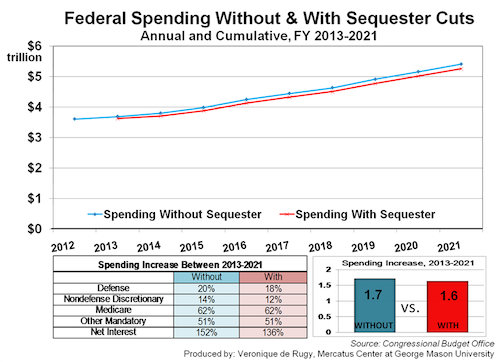
A very important point is being almost entirely overlooked in the sequestration debate: sequestration wouldn’t actually cut spending. As I’ve pointed out before, a cut is when spending goes down. Under sequestration, projected spending increases would merely be a little smaller. Federal spending is set to go up every year through at least 2021, sequestration or not.

It says a lot about the power of political inertia that something as inconsequential as sequestration generates months of dire headlines and heated debate. This is not a cause for optimism. If you prefer a slightly sunnier view, read Peter Suderman’s insightful Hit & Run post (from which I also poached the above chart).