From Politico: “The IRS softball team in Washington canceled a game scheduled for Friday against a team from Texas Sen. John Cornyn’s office and wasn’t able to reschedule.”
The plot thickens.

From Politico: “The IRS softball team in Washington canceled a game scheduled for Friday against a team from Texas Sen. John Cornyn’s office and wasn’t able to reschedule.”
The plot thickens.
Well worth five minutes of your time. Features the ACLU’s Michael MacLeod-Ball, David Keating from the Center for Competitive Politics, and Cato’s John Samples and Gene Healy (Gene’s column on the same subject is also worth reading). Click here if the video embedded below doesn’t work.
Comments Off on New Cato Video on the IRS Scandal
Posted in Political Animals, Taxation
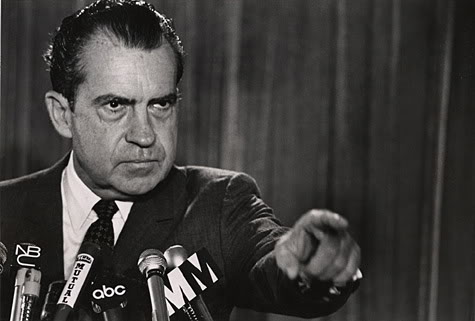
The only surprising part of this story is that the IRS apologized. Whichever party is in power, its critics can expect more IRS attention than usual. Since the executive branch is currently run by a Democrat, tax-exempt groups with phrases like “tea party” and “patriot” in their names were targeted. But the tables turn when a Republican is president. Charlotte Twight gives a historical example on p. 271 of her book Dependent on D.C.:
Republican President Richard Nixon in 1971 expressed his intention to select as IRS commissioner “a ruthless son of a bitch,” who “will do what he’s told,” will make sure that “every income tax return I want to see I see,” and “will go after our enemies and not go after our friends.”
President Bill Clinton, a Democrat, is also alleged to have abused his position to punish political enemies.
Conservatives are right to be outraged by today’s news. But they shouldn’t be surprised by it. Nor should they direct their ire at President Obama or the IRS staffers who initiated the unnecessary investigations. They should be outraged that politics has become such a high-stakes game in the first place that officeholders view this type of behavior as a legitimate political tactic. The problem is systemic, not partisan.
Comments Off on IRS Apologizes for Targeting Conservative Groups
Posted in Political Animals, Taxation
One criticism I face fairly often is the assertion that I must be dishonest — I must be cherry-picking my evidence, or something — because the way I describe it, I’m always right while the people who disagree with me are always wrong. And not just wrong, they’re often knaves or fools. How likely is that?
But may I suggest, respectfully, that there’s another possibility? Maybe I actually am right, and maybe the other side actually does contain a remarkable number of knaves and fools.
Evidence of a closed mind. Always such a sad thing to see.
Comments Off on Certainty with a Capital C
Posted in Certainty, Economics, Philosophy
I am neither a Thatcherite nor a Reaganite, but I’d still take either of them over today’s Republican Party in a heartbeat. Reflecting on Thatcher’s recent passing, Warren Brookes Fellow Matthew Melchiorre and I explore that theme in today’s American Spectator:
In pursuing what she described as an “enterprise society,” Thatcher revolutionized politics on both the right and the left. In fact, her policies were so popular with the working class its support for the Conservative Party was 51 percent higher than normal during her term, according to our calculations of polling data. Thatcher’s restoration of the Conservative Party as a credible alternative to Labour gave Tony Blair no choice but to re-brand Labour into the more market-oriented “New Labour” to win national elections again.
What can today’s Republicans learn from comparing Thatcher’s legacy with their own? The GOP’s failure to match tax cuts with spending cuts hasn’t worked — in the economy or at the ballot box. A better approach to encourage entrepreneurship would be to make real spending cuts, lighten regulation to free up access to credit, and restore government finances through a simpler tax code instead of higher rates.
Thatcher certainly earned her nickname, the Iron Lady. It is a shame that, across the board, today’s politicians are made of much more malleable material. Read the whole thing here.
Comments Off on Margaret Thatcher vs. Today’s GOP
Posted in Economics, Political Animals, Publications

It may not be a popular fact, but a fact it is: the environment is getting cleaner, and it has since about the mid-20th century. The question is, what caused this improvement? How can we keep it going? Over at Topix.com, my colleague Geoffrey McLatchey and I argue that the best answer for both questions is wealth creation:
Economic growth and environmental quality are not opposing values. They go hand-in-hand. Something happens to a country when its per capita GDP reaches about $5,000 (U.S. per capita GDP is about $48,000). At that point, families are certainly not rich. But they don’t have to worry as much about where their next meal will come from. They can afford to begin to take care of other needs, such as building sewage systems and other pollution-reducing infrastructure. Instead of using wood for heating and cooking, people can turn to more efficient fossil fuels, which means less deforestation. Farmers can afford to adopt modern techniques that produce more food with less land, leaving more left over for wildlife.
That’s the good news. The even better news is that greater progress is on the horizon. The number of people living in absolute poverty halved between 1990 and 2010, and the number continues to dwindle. Remarkably, this is happening even as global population increases. As more countries pass the $5,000-per capita benchmark, ecosystems around the world will benefit.
Read the whole thing here. Even if people do concede to the data and admit that the world’s environmental situation isn’t doom-and-gloom, they often give credit to the EPA. A glance at my recent EPA report card will hopefully disabuse people of that notion. Innovation, not regulation, is what will keep the environment healthy. That’s the lesson people should take from Earth Day.
Comments Off on Earth Day: The Greener Side of Growth
Posted in Economics, Publications, The New Religion
Two great quotes from “Economists and Public Policy,” from Coase’s collection Essays on Economics and Economists:
If we took seriously the argument used by those who advocate price controls and similar measures, we would expect much more extreme, and less sensible, proposals than are actually put forward. Thus, some senators belive that lower prices for gasoline would benefit consumers, so they introduce a measure which would make the gasoline prices of last December [1973] mandatory, not the still lower prices that prevailed in the 1930s.
Which implies that even senators tacitly acknowledge the laws of economics. The quotation below is self-explanatory, and has rightly become famous:
An economist who, by his efforts, is able to postpone by a week a government program which wastes $100 million a year (what I would consider a modest success) has, by his action, earned his salary for the whole of his life.
Comments Off on The Wisdom of Ronald Coase
Posted in Books, Economics, Great Thinkers
From Gordon Tullock’s 1986 essay “Industrial Organization and Rent Seeking in Dictatorships,” in particular on p.124 of Vol. 5 of his collected works, The Rent-Seeking Society (footnote omitted):
I have currently been reading a series of articles in The Washington Post in which a communist official in Vietnam is quoted as saying that their society is stabler than other South East Asian countries’ because although it is extremely poor, the poverty is evenly spread. The reporter clearly thought this was a significant argument.
Odd though this thinking is, it is also common. I humbly submit that it is more humane to be concerned with how to better the lot of the poor, rather than the mathematical ratio between the poor and the wealthy. This is literally the difference between caring about people versus numbers.
Comments Off on Not the Strongest Argument for Income Equality
Posted in Economics, Philosophy, Public Choice
Once a government policy is in place, it is almost impossible to repeal. As Gordon Tullock points out, this is especially true when a policy is the result of rent-seeking — a private company using government to secure ill-gotten gains. Tullock explains this “transitional gains trap” on p. 68 in volume 5 of his collected works, The Rent-Seeking Society:
The problem posed by the transitional gains trap is the ratchetlike nature of rent seeking. Once a rent has been successfully sought out through government lobbying, it is very difficult to remove even after it has ceased to produce positive benefits for its rent-seeking beneficiaries. Its elimination almost always implies losses for those who now exercise the privilege. To avoid such losses, they will rent-seek yet again to retain the privileges. Politicians are rightly reluctant to inflict direct losses on specific sections of the electorate — inevitably a losing strategy.
Once in place, always in place. Inertia wins.
Comments Off on The Transitional Gains Trap
Posted in Economics, Public Choice
It has always been fashionable to lament the decline of morals and decency. Every generation has had some variation of the “kids these days” trope. Applying this folk wisdom to modern century politics, the rise of special-interest groups during the 20th century must certainly have been a disturbing development to witness. Even today, it seems like pressure groups grow more powerful with every election cycle. What is happening to our democracy?
Whatever is going on, moral decay has little to do with it. On pp. 285-6 of their classic Calculus of Consent, James Buchanan and Gordon Tullock offer a much more realistic theory on why K Street is what it is:
A hypothesis explaining the increasing importance of the pressure group over the last half century need not rest on the presumption of a decline in the public morality. A far simpler and much more acceptable hypothesis is that interest-group activity, measured in terms of organizational costs, is a direct function of the “profits” expected from the political process by functional groups.
In other words, if the amount of money in politics disturbs you, then you should advocate for less politics. Just as bank robbers go where the money is, so do rent-seekers.
Comments Off on The Origin of Interest Groups
Posted in Books, Economics, Political Animals, Public Choice

 Inertia Wins!