Category Archives: Economics

Cronyism and the Export-Import Bank

Over at Rare, I have a piece on the cronyism angle of the Export-Import Bank debate. The Senate will likely vote this month on whether or not to end the bank:

[I]f government is going to dole out corporate welfare, the most efficient way to do it is to hand out cold, hard cash. Straight subsidies don’t distort international markets or invite corruption the way export subsidies do.

But most cash gifts to corporations are political non-starters. They’re a little too obvious. So companies and allied politicians need cover stories. The Export-Import Bank fits the bill.

An official logo, sophisticated-sounding economic rhetoric, and appeals to American jobs and patriotism are designed to make people feel good about the special favors Ex-Im performs for businesses.

Read the whole thing here.

Ex-Im’s Invitation to Corruption

When government has a lot of money and power, it is natural for people to curry its favor. It is just as natural for those wielding money and power to use it for personal gain. The Export-Import Bank has just provided the latest real-world example of this human frailty. The Wall Street Journal is reporting that four Ex-Im employees have been removed or suspended in recent months, “amid investigations into allegations of gifts and kickbacks.”

The article names one employee, Johnny Gutierrez, who accepted cash payments from an executive of Impex Associates, a construction equipment manufacturer that has received Ex-Im financing on multiple occasions. The other cases involve two “allegations of improperly awarding contracts to help run the agency,” and another employee who accepted gifts from an Ex-Im suitor. A spokesman responded to the allegations by noting that “the Export-Import Bank takes extremely seriously its commitment to taxpayers and its mission to support U.S. jobs.”

These are not isolated incidents. Over at the Daily Signal, Diane Katz notes that 74 potential cases of fraud have occurred since April 2009, just five years ago. For an agency with only 400 employees, this is a very serious problem.

These corruption allegations offer another reason to end the Export-Import Bank. Fortunately, the Bank’s charter expires on September 30. If Congress doesn’t vote to extend that charter, the Bank will automatically cease to exist, and the Treasury Department will wind down Ex-Im’s $140 billion portfolio.

With Ex-Im gone, companies would spend a little less time wooing government officials, and more time actually creating value for consumers. Getting rid of Ex-Im wouldn’t just help the economy, it would remove one of Washington’s numerous opportunities for corruption.

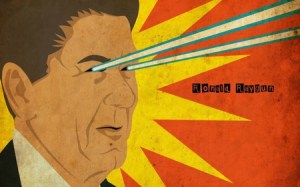
Ex-Im Reauthorization Fight: Release the Reagan

ronald raygun
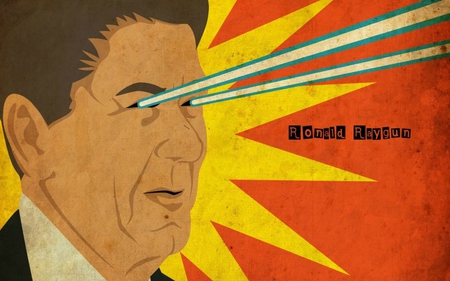
The Export-Import Bank is up for reauthorization in September. If the vote fails in Congress, the Bank and its $140 billion portfolio will cease to exist. In an effort to appeal to free-market types who oppose Ex-Im, the Aerospace Industries Association is invoking Ronald Reagan. A page two ad in yesterday’s Politico and an accompanying fact sheet sent to every member’s office on Capitol Hill prominently feature Reagan’s image and include quotes of the Gipper praising Ex-Im.

The fact sheet notes that Reagan increased the cap on Ex-Im’s lending portfolio by 14 percent from 1981-86, from $8.8 billion to $12 billion. Then again—Reagan cut Ex-Im in 1983 and again in 1988. And over Reagan’s entire time in office, Ex-Im’s cap actually shrank in real terms. You can check the numbers yourself with the Minneapolis Fed’s handy inflation calculator.

And as Veronique de Rugy ably points out here and here, Reagan was no fan of the Export-Import Bank, and said so publicly (see also video evidence).

The fact sheet also contains this gem of a quote:

“Why does a small group of fringe political organizations oppose the U.S. Export-Import Bank? Because they favor the interests of foreign nations over American businesses.”

Where to begin? One, the argument from consensus is a well-known logical fallacy. I don’t know how many people favor or oppose Ex-Im, but I do know it’s based on bad economics and is one of the government’s largest corporate welfare programs.

Two, I was unaware until reading this fact sheet that as an Ex-Im opponent, I “favor the interests of foreign nations over American businesses.” That charge is actually true of Ex-Im itself. When the Bank guarantees loans to foreign airlines for buying Boeing planes, they are literally subsidizing domestic airlines’ direct foreign competitors.

As a general rule, it is better to analyze arguments rather than motives. But roughly 40 percent of Ex-Im’s activities benefit a single company, Boeing, that is a major part of America’s aerospace industry. Even though they surely know the arguments are overwhelmingly against Ex-Im, one understands why they’re fighting so hard to preserve their privilege. One also understands why they are using such shoddy arguments—those are the only kind they have.

If Ex-Im beneficiaries want government handouts—and clearly they do—it would be far more efficient for the government to simply give them cash. Such a policy wouldn’t distort financial markets and international business decisions. The problem is that a naked cash grab would strike voters and most everyone else as unseemly. As the economist Gordon Tullock pointed out, this is precisely is why rent-seekers and politicians create cover stories such as the Export-Import Bank. The trouble is that these cover stories cause real harm to others, from capital-needy startups to established companies like Delta Airlines. The Ex-Im fight could use more honesty on what it’s really about.

Images of Ronald Reagan and appeals to patriotism are cynical ways to lure conservatives into supporting the Export-Import Bank. But Reagan didn’t actually support the Bank, and its mercantilist economics were debunked centuries ago by Adam Smith and David Ricardo. It’s time to move on.

Laughing All The Way to the Export-Import Bank

The Kronies are back with a video about the Export-Import Bank, one of the federal government’s largest corporate welfare programs. While the video is less than subtle, it makes the rent-seeking and deal-making surrounding the Bank very clear. Fortunately, the Bank’s charter expires on September 30 of this year. Ex-Im will cease to exist unless Congress votes to reauthorize it. CEI’s Iain Murray recently weighed in on the Ex-Im fight here.

Cronyism is far from the Export-Import Bank’s only problem. It also has enormous opportunity costs. There is only so much investment capital to go around. Every time Ex-Im secures favorable financing for a debacle such as Enron or Solyndra, or a sound company like Boeing or Caterpillar that doesn’t need taxpayer help, a deserving company elsewhere has to pay higher interest rates, or may even be denied financing altogether. The Ex-Im Bank’s portfolio is currently in the neighborhood of $140 billion. This is an enormous amount of capital being politically-directed, instead of market-tested. Here’s hoping Congress decides to end the Export-Import Bank this fall.

Public Choice 101: Carl Sagan Edition

From pages 332-333 of Sagan’s superb novel Contact, as spoken by protagonist Ellie Arroway:

“This planet is run by crazy people. Remember what they have to do to get where they are. Their perspective is so narrow, so… brief. A few years. In the best of them a few decades. They care only about the time they are in power.”

I greatly admire Carl Sagan, though his politico-economic analysis is usually rather naive. This time, he nails it.


Debunking Cognitive Biases

My former professor Bryan Caplan stars in a series of short videos about four cognitive biases that explain why voters systematically vote for bad policies. You can read about them in detail in his 2007 book Myth of the Rational Voter, or you can watch these videos:

Make-Work Bias

Pessimistic Bias

Anti-Market Bias

Anti-Foreign Bias

What Hollowed Out Military?

Politico ran a story earlier this week with the headline “How Congress Is Hollowing Out the Military.” Congress is forcing the Pentagon to pay for many expensive weapons programs it neither wants nor needs. This leaves less funding available for defense-related defense spending. Sequestration is putting further pressure on military finances. In fact, the winding down of Iraq and, one hopes, Afghanistan, have led to actual cuts in the DOD’s budget. The authors worry about how this could affect military readiness if an actual defense-related conflict were to arise.

To put this hollowness in context, I looked up a historical table (Excel format) of agency spending. It turns out the military has more than doubled its spending since 2000, from $290 billion to $586 billion in 2014. This is down from a 2010 peak of $695 billion, when Iraq and Afghanistan (and everywhere else the last two adminstrations have ventured) were more fiercely contested than today. The current defense budget is hardly austere.

I would be delighted to see Congress scrap unneeded weapons programs, though public choice problems probably preclude it. Regardless of political developments going forward, defense hawks need not worry about the Pentagon’s budget. Its long-run growth is practically assured, regardless of who is in power.

Trade and Immigration Restrictions Have Evolutionary Origins

It’s a point I’ve made before, but human beings are hardwired to affirm their in-group and vilify out-groups. It takes a lot of social conditioning to get people to be polite to strangers. This also explains the continuing popularity of trade barriers and immigration restrictions, in the face of basic economics. It also explains why, despite massive improvements in recent decades, racism and homophobia will almost certainly never die. People will always look for reasons to not get along with each other.

According to Carl Sagan and Ann Druyan’s delightful 1992 book Shadows of Forgotten Ancestors, humanity’s inborn suspicion of outsiders actually predates humanity. It goes back billions of years, and has been observed in bacteria (see location 1773 of the Kindle edition):

You may be a ruthless, implacable predator, but you must also be a pushover for your relatives and neighbors. So all of you may suffuse your outer membranes with a chemical that serves for species recognition. When you taste this molecule emanating from another microbe, you become very affable. “Friend,” the chemical says. “Sister.” Other chemicals carry different information. Some bacteria routinely produce their own chemical warfare agents, antibiotics that are harmless to themselves and others of their own strain, but deadly to bacteria of different strains, foreigners. A delicate balance has evolved between hostility to the outside group and cooperation with the inside group. Them and us. The first intimations of xenophobia and ethnocentrism evolved early.

CEI Podcast for April 23, 2014: Reforming Fannie and Freddie

Have a listen here.

Senior Fellow John Berlau argues that a bill from Senators Tim Johnson and Mike Crapo intended to reform Fannie Mae and Freddie Mac would only make things worse.

CEI Podcast for April 17, 2014: Brexit Strategy

brexit-logo
Have a listen here.

Iain Murray, CEI’s Vice President for Strategy, along with Freedom Association Director Rory Broomfield, won second place in the Institute for Economic Affairs’ Brexit Competition. The goal of the competition is to devise a strategy for Britain’s exit from the European Union.