
Category Archives: Economics

The Hidden Trillion

In today’s Investor’s Business Daily, Wayne Crews and I have a piece about regulation. Federal regulations alone cost businesses and consumers $1.17 trillion last year. State and local rules are extra. We offer some ideas for lightening the load and stimulating the economy.
Fulfilling Prophecies

CBO estimated today that unemployment will top out at around 10.5% before it recovers. Congress is doing its part to make CBO’s dire prophecy a reality.

Rep. Alan Grayson is set to introduce the Paid Vacation Act, which would make it federal law for employers to offer paid vacation for employees (hat tip to Marc Scribner for finding the story). Rep. Grayson believes his bill will stimulate the economy. “Fewer sick days, better productivity and happier employees” will boost GDP and employment.

The Congressman may be unaware that when workers become more expensive to hire, employers hire fewer of them. Or else he is more concerned with making CBO’s predictions come true.

(Cross-posted at Open Market)

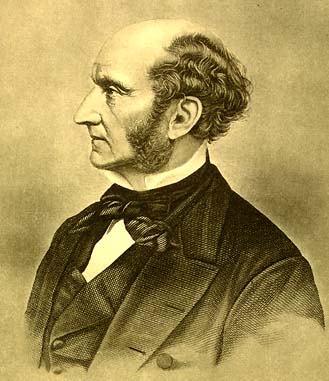
Happy 203rd Birthday, John Stuart Mill

John Stuart Mill was born on this day in 1806. He is best known for classical liberal writings like On Liberty and The Subjection of Women. College students today also learn about his philosophy of utilitarianism, inherited from father James Mill and family friend Jeremy Bentham.

Mill had an unusual life story, told in one of the most compelling autobiographies in literature. John’s father gave him an intensive education that, for example, had him reading ancient Greek at age three. John never had any formal schooling, and the only children with whom he was allowed contact were his siblings.

His father’s pedagogical experiment worked in that it gave John one of the most formidable intellects of his age. But it failed in other ways. His strict upbringing resulted in a nervous breakdown at age 20 that set him back years. He was always socially awkward, and didn’t marry until age 45 — itself an interesting story.

Mill made important contributions to economics, political science, and philosophy. A deep love of liberty runs through them all. I don’t personally agree with everything he wrote (utilitarianism leads to absurd conclusions when taken too far), but he remains one of brightest lights in the classical liberal pantheon. Happy birthday, John Stuart Mill.

(Cross-posted at Open Market)

Fed’s Policies Contradict Each Other

My colleague Seth Bailey and I have this letter in today’s Financial Times:

Sir, Henry Kaufman frets that “libertarian dogma led the Fed astray” (April 28). Congress, not free-market ideology, is the real culprit.One reason is mission creep. The Fed’s original job was to keep inflation low by keeping the money supply in check. That’s it. The Humphrey-Hawkins Act of 1978 expanded that mission to include keeping unemployment low.

Low-inflation monetary policy and low-unemployment monetary policy contradict each other. If the Fed keeps inflation low, then it cannot lower unemployment rates through an artificial inflation-induced boom. If the Fed wants to lower unemployment, it must forgo low inflation. Worse, since a bust always follows an inflationary boom, business cycles become more volatile.

The results speak for themselves. The Fed can control inflation – if left free from political interference. But it cannot also accomplish its other missions, especially through the un-libertarian means of manipulating price levels. Where is the libertarianism?

Ryan Young and Seth Bailey,
Research Associates,
Competitive Enterprise Institute,
Washington, DC, US

The Economics of Pirate Deterrence

How can we stop pirate attacks? By applying the law of demand. If something becomes more costly, people consume less of it. In this case, making piracy more costly means fewer people will become pirates.

How do this? One cruise ship company has an answer: fire back. Making piracy a riskier, more dangerous proposition — i.e., more expensive — forces pirates to think twice before attacking.

How disheartening, then, that both of the experts quoted in this news report oppose arming ships that pass through pirate-infested waters. They ignore the law of demand at the peril of innocent people.

This is exactly why I mourn economic illiteracy.

(cross-posted at Open Market.)

Ending Poverty

One of the central lessons of economics is that poverty is the natural order of things. Creating wealth requires active effort. It needs to be produced; “making money” is a literal statement.

Tyler Cowen, in the guise of a movie review, teaches that oft-ignored lesson as vividly as I’ve ever seen. Well worth a read.

Strange Logic

The logic behind the Bush-Obama stimulus runs like this: if people aren’t spending enough money to keep the economy afloat, then government should increase its spending to make up the difference. It’s conventional Keynesian theory.

Surprising, then, that President Obama asked federal departments to find $100 million dollars in cuts.

Does that mean that a $787 billion stimulus package is too much, but $786.9 billion is just right?

Trillions and Trillions

The latest trillion-dollar government proposal comes to us from the London G-20 summit: $1.1 trillion for the IMF and World Bank.

The human mind is not capable of comprehending numbers that large. Anything past the low hundreds, our brains simply categorize as “large.” This neat illustration can help.

Keep that picture in your head. One for the trillion-dollar stimulus. Another one for the new trillion-dollar banking bailout. One more for the federal budget deficit. And now yet another to cover the donations to the Bretton Woods institutions.

GM CEO to Resign

Rick Wagoner is stepping down, apparently on White House orders.

New leadership may well be a good move for GM. But that is a decision for GM’s board and shareholders to make. They have years of auto industry experience.

They also have a vested stake in the matter. If they fail, they lose the shirts off their backs. They have all the incentive in the world to choose wisely.

President Obama and the Presidential Task Force on Autos have none of these advantages.

Their line of thinking seems to be that GM is not fit to run itself. Given GM’s recent performance, they may well be right.

But how on earth does that imply that Washington can do better? The logic just doesn’t follow.

This mindset is arrogance. It is hubris.

Worse, it is poison to an already ailing economy.

(Cross-posted at Open Market)

How Not to Tax the Internet

The American Spectator Online ran an article of mine today on sales taxes on the Internet. Taxation without representation at its finest. Read it here.