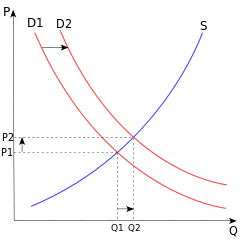
Gordon Tullock has a reputation for being rather salty at times. But, more often than not, he is right. This quotation captures both qualities:
[N]o teacher with classroom experience can really believe that everyone is perfectly informed.
Gordon Tullock has a reputation for being rather salty at times. But, more often than not, he is right. This quotation captures both qualities:
[N]o teacher with classroom experience can really believe that everyone is perfectly informed.
Comments Off on No Such Thing as Perfect Information
Posted in Books, Economics, Great Thinkers, Public Choice
“The great society indeed became possible by the individual directing his own efforts not towards visible wants but towards what the signals of the market represented as the likely gain of receipts over outlay.”
-F.A. Hayek, “Adam Smith (1723–1790): His Message in Today’s Language”, The Trend of Economic Thinking, 117. (PDF)
That process, writ large, is the single most powerful force in all the social sciences. It has conquered hunger, disease, and poverty wherever it has been allowed to operate with a reasonable degree of freedom.
Majoritarian democracy tends to result in milder governments than monarchies or dictatorships. But it is not without its perils, as James Buchanan pointed out in his paper “Predictability: The Criterion of Monetary Constitutions,” specifically on p. 416 of the first volume of his collected works, The Logical Foundations of Constitutional Liberty:
We should never lose sight of the fact that the average man knows little of economics and, worse than this, he does not know how little he does know.
That the median voter apparently has even less intellectual humility than a typical economist is unsettling. It also explains the persistence of many harmful economic policies, ranging from trade and immigration restrictions to minimum wage laws to price controls. Politicians win by giving the median voter what he wants. If he wants policies that make economists shake their heads, politicians will deliver them or lose their jobs to others who will.
As Buchanan would argue, the solution lies in institutional change. The current rules of the political game consistently give certain results. This is why reform is always difficult, and why the last two presidents have behaved so similarly despite belonging to different political parties. A political system that accounts for voters’ systematic cognitive biases would greatly reduce the harm caused by widespread economic ignorance.

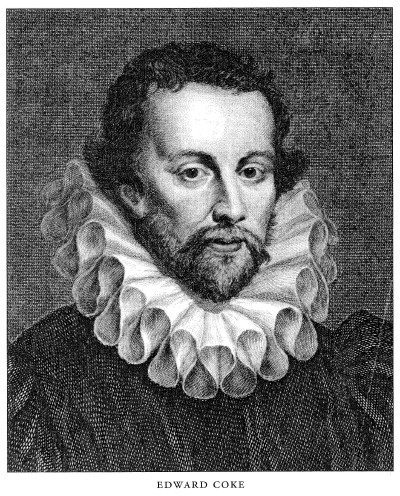
Francis Bacon and Edward Coke were intellectual rivals. Bacon was a father of the scientific method, and a hero to top-down engineering types. Coke was more from the bottom-up evolutionary common law tradition. When Bacon presented a copy of his New Organon to Coke, Coke inscribed this couplet on the title page:
It deserveth no to be read in Schooles
But to be freighted in the ship of Fooles
(F.A. Hayek, The Trend of Economic Thinking, 72.)
Comments Off on Great Insults from History
Posted in Books, General Foolishness, Great Thinkers, Philosophy

A bit of pith, courtesy of James Buchanan in his excellent rent-seeking primer, “Rent Seeking and Profit Seeking,” which can be found in pages 103-115 of the first volume of his collected works, The Logical Foundations of Constitutional Liberty (the quote is on p. 109):
Rent-seeking activity is directly related to the scope and range of governmental activity in the economy, to the relative size of the public sector.
Or, as the bank robber Willie Sutton supposedly put it even more pithily, “that’s where the money is.”
Comments Off on What Causes Rent-Seeking?
Posted in Books, Economics, Pith, Public Choice
Only the most naive of libertarians deny that market failures exist. Externalities, information asymmetries, and public goods problems, in their various combinations, regularly lead to outcomes that fall well short of the blackboard economist’s Pareto-optimal perfect competition model.
That’s all very well established. What isn’t is the leap in logic that most people make next: therefore, government. Well, maybe. But maybe not. If the goal is efficiency, it becomes an empirical question. But most economists treat government as a black box without its own desires, goals, and behavioral quirks. Government actors are people, too. This means that government is subject to the same failures as markets. Harold Demsetz called the common assumption of perfect government the Nirvana Fallacy.
Geoffrey Brennan and James Buchanan, without using its name, perfectly describe the Nirvana Fallacy on p. 130 of their 1985 book The Reason of Rules:
There is no necessary presumption that simply because markets are imperfect, political processes will work better. On the contrary, as public-choice theory reminds us, there are very good reasons for doubting the capacity of political processes to achieve Pareto optimality. The normatively relevant comparison is between two imperfect institutions.
In fact, built-in incentive problems ranging from concentrated benefits and diffused costs to higher discount rates and shorter time horizons mean that government is usually more imperfect than markets. People seeking to improve on market outcomes who do not factor this into their analysis are unlikely to succeed.

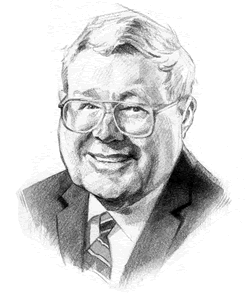
Anyone who has taken an introductory economics course has marveled at how easy it is to suss out the effects of different policies simply by manipulating the familiar intersecting Marshallian supply and demand curves. This geometric analysis is a useful tool for understanding how markets react to different types of changes. But using this approach to actually implement those changes in real life is another matter. Economics is a useful science, but it has its limits. This “blackboard economics,” as Ronald Coase calls it, exceeds those limits. In the introductory essay to his collection The Firm, the Market, and the Law, he explains (p. 19):
The policy under consideration is one which is implemented on the blackboard. All the information needed is assumed to be available and the teacher plays all the parts. He fixes prices, imposes taxes, and distributes subsidies (on the blackboard) to promote the general welfare. But there is no counterpart to the teacher within the real economic system.
Wise and humble words, often forgotten by economists who would rather be engineers.
Most classical liberals use a combination of utilitarianism and natural rights in their philosophical framework. Some, like Jeremy Bentham, reject rights altogether in favor of a purely “greatest good for the greatest number” approach. This is all well and good, except for the fact that it is impossible to calculate a person’s utility function.
Even if you could, you can’t meaningfully compare different people’s utility functions to each other. You can make ordinal comparisons (order of preference), but not cardinal (strength of preference) comparisons. This throws a rather large wrench into the pure utilitarian enterprise.
Bentham’s faux pas led to a Hayekian riposte from the mid-18th century philosopher and theologian Bishop Butler, shared by George H. Smith on page 155 of his excellent new book The System of Liberty:
Bishop Butler expressed a similar concern when he said that although God is probably a utilitarian, it is better that men not be, for they are likely to commit serious errors in calculating what will promote the greatest happiness for the greatest number.
Comments Off on Utilitarianism vs. Natural Rights
Posted in Books, Philosophy
The concept of lending money for interest hasn’t needed many defenders since roughly the Renaissance, when usury laws fell out of fashion. Even so, some people are still innocent of economics and the time value of money. They still attack the very notion of interest. Ludwig von Mises offers a pithy defense on p. 41 of 1940’s Interventionism: An Economic Analysis:
In order to do away with interest we would have to prevent people from valuing a house, which today is habitable, more highly than a house which will not be ready for use for ten years. Interest is not peculiar to the capitalistic system only. In a socialist community too the fact will have to be considered that a loaf of bread which will not be ready for consumption for another year does not satisfy present hunger.
Objections to interest then, must clear hurdles as high as human nature, hunger, and time itself. Good luck, I say.

The line of thought that Kurt Vonnegut describes on p. 27 of Breakfast of Champions isn’t true of all people, but it is still distressingly common.
Ideas on Earth were badges of friendship or enmity. Their content did not matter. Friends agreed with friends, in order to express friendliness. Enemies disagreed with enemies, in order to express enmity.
There is a good reason why Vonnegut’s depressing observation is true. Humans evolved as a tribal species, and we haven’t quite grown out of it yet. This is one reason an immigration debate still exists, even though economists decided the issue more than two centuries ago. More to the point, agreeing or disagreeing with people for merit-unrelated reasons is one way that people define their in-groups and out-groups.
Comments Off on Vonnegut on Partisanship
Posted in Books, The Partisan Mind