Monthly Archives: January 2013

Headline of the Day

Comes from the New York Times, circa 1945 in the aftermath of the Labour Party’s trouncing of Winston Churchill:

After winning the election by a wide margin, Prime Minister Atlee informed reporters that he, not Professor Laski, would be in charge of policy making. The New York Times duly ran a story with the droll headline: “Britain Not Run by Intellectuals.”

-Lawrence White, The Clash of Economic Ideas, p. 174.


CEI Podcast for January 31, 2013: The Recess Appointments That Weren’t

Judges-gavel
Have a listen here.

Federal judges recently struck down four recess appointments to the National Labor Relations Board, claiming the Senate was in pro forma session when President Obama made the appointments. Senior Fellow Matt Patterson talks about the case and its far-reaching consequences for the labor market, as well as the separation of powers.

The First Law of Congressional Behavior

On page 140 of Douglas Arnold’s book The Logic of Congressional Action, while discussing why Congressmen are so reluctant to close unneeded military bases in their home districts, he states the first law of congressional behavior:

[N]ever impose costs on one’s constituents that might be directly traced to one’s own individual actions.

This is both true and important. Reforms that ignore this law are doomed to failure.

Sequestration: Not a Cut

the-terror-of-spending-cuts

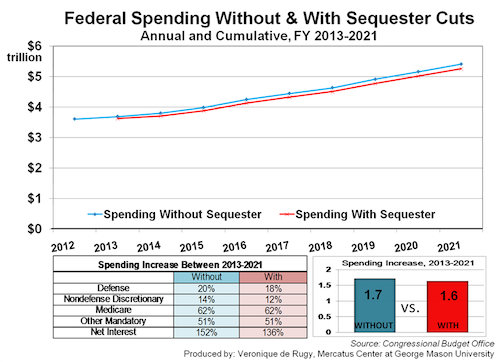
A very important point is being almost entirely overlooked in the sequestration debate: sequestration wouldn’t actually cut spending. As I’ve pointed out before, a cut is when spending goes down. Under sequestration, projected spending increases would merely be a little smaller. Federal spending is set to go up every year through at least 2021, sequestration or not.

It says a lot about the power of political inertia that something as inconsequential as sequestration generates months of dire headlines and heated debate. This is not a cause for optimism. If you prefer a slightly sunnier view, read Peter Suderman’s insightful Hit & Run post (from which I also poached the above chart).

CEI’s Battered Business Bureau: The Week in Regulation

citrus grove
This week in the world of regulation:

  • Last week, 56 new final regulations were published in the Federal Register. This is up from 54 new final rules the previous week.
  • That’s the equivalent of a new regulation precisely every 3 hours — 24 hours a day, 7 days a week.
  • All in all, 190 final rules have been published in the Federal Register this year.
  • If this keeps up, the total tally for 2013 will be 2,774 new final rules.
  • Last week, 1,411 new pages were added to the 2013 Federal Register, for a total of 5,697 pages.
  • At its current pace, the 2013 Federal Register will run 83,780 pages.
  • Rules are called “economically significant” if they have costs of $100 million or more in a given year. One such rule was published last week, for a total 4 so far in 2013.
  • The total compliance costs of this year’s economically significant regulations ranges from $925 million to $2.9754 billion.
  • So far, 15 final rules that meet the broader definition of “significant” have been published in 2013.
  • So far this year, 34 final rules affect small business; 2 of them are significant rules.

Highlights from final rules published last week:

For more data, go to TenThousandCommandments.com.

CEI Podcast for January 24, 2013: Gov. McDonnell’s Transportation Plan

i-664_va_st_05
Have a listen here.

Virginia Governor Bob McDonnell recently released a headline-grabbing plan for the state’s transportation funding that would abolish the state’s gasoline tax and raise other taxes to make up the difference. Land-use and Transportation Policy Analyst Marc Scribner is critical of the plan, and prefers policies that fit the user-pays, user-benefits principle.

REINS Act Introduced in the House

house floor
CEI has been pushing a common-sense regulatory reform idea for years: Congress should vote on all regulations with an annual cost of $100 million or more. Agencies don’t always wait for Congress to pass a bill before issuing rules; we call this regulation without representation. One way to mitigate the problem is to require members of Congress to go on record as supporting or opposing these rules. The Regulations from the Executive In Need of Scrutiny, or REINS Act, introduced today in the House by Rep. Todd Young (no relation), would do just that. REINS is actually quite modest, since it only covers major rules. But it is a needed step in the fight to end regulation without representation. In a press release, Wayne Crews had this to say:

“Congress needs to take responsibility for the costs and results of federal programs,” he continued. “REINS would induce members of Congress to acknowledge and affirm that the costs of agency rules, now approaching $2 trillion dollars annually in the aggregate, are tolerable to them and to their constituents before they go into effect.”

Crews raised one concern with the bill: It is limited to major rules, a designation many rules deserve but escape. “Agencies, both executive and independent, often don’t own up to the costs of their rules at all. The Federal Communications Commission’s sweeping net neutrality order and rules stemming from Dodd-Frank financial legislation are prime examples,” Crews explained. “So REINS should also hold for rules that a member designates as particularly controversial, not just ‘major’ ones.”

“REINS-style reform is long overdue,” he noted. “Bills requiring Congress to affirm what regulators end up doing after they ‘pass the bill’ and later ‘find out what is in it’ have been proposed since the 1990s. If Congress can’t cut spending to grow the economy, maybe it can stem the regulatory burden to accomplish the same goal, which would lessen budget woes as a side effect.”

Here are my comments:

“There is too much regulation without representation in this country. In an average year, Congress will pass a little over 100 bills into law, while regulatory agencies will pass more than 3,500 new regulations.

“It’s easy to see why members of Congress like agencies to do their job for them. If a regulation turns out to be unpopular, or more costly than expected, they can just shift the blame to, say, the EPA or FCC. It’s well past time for Congress to take its lawmaking responsibility seriously again. REINS is the first step in that process.”

This is a bill to keep an eye on. REINS passed the House last Congress. But it stalled in the Senate, where all good bills go to die. May reformers have better luck this time.

Read the entire press release here. Rep. Young’s office has a press release here.

Great Stagnation?

factory workers
After adjusting for inflation, average wages in the U.S. have been stagnant for 50 years. This is a major problem, according to many a campaign stump speech. The solutions, the speech continues, usually involve grand federal plans for everything from education to renewable energy. Vote for me.

In a wonderful piece in today’s Wall Street Journal, Don Boudreaux and Mark Perry beg to differ. They argue that even though real wages haven’t budged, actual living standards have – for the better. They give three reasons.

One is that the Consumer Price Index isn’t a very good measure of inflation. It doesn’t account for technological advances and improving product quality. “Would you prefer 1980 medical care at 1980 prices, or 2013 care at 2013 prices? Most of us wouldn’t hesitate to choose the latter,” they point out. Even if you have the same amount of dollars that you used to, today’s dollars buy better stuff.

The second reason is that while wages stay roughly the same, benefits have gone way up, so average total compensation is higher than it was 30 years ago.

Their third point is more subtle, and also the most important. Thinking only in terms of averages isn’t the right way to judge living standards. I’ll let Boudreaux and Perry explain:

[T]he average hourly wage is held down by the great increase of women and immigrants into the workforce over the past three decades. Precisely because the U.S. economy was flexible and strong, it created millions of jobs for the influx of many often lesser-skilled workers who sought employment during these years.

Since almost all lesser-skilled workers entering the workforce in any given year are paid wages lower than the average, the measured statistic, “average hourly wage,” remained stagnant over the years—even while the real wages of actual flesh-and-blood workers employed in any given year rose over time as they gained more experience and skills.

People tend to better their lot over time. That is just the kind of argument Julian Simon might make, were he around today. His combination of compassion and numeracy, which Boudreaux and Perry share, is entirely too rare. This rarity is reflected in the quality of most political speechifying.

Read the whole thing.

CEI’s Battered Business Bureau: The Week in Regulation

radar-range-very-old-microwave
This week in the world of regulation:

  • Last week, 54 new final regulations were published in the Federal Register. This is up from 52 new final rules the previous week.
  • That’s the equivalent of a new regulation precisely every 3 hours and 7 minutes — 24 hours a day, 7 days a week.
  • All in all, 134 final rules have been published in the Federal Register this year.
  • If this keeps up, the total tally for 2013 will be 2,717 new final rules.
  • Last week, 1,676 new pages were added to the 2013 Federal Register, for a total of 4,286 pages.
  • At its current pace, the 2013 Federal Register will run 82,424 pages.
  • Rules are called “economically significant” if they have costs of $100 million or more in a given year. Two such rules were published last week, for a total 3 so far in 2013.
  • The total compliance costs of this year’s economically significant regulations ranges from $811 million to $2.75 billion.
  • So far, 11 final rules that meet the broader definition of “significant” have been published in 2013.
  • So far this year, 29 final rules affect small business; one of them is a significant rule.

Highlights from final rules published last week:

For more data, go to TenThousandCommandments.com.

John Locke Anticipates Public Choice

While James Buchanan’s simple insight that politicians are just as self-interested as the rest of us may have shocked the economic discipline, it strikes the rest of humanity as simple common sense. John Locke, writing well before the rise of Samuelson and Nordhaus, shows such common sense towards the beginning of chapter 12 of his Second Treatise:

And because it may be too great a temptation to human frailty, apt to rasp at power, for the same persons, who have the power of making laws, to have also in their hands the power to execute them, whereby they may exempt themselves from obedience to the laws they make, and suit the law, both in its making, and execution, to their own private advantage, and thereby come to have a distinct interest from the rest of community, contrary to the end of society and government: therefore in well-ordered commonwealths, where the good of the whole is so considered, as it ought, the legislative power is put into the hands of divers persons, who duly assembled, have by themselves, or jointly with others, a power to make laws, which when they have done, being separated again, they are themselves sunject to the laws they have made; which is a new and near tie upon them, to take care, that they make them for the public good.

That incredibly long sentence says two things, and both of them are true: legislators act in their own interest, and we should design our political institutions with that in mind to minimize the harm they can do. Buchanan would agree on both fronts.