
Monthly Archives: August 2011

Tim Carney on Rick Perry

Washington Examiner columnist (and former CEI Warren Brookes Fellow) Tim Carney has a must-read column today on Texas Governor and presidential candidate Rick Perry’s economic policies. They appear suspiciously similar to Bush and Obama’s policies:

“I’m a pro-business governor — I don’t make any apologies about it,” Rick Perry told the crowds in Iowa this week. He’s right, but we can get more specific. Perry is pro-Merck, pro-Boeing, pro-Mesa Wind, pro-Texas Instruments, pro-Convergen, and pro-dozens of businesses that donate to his campaigns and hire his aides as lobbyists.

Perry promises to “get Americans back to work,” but his policies — from backroom drug company giveaways to green energy subsidies — eerily mirror the unseemly big business-big government collusion that has characterized President Obama’s presidency. Judging by his record in Texas, Perrynomics might just be low-tax Obamanomics.

Pro-business politicians like Perry and Obama are a dime a dozen. What the economy needs to recover are more pro-market politicians. Instead of putting their thumbs on the competitive scales to favor one business or another, Congress and the president should allow an open, competitive market process.

That means the rules of the game would be both clear and few; they would also be consistently enforced. Unlike Perry and Obama, markets respect no special interest. If they did, no company would bother with a Washington office.

Consumers do a much better job of picking winners and losers than politicians with campaigning and fundraising on the brain. They should be allowed to try it sometime.

What a shame that no presidential aspirant is likely to admit that; such is the curse of “do-something” bias.
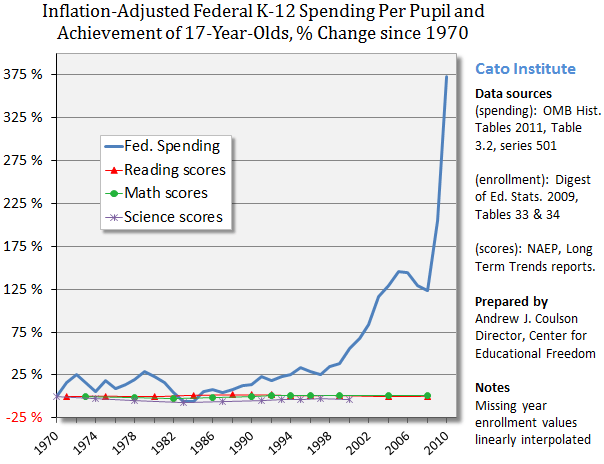

Worth a Thousand Words

Click to enlarge; original here.

Remember this graph the next time someone proposes spending more federal dollars in education.

Also remember how far removed Washington is from most state and local jurisdictions. Maybe those jurisdictions should have more say, and Washington less.

Brewers 3, Dodgers 1

St. Louis also won, 7-2 over Pittsburgh.

Milwaukee’s magic number is down to 32, with 38 games left to play.

Humility Is a Virtue

Penn Jillette has a column up at CNN.com titled “I don’t know, so I’m an atheist libertarian.” Well worth reading.

I don’t believe the majority always knows what’s best for everyone. The fact that the majority thinks they have a way to get something good does not give them the right to use force on the minority that don’t want to pay for it. If you have to use a gun, I don’t believe you really know jack. Democracy without respect for individual rights sucks. It’s just ganging up against the weird kid, and I’m always the weird kid.

How did we get here and how do we save everyone? I don’t know, but I’m doing the best I can. Sorry Piers [Morgan, CNN host], that’s all I got.

An Illiberal Liberal

Brad DeLong writes that “America’s best hope for sane technocratic governance required the elimination of the Republican Party from our political system as rapidly as possible.”

There are two things wrong with that statement. One is that he wants a technocratic government. Top-down. Orderly. Planned. But we live in a bottom-up world. Everything from language to Wikipedia to the economy itself is is a spontaneous order. They grow and evolve despite, not because of, direction from above. The most beautiful designs have no designer.

The other flaw is that DeLong favors a one-party state. Such regimes have been tried many times over the years. The results have rarely been humane.

I am neither conservative nor a Republican. But I sure am glad that America has two parties instead of one. That second party is proof that some people can’t shut other people out of the political discourse simply for disagreeing. Freedom of speech and thought are the cornerstones of a liberal society. DeLong rejects them at our peril.

On the traditional left-right spectrum, DeLong is on the left side. But that never has been an accurate way of identifying ideologies. A progressive should never be mistaken for a liberal. Yet most people make that mistake every day.

I’ve written before that Bush and Obama’s policies differ in degree, but not in kind. They are amazingly similar, both in domestic and foreign policy. Yet people insist on calling one a conservative, and the other a progressive. They are placed at opposite ends of the spectrum. How curious. How inaccurate.

A more accurate dichotomy than progressive-conservative is liberal-illiberal. I’m a proud liberal; DeLong might be surprised to find his illiberalism nestled right next to his detested George W. Bush.

Brewers 2, Dodgers 1

Milwaukee wins yet another 1-run game. Since a team’s record in 1-run games is largely luck in the long run, I’m a bit worried about mean reversion kicking in.

Elsewhere, the Pirates downed the Cardinals 5-4 in 11 innings.

The Brewers’ magic number is down to 33 with 39 games remaining.

American Mustache Institute Interviews John Axford

84 Percent Disapprove of Congress

That’s an all-time high.

What are the other 16 percent thinking?

Alien Stimulus

If hostile aliens invade the planet, “this slump would be over in 18 months,” according to New York Times columnist Paul Krugman. It’s a bizarre way to express a bizarre idea: that war is good for the economy.

He draws an analogy with World War II, where the massive military buildup – conscription is left unmentioned – reduced unemployment and caused GDP to skyrocket.

The Independent Institute’s Mary Theroux points out:

The World War II years were a time of shared privation, with virtually every item that we take for granted today either rationed: e.g., meat, gasoline, sugar, clothing; or not available at any cost: e.g., new cars, appliances, etc. The American standard of living throughout World War II remained at an excruciatingly low level that no 21st century American would accept.

War does not create. It can only destroy. True, aggregate numbers like GDP can thrive during such troubled times. Workers were cranking out munitions like nobody’s business. But those workers’ actual standard of living was not high; everyday essentials were being rationed.

That’s the peril of relying on GDP as an economic barometer. It certainly has its uses. But over-reliance on it has made Krugman ignore other, harsher aspects of war. The fighting. The dying. The separated families, in some cases made smaller by the economic stimulus. The privation at home. The lost opportunities, economic and otherwise.

Krugman’s claim that an alien invasion would stimulate the economy is as alien to the economic way of thinking as our new overlords are to us.

Fortunately, not everyone is taking him seriously. A satirical Twitter account, @KrugmanAliens, is poking devastating fun.

Some readers might also be interested in this working paper I wrote a few years ago about the economics of war.

Brewers 3, Dodgers 0

Milwaukee gets yet another home win courtesy of home runs from Ryan Braun, Jonathan Lucroy, and Corey Hart. Randy Wolf pitched 8 shutout innings.

The defense also turned a rare triple play. The game ended on Milwaukee’s fourth double play of the evening.

The Brewers have a poor defensive reputation. The data show them to be in line with the league average; tonight’s performance was somewhat above that.

The Cardinals found themselves on the wrong side of a Pirates outburst. They lost 6-2.

Milwaukee’s magic number moves to 35.